Accelerating Drug Development with Advanced AI Technologies
Advanced AI technologies are transforming drug development through faster target discovery, smarter molecular design, and more efficient R&D pipelines.
The Next Frontier in Drug Discovery: AI-Powered Innovation
The landscape of pharmaceutical research has undergone a seismic shift in recent years, thanks to the integration of artificial intelligence (AI). Once time-consuming and costly, drug development is being redefined by technologies that harness AI’s ability to model complex biological systems and predict molecular interactions. These innovations are paving the way for faster, more precise, and more affordable therapeutics, with the potential to benefit patients worldwide.
The pharmaceutical industry’s current challenges underscore the need for innovation. On average, it takes 10–15 years and over $2 billion to bring a single drug to market. Alarmingly, nearly 90% of drug candidates fail, often due to unforeseen problems during clinical trials. The core issue remains the difficulty of accurately predicting how drug molecules will behave in the human body. Proteins, the primary targets of most drugs, are highly dynamic, and their structural flexibility often presents a significant hurdle. Addressing this dynamic complexity requires a shift from conventional, rigid design methodologies to approaches that embrace biological realism. This is where AI steps in.
AI-Driven Technologies Transforming R&D
Artificial intelligence has emerged as a game-changing force in pharmaceutical R&D, transforming every stage of drug discovery—from target identification to lead optimization and preclinical validation. Below, we discuss some of the most impactful AI-powered approaches accelerating this transformation.
1. Dynamic Protein Modeling with Diffusion Techniques
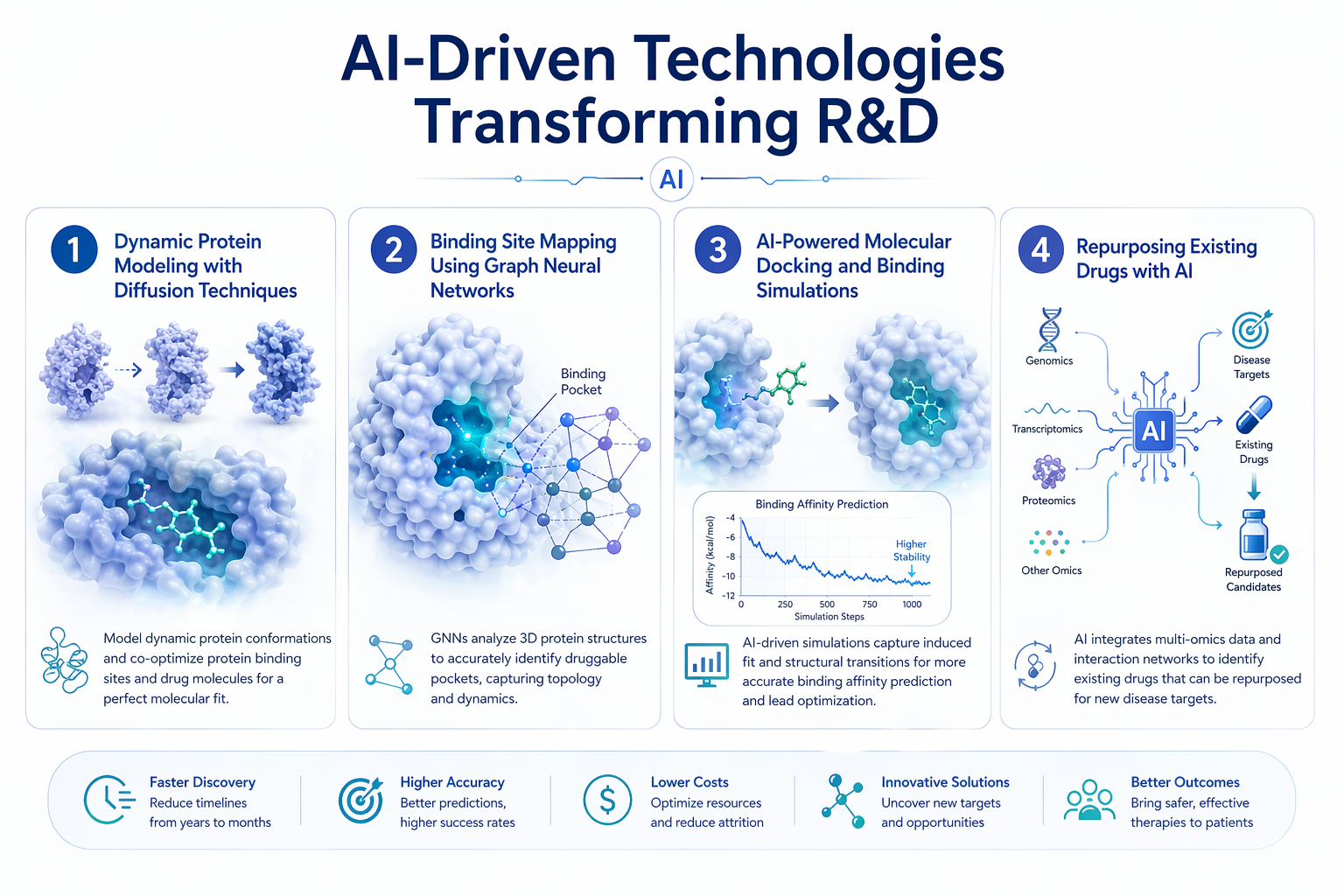
Recent advances in AI-driven molecular modeling adopt sophisticated methods, such as diffusion models, to account for the flexibility of protein targets. Conventional methods often treat proteins as static “locks” when designing corresponding drug “keys.” However, proteins in living systems are anything but static—they continuously shift, adopting multiple conformations. Advanced AI algorithms model these dynamic interactions to create molecules that bind to proteins in their realistic, flexible states.
An example of this dynamic approach is the use of generative AI, which can simultaneously optimize the shape of a protein-binding site and a drug candidate molecule. This co-evolutionary approach ensures that the drug molecule fits precisely, increasing its likelihood of being both effective and safe.
2. Binding Site Mapping Using Graph Neural Networks
Identifying the precise binding pocket on a protein where a drug molecule can interact is critical to drug development. AI models powered by graph neural networks (GNNs) have proved particularly adept at parsing three-dimensional protein structures to pinpoint these pockets. These advancements build on resources such as AlphaFold’s predicted protein structures, enabling researchers to identify druggable sites with unparalleled accuracy.
Unlike traditional computational methods, which often fail to account for thermodynamic flexibility or small shifts in protein conformations, GNNs analyze both the topology and dynamics of protein structures. By doing so, they reveal previously overlooked pockets that may serve as viable drug targets.
3. AI-Powered Molecular Docking and Binding Simulations
AI-based molecular docking has also demonstrated its ability to streamline lead optimization. Traditional docking models, while useful, occasionally overlook critical structural transitions such as induced fit—where the protein’s shape adjusts upon binding to a drug molecule. With AI driving simulations, researchers can better account for these structural adjustments, improving both the accuracy of binding affinity predictions and the design of drug candidates that succeed in experimental evaluations.
4. Repurposing Existing Drugs with AI
Accelerating the time to market is especially critical during health emergencies. AI’s ability to parse multi-omics data (genomics, transcriptomics, proteomics, etc.) holds particular promise for drug repurposing. By analyzing the molecular features of existing drugs and cross-referencing them with the interaction networks of emerging disease targets, AI expedites the identification of candidates that may be repurposed for new diseases.
For example, AI-enabled strategies have been employed to identify existing drugs for COVID-19, bypassing years of exploratory research. These efforts highlight AI’s potential not only for discovering novel compounds but also for revitalizing the therapeutic potential of the existing pharmaceutical pipeline.
Medvolt’s Contribution to the AI-Driven Revolution
Medvolt exemplifies the transformative potential of AI in biotechnology. The company integrates cutting-edge computational methodologies into its R&D workflow, empowering researchers to address the most complex challenges in drug discovery. Below are some highlights:
Comprehensive Target Identification
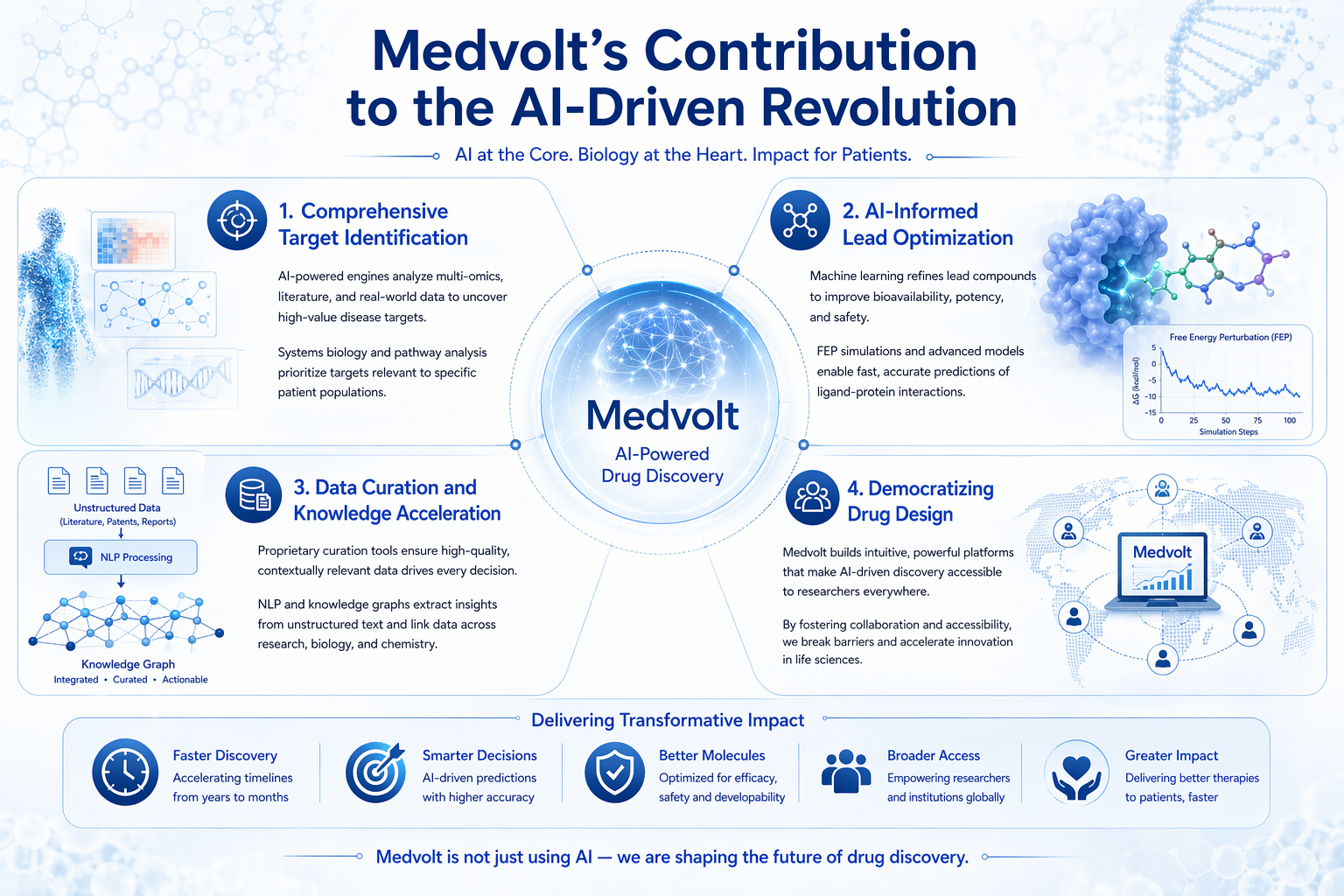
Medvolt employs AI-powered engines that sift through vast volumes of biological data to identify high-value disease targets. The incorporation of systems biology and pathway analysis ensures the prioritization of targets relevant to specific patient populations.
AI-Informed Lead Optimization
Medvolt leverages machine learning techniques to refine lead compounds, enhancing their physicochemical properties such as bioavailability, potency, and safety. Algorithms informed by free energy perturbation (FEP) simulations allow fast and precise predictions of ligand-protein interactions, accelerating the optimization phase.
Data Curation and Knowledge Acceleration
Modern drug discovery doesn’t merely involve experimentation; it is increasingly dependent on managing, curating, and analyzing vast datasets. Medvolt’s proprietary knowledge curation tools ensure that decisions are informed by the highest-quality, most contextually relevant data possible. Integration with natural language processing (NLP) techniques enables the extraction of insights from unstructured datasets, further enhancing R&D efficiency.
Democratizing Drug Design
In a bid to make AI-driven discovery scalable and universal, Medvolt fosters collaborations by developing user-friendly platforms for researchers worldwide. By democratizing access, the company aims to reduce the barriers to innovation in life sciences.
Implications for Patients and the Industry
The impact of AI-driven drug discovery extends far beyond the laboratory walls. For patients, the benefits include access to safer and more effective therapies developed in a fraction of the traditional timeline. For pharmaceutical companies, this translates to reduced costs and higher success rates for drug approvals, ultimately boosting productivity in an industry often plagued by inefficiencies.
Moreover, the rise of AI in drug development aligns with the broader demands for precision medicine. Through the integration of genomics, proteomics, and advanced modeling techniques, AI makes it possible to design therapies tailored to individual patient profiles, improving outcomes and mitigating side effects.
The Road Ahead
While the progress made with AI has been groundbreaking, challenges remain. Regulatory frameworks are still adapting to the role AI plays in drug discovery, and there is a need for robust validation of computer-generated predictions in biological systems. Ethical considerations surrounding data privacy and algorithmic transparency also demand ongoing attention.
Nevertheless, the trajectory of AI-driven innovation in drug development is clear—it is a force that cannot be ignored. As companies like Medvolt continue to lead advancements in this space, the pharmaceutical industry stands on the brink of an era marked by unprecedented efficiency, affordability, and innovation.
In the coming decade, AI will undoubtedly reshape the discovery-to-market pipeline. Thought leaders, investors, and researchers alike must prepare to navigate this exciting frontier, armed with the tools and expertise to harness AI’s transformative potential for the benefit of global health.