


Adopting Integrated Molecular Dynamics and Machine Learning Workflows to Enhance Early Prediction of Drug-Induced Mitochondrial Toxicity
Explore how molecular dynamics and machine learning can improve early prediction of drug-induced mitochondrial toxicity through integrated, physics-based workflows.
Mitochondrial Toxicity as a Critical Safety Concern in Drug Development
Mitochondria are essential organelles responsible for cellular energy production through oxidative phosphorylation. Their integrity and function are vital for cell viability and metabolic homeostasis. Drug-induced mitochondrial toxicity disrupts these processes, leading to impaired energy metabolism, oxidative stress and ultimately cell death. Such toxicity is implicated in a range of adverse drug reactions and is a significant contributor to late-stage attrition in pharmaceutical development.
Traditional in vitro assays and computational prediction tools often fall short in detecting mitochondrial toxicity early in drug discovery. These methods may lack sensitivity to subtle or complex perturbations of mitochondrial membranes and associated proteins, limiting their predictive power. Consequently, there is a pressing need for more mechanistically informed and accurate early-stage toxicity assessment strategies.
Modeling Mitochondrial Membranes with Molecular Dynamics Simulations
Physics-based molecular dynamics (MD) simulations provide a detailed, atomistic view of mitochondrial membrane systems. These simulations incorporate realistic representations of the lipid bilayer composition, including cardiolipins, phosphatidylcholines and other mitochondrial-specific lipids, as well as integral membrane proteins.
By simulating drug binding, insertion and interaction dynamics, MD captures transient perturbations to membrane structure and function. For example, simulations can reveal how a compound alters lipid packing, induces membrane thinning or curvature or disrupts protein conformations critical for mitochondrial function. This dynamic perspective offers mechanistic insights beyond static structural models or endpoint assays.

However, MD simulations are computationally intensive, especially when modeling complex membranes over biologically relevant timescales. Despite these challenges, the ability to observe molecular interactions and conformational changes in silico provides a powerful tool for understanding drug-induced mitochondrial perturbations.
Machine Learning Approaches for Predicting Mitochondrial Toxicity
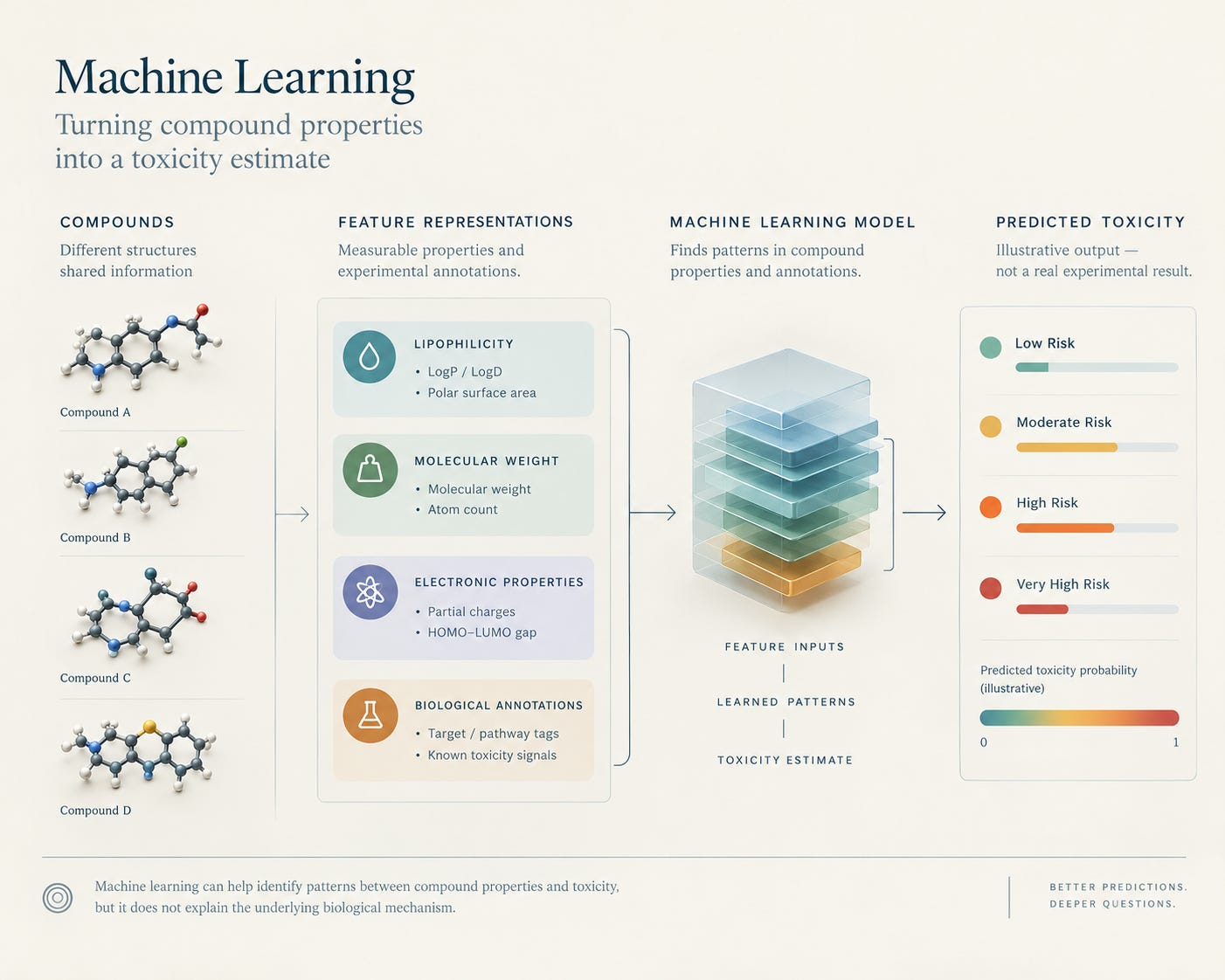
Machine learning (ML) models have been employed to predict mitochondrial toxicity by leveraging diverse physicochemical and biological features of compounds. These features include molecular descriptors such as lipophilicity, molecular weight and electronic properties, as well as biological annotations related to mitochondrial pathways.
Training datasets are curated from experimental mitochondrial toxicity annotations, though these datasets are often limited in size and heterogeneity. Model validation typically involves cross-validation and external test sets to assess predictive performance.
While ML models can identify statistical patterns correlating compound features with toxicity outcomes, they may lack mechanistic interpretability and can be susceptible to overfitting or bias due to dataset variability. Thus, ML predictions alone may not fully capture the complexity of mitochondrial toxicity mechanisms.
Integrating Molecular Dynamics and Machine Learning for Enhanced Toxicity Prediction
Combining MD simulations with ML offers a synergistic approach that leverages the strengths of both methods. Quantitative features extracted from MD trajectories such as changes in membrane thickness, lipid order parameters, protein conformational fluctuations and interaction energies can serve as mechanistically informed inputs for ML models.
This integration enables ML algorithms to incorporate dynamic molecular interaction signatures alongside traditional physicochemical descriptors, potentially improving prediction accuracy and interpretability. For instance, an ML model trained on combined features may better distinguish compounds that induce subtle membrane destabilization from those with negligible effects.
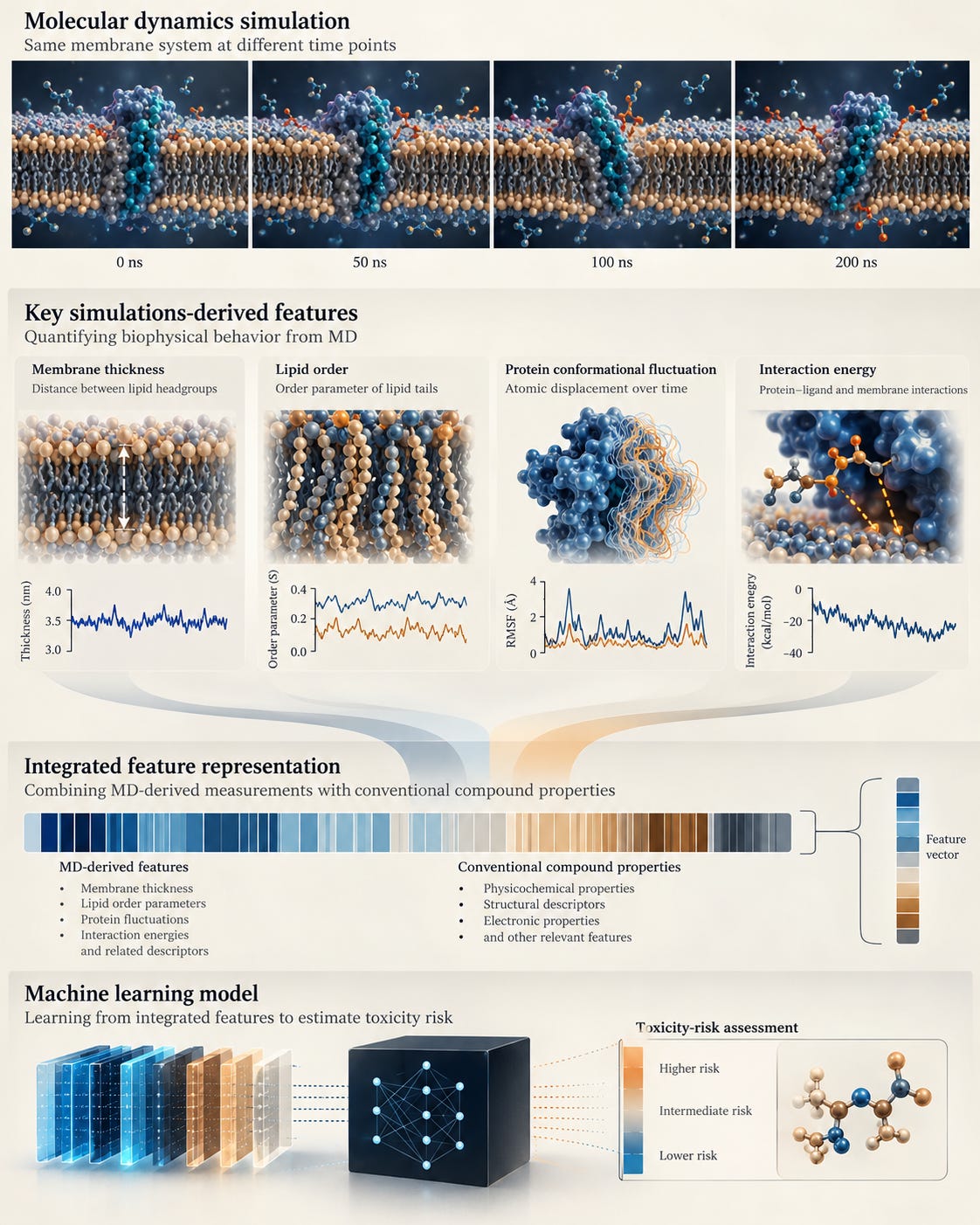
Illustrative cases include simulations revealing drug-induced disruption of cardiolipin-rich domains critical for mitochondrial function, with corresponding ML models successfully classifying toxicity risk based on these simulation-derived features. Such combined workflows provide a more comprehensive assessment of mitochondrial toxicity potential than standalone approaches.
Challenges in Implementing Integrated Computational Toxicity Workflows
Despite their promise, integrated MD-ML workflows face several practical and technical challenges. MD simulations require substantial computational resources and expertise, limiting throughput and scalability for large compound libraries.
Data integration poses difficulties due to heterogeneous data types and scales, necessitating careful feature engineering and normalization. Ensuring ML model interpretability remains a concern, as complex models may obscure mechanistic understanding.
Standardization and reproducibility of integrated workflows are essential but currently limited by variability in simulation protocols, dataset quality and validation strategies. These barriers slow widespread adoption in pharmaceutical R&D.
Strategies for Incorporating Integrated Toxicity Prediction in Pharmaceutical R&D
Effective integration of MD-ML workflows into drug discovery pipelines requires balancing prediction accuracy with throughput and cost considerations. One approach involves prioritizing compounds for detailed MD simulations based on initial ML screening, thereby focusing computational resources on high-risk candidates.
Complementing computational predictions with targeted experimental assays can validate and refine models, creating an iterative cycle of prediction and testing. Embedding these workflows within decision-making frameworks supports early safety assessment and candidate prioritization.
Case examples from industry illustrate how computational toxicity prediction tools can inform medicinal chemistry optimization and experimental design, although these implementations remain in early stages and require further validation.
Medvolt’s Computational Tools Supporting Integrated Toxicity Prediction
Medvolt offers physics-based molecular dynamics modules and AI integration capabilities that align with the requirements of combined mitochondrial toxicity prediction workflows. The MedGraph Oopal-cMD™ platform enables detailed simulation of mitochondrial membrane systems, capturing atomistic interactions, membrane dynamics and protein conformational changes.
Oopal-cMD supports extraction of quantitative features from simulation trajectories, such as lipid order parameters, membrane thickness variations and interaction persistence metrics. These features can be integrated with physicochemical drug properties to serve as inputs for machine learning models within connected workflows.
By facilitating the combination of physics-based simulation data with AI-driven analysis, Medvolt’s platforms provide operational tools to address the complexity of mitochondrial toxicity mechanisms. This integration supports more mechanistically informed early toxicity assessments, complementing experimental approaches.
It is important to note that while Medvolt’s capabilities support these integrated workflows, claims regarding definitive improvements in prediction accuracy or direct impacts on clinical outcomes require experimental validation and are beyond the scope of current evidence.
Current Limitations and Future Directions in Integrated Mitochondrial Toxicity Prediction
Several scientific and technical gaps remain in integrated mitochondrial toxicity prediction. Simulation accuracy is constrained by force field limitations, timescale restrictions and challenges in fully representing mitochondrial membrane complexity.
High-quality, standardized mitochondrial toxicity datasets remain scarce, limiting ML model training and generalizability. Moreover, interpreting combined simulation and ML outputs mechanistically is complex and requires ongoing methodological development.
Future research may explore enhanced sampling techniques, improved force fields and richer datasets to extend simulation fidelity and ML robustness. Advances in explainable AI could improve model interpretability, facilitating mechanistic insights.
Continued development of standardized, reproducible workflows and benchmarking against experimental data will be critical to advancing these integrated approaches toward practical pharmaceutical applications.
Conclusion
Drug-induced mitochondrial toxicity presents a significant challenge in drug development due to its complex mechanisms and impact on cellular energy metabolism. Conventional early prediction methods often lack the sensitivity and mechanistic detail required to identify such toxicity reliably.
Integrating physics-based molecular dynamics simulations of mitochondrial membranes with machine learning models offers a promising strategy to enhance early toxicity prediction. This approach captures dynamic molecular interactions and complex toxicity signatures that standalone methods may miss, providing a more comprehensive and mechanistically grounded assessment.
However, practical adoption of integrated MD-ML workflows faces challenges including computational demands, data integration complexity and the need for standardized validation. Addressing these barriers will require coordinated efforts in computational method development, dataset curation and experimental collaboration.
Medvolt’s physics-based simulation platforms and AI integration capabilities exemplify operational tools that can support these workflows, enabling detailed molecular modeling and data-driven analysis tailored to mitochondrial toxicity prediction.
As the field advances, integrating mechanistic simulations with machine learning holds potential to inform early safety assessment more effectively, guiding candidate prioritization and experimental design in pharmaceutical research. Engaging with these scientific challenges and computational opportunities will be essential for realizing this potential in drug discovery pipelines

