


Adopting Replica Exchange Free Energy Perturbation Simulations to Improve Prediction Accuracy of Mutation-Induced Kinase Inhibitor Binding Affinity Changes
Explore how replica exchange free energy perturbation (RE-FEP) improves kinase inhibitor binding affinity predictions, mutation analysis and drug resistance research.
Impact of Kinase Mutations on Inhibitor Binding Affinity and Drug Resistance
Protein kinases are central regulators of cellular signaling pathways, and their dysregulation is implicated in numerous diseases, notably cancer. Kinase inhibitors have become a cornerstone of targeted therapies, designed to bind the kinase domain and modulate its activity. However, mutations within kinase domains frequently alter inhibitor binding affinities, often leading to drug resistance. These mutations can modify the shape, dynamics, or electrostatics of the binding pocket, diminishing inhibitor efficacy and complicating treatment.
Accurately predicting how specific kinase domain mutations affect inhibitor binding is therefore crucial for medicinal chemists aiming to optimize compounds against resistant variants. Computational methods, particularly free energy perturbation (FEP) simulations, have been employed to estimate relative binding free energy changes induced by mutations. Yet, conventional FEP approaches often face limitations due to insufficient sampling of the protein-ligand conformational landscape, especially when mutations induce subtle or large-scale structural rearrangements. This sampling inadequacy can reduce prediction reliability and reproducibility, constraining the utility of FEP in mutation-driven drug design.

Fundamentals of Free Energy Perturbation and Sampling Challenges
Free energy perturbation is a physics-based computational technique that estimates the difference in binding free energy between two related molecular states, such as a wild-type and mutant kinase bound to an inhibitor. FEP relies on molecular dynamics (MD) simulations to sample conformational ensembles and calculate thermodynamic averages over alchemical transformations.
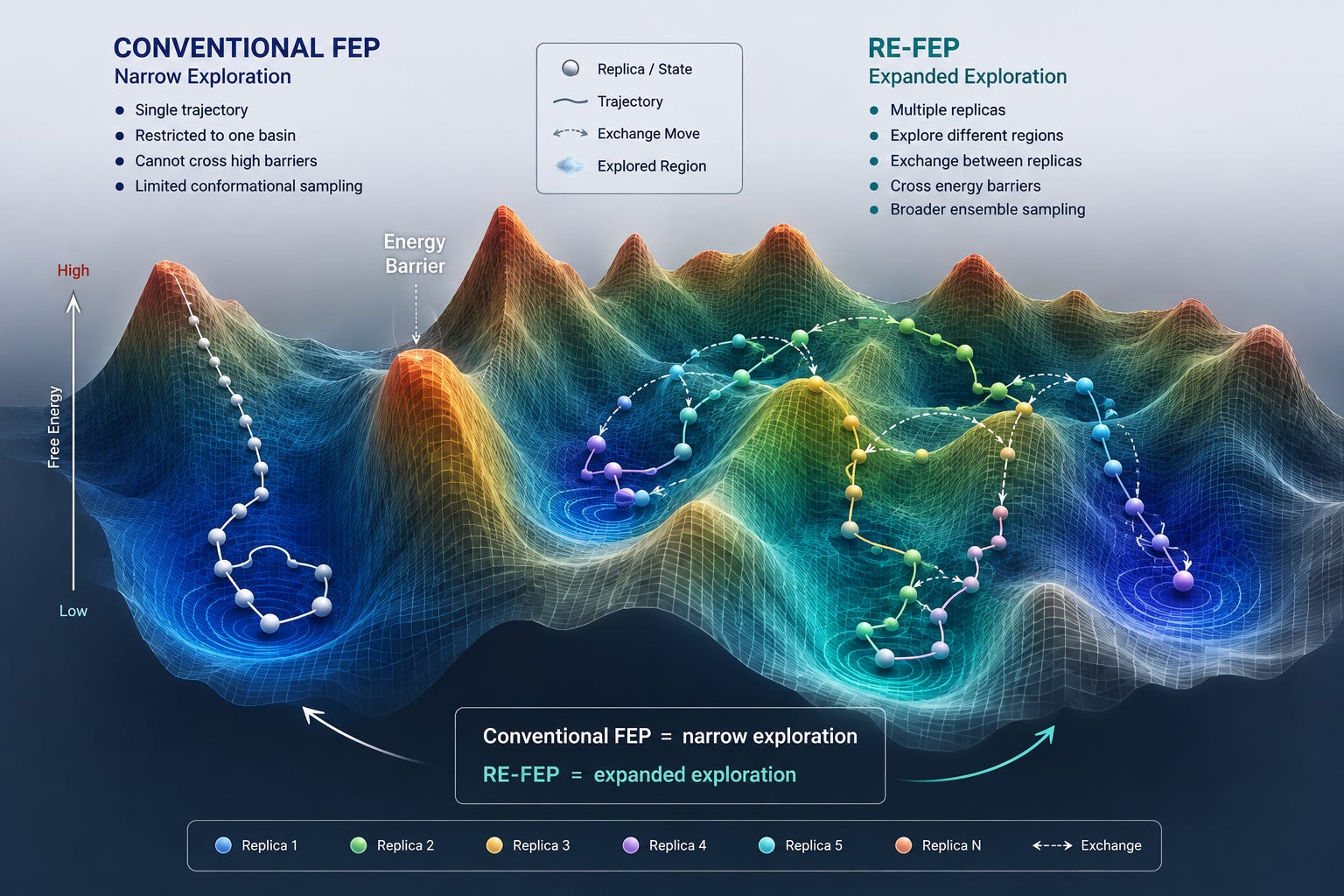
The accuracy of FEP critically depends on thorough exploration of relevant conformational states. In kinase mutation contexts, mutations can induce conformational heterogeneity, alter pocket flexibility, or shift equilibrium populations. Conventional FEP simulations, typically performed at a single temperature and Hamiltonian, may become trapped in local energy minima, failing to cross energy barriers that separate distinct conformations. This limited sampling leads to biased free energy estimates and increased uncertainty.
For example, a mutation that stabilizes an alternative kinase activation loop conformation may not be adequately sampled in standard FEP runs, causing underestimation or mischaracterization of its impact on inhibitor binding. Such sampling bottlenecks are a recognized challenge in applying FEP to mutation effect prediction.
Principles and Implementation of Replica Exchange Methods in FEP
Replica exchange methods enhance conformational sampling by running multiple parallel simulations (replicas) of the system under different conditions, such as varying temperatures or Hamiltonians. Periodically, these replicas attempt exchanges of their configurations according to a probabilistic acceptance criterion that preserves the correct ensemble distribution.
In temperature replica exchange molecular dynamics (REMD), replicas span a temperature ladder, allowing high-temperature simulations to overcome energy barriers and explore diverse conformations. Exchanges enable low-temperature replicas to inherit these configurations, improving sampling efficiency. In Hamiltonian replica exchange, the system’s potential energy function is modulated across replicas, facilitating transitions between states that might be kinetically inaccessible otherwise.
When integrated with FEP, replica exchange free energy perturbation (RE-FEP) leverages these exchanges to better sample the conformational space relevant to mutation-induced binding changes. This approach can capture multiple protein-ligand conformations, including those stabilized or destabilized by mutations, leading to more robust free energy difference estimates.
The enhanced sampling addresses the fundamental limitation of conventional FEP by reducing the risk of simulations being confined to narrow conformational basins. Consequently, RE-FEP can improve the accuracy and reproducibility of predicted mutation effects on kinase inhibitor binding affinities.
Evaluating Accuracy Gains and Computational Costs of RE-FEP
Comparative analyses indicate that RE-FEP can yield improved correlation with experimental binding affinity changes relative to conventional FEP, particularly for mutations that induce significant conformational rearrangements or alter binding site dynamics. By facilitating transitions over energy barriers, RE-FEP captures a broader ensemble of relevant states, refining free energy estimates.
However, these accuracy gains come at the expense of increased computational resource requirements. Running multiple replicas simultaneously multiplies the total simulation time and hardware demands. For kinase systems, which are often large and flexible, RE-FEP simulations may require substantial parallel computing infrastructure and extended wall-clock runtimes.
Balancing the improved predictive performance against throughput constraints is a key consideration in drug discovery workflows. While RE-FEP may be well-suited for focused studies on high-priority mutations or lead compounds, its computational cost can limit application to large compound libraries or early-stage screening.
Practical Integration of RE-FEP into Drug Discovery Workflows
Implementing RE-FEP in medicinal chemistry projects involves several technical and operational challenges. The method demands expertise in setting up replica exchange simulations, selecting appropriate temperature or Hamiltonian ladders, and ensuring convergence across replicas. This complexity can raise the barrier for routine use by medicinal chemists without specialized computational support.
Integration with existing computational pipelines also requires compatibility with molecular preparation, force field parameterization, and data management systems. Handling the increased volume of simulation data and interpreting free energy results necessitates robust workflow standardization and visualization tools.
Moreover, translating RE-FEP predictions into actionable medicinal chemistry insights involves careful interpretation, considering uncertainties and potential force field limitations. Establishing best practices and training users are essential steps toward broader adoption.
Case Studies Demonstrating RE-FEP in Kinase Mutation Impact Predictions
Published case studies have applied RE-FEP to clinically relevant kinase mutations associated with drug resistance. In these examples, RE-FEP predictions showed improved agreement with experimental binding affinity measurements compared to conventional FEP, elucidating mutation mechanisms that alter inhibitor interactions or pocket dynamics.
One such case involved a mutation that induced a shift in the kinase activation loop conformation, which was poorly sampled in standard FEP but captured by RE-FEP, enabling more accurate affinity ranking. These studies also highlighted practical lessons, such as the importance of replica number selection, exchange frequency tuning, and convergence assessment.
While these reports demonstrate the scientific value of RE-FEP, they also underscore the need for careful workflow design and computational resource planning to realize its benefits in medicinal chemistry projects.
Medvolt’s Computational Support for RE-FEP Adoption
Medvolt offers scalable simulation-as-a-service platforms capable of executing RE-FEP workflows tailored to kinase systems. By providing access to high-performance computing resources optimized for replica exchange molecular dynamics and free energy perturbation, Medvolt facilitates the practical application of RE-FEP without requiring extensive local infrastructure.
Expertise in physics-based molecular simulations and free energy methods supports users in setting up, running, and interpreting RE-FEP studies. Medvolt’s integrated workflows enable compatibility with medicinal chemistry computational pipelines, streamlining data management and result integration.
This support helps medicinal chemistry teams balance the computational demands of RE-FEP with the need for robust, reproducible predictions of mutation-driven binding affinity changes. Medvolt’s approach aligns with a science-first philosophy, emphasizing rigorous simulation protocols and human-in-the-loop interpretation to inform experimental planning.
Current Limitations and Future Directions for RE-FEP Methods
Despite its advantages, RE-FEP faces limitations that temper its routine adoption. Force field inaccuracies and solvent model approximations introduce uncertainties that can affect prediction reliability. Large, flexible kinase systems pose challenges in achieving full conformational convergence, even with replica exchange.
The computational expense remains a significant barrier, particularly for extensive compound libraries or rapid iteration cycles. Additionally, the complexity of RE-FEP workflows demands automation and user-friendly interfaces to reduce the expertise threshold.
Future developments may focus on improved force fields, enhanced sampling algorithms, and standardized protocols tailored for kinase mutation studies. Integration with machine learning approaches to guide sampling or prioritize mutations could further enhance efficiency.
Implications for Medicinal Chemistry and Drug Resistance Mitigation
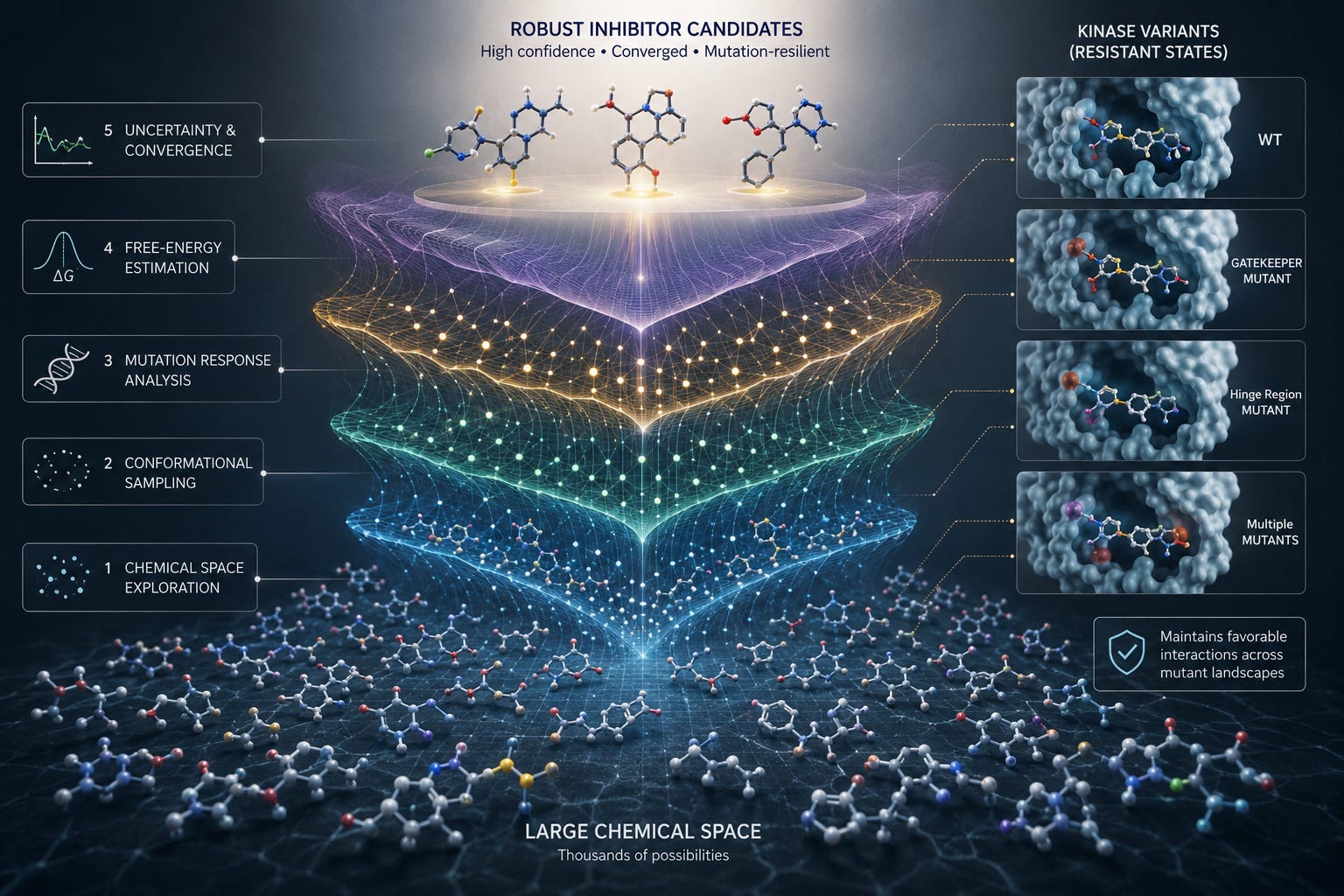
Adopting RE-FEP simulations offers medicinal chemists a more accurate tool for prioritizing kinase inhibitor candidates against resistant mutants. By better capturing mutation-induced conformational effects on binding, RE-FEP can refine mechanistic understanding and guide rational design strategies.
This improved predictive capability supports more informed resource allocation, focusing experimental validation on compounds with higher likelihoods of retaining efficacy. Additionally, insights from RE-FEP can illuminate mutation mechanisms, aiding in the design of inhibitors less susceptible to resistance.
While RE-FEP does not replace experimental testing, it provides a valuable computational layer that complements medicinal chemistry optimization and resistance management efforts.
Conclusion
Replica exchange free energy perturbation simulations address a critical limitation of conventional FEP by enhancing conformational sampling in kinase mutation contexts. This methodological advancement improves the accuracy and robustness of predictions for mutation-driven changes in kinase inhibitor binding affinities, a key challenge in overcoming drug resistance.
However, the increased computational demands and workflow complexity require careful consideration when integrating RE-FEP into drug discovery pipelines. Balancing accuracy improvements with throughput and operational feasibility remains essential.
Medvolt’s scalable simulation-as-a-service platform and expertise in physics-based molecular simulations provide practical support for implementing RE-FEP workflows. By facilitating access to computational resources and standardized protocols, Medvolt helps medicinal chemistry teams harness the benefits of RE-FEP while managing its challenges.
In sum, RE-FEP represents a meaningful enhancement in computational prediction capabilities for kinase inhibitor design, contingent on thoughtful adoption strategies that align scientific rigor with practical drug discovery needs.

