


Advancing Kinase Inhibitor Affinity Predictions: Adoption of Replica Exchange Free Energy Perturbation in Mutation Impact Assessment
Explore how replica exchange free energy perturbation (FEP-RE) enhances kinase inhibitor binding affinity predictions and supports drug resistance research.
Understanding Kinase Mutation-Induced Resistance and Its Impact on Inhibitor Binding
Protein kinases are critical regulators of cellular signaling pathways, and their dysregulation is implicated in numerous cancers. Targeted kinase inhibitors have become a cornerstone of oncology therapeutics. However, the emergence of resistance mutations within kinase domains frequently undermines clinical efficacy by altering inhibitor binding affinities.
Resistance-conferring mutations can be diverse, including point substitutions at the ATP-binding site, gatekeeper residues, or allosteric regions. These mutations often induce subtle or pronounced structural rearrangements that reshape the kinase active site or modulate its conformational dynamics. Such alterations can disrupt key protein-ligand interactions, modify solvent networks, or induce changes in flexibility, collectively impacting the binding free energy of inhibitors.
The net effect is a shift in the thermodynamic landscape governing inhibitor affinity, which can reduce drug potency and promote therapeutic failure. Accurately predicting these mutation-induced changes in binding affinity is therefore essential for prioritizing drug candidates effective against resistant variants and guiding medicinal chemistry efforts.
Fundamentals of Free Energy Perturbation and Role of Replica Exchange
Free Energy Perturbation (FEP) is a rigorous physics-based computational method used to estimate relative changes in binding free energies upon molecular modifications, including mutations. FEP simulations employ alchemical transformations to compute free energy differences by sampling ensembles of molecular conformations.
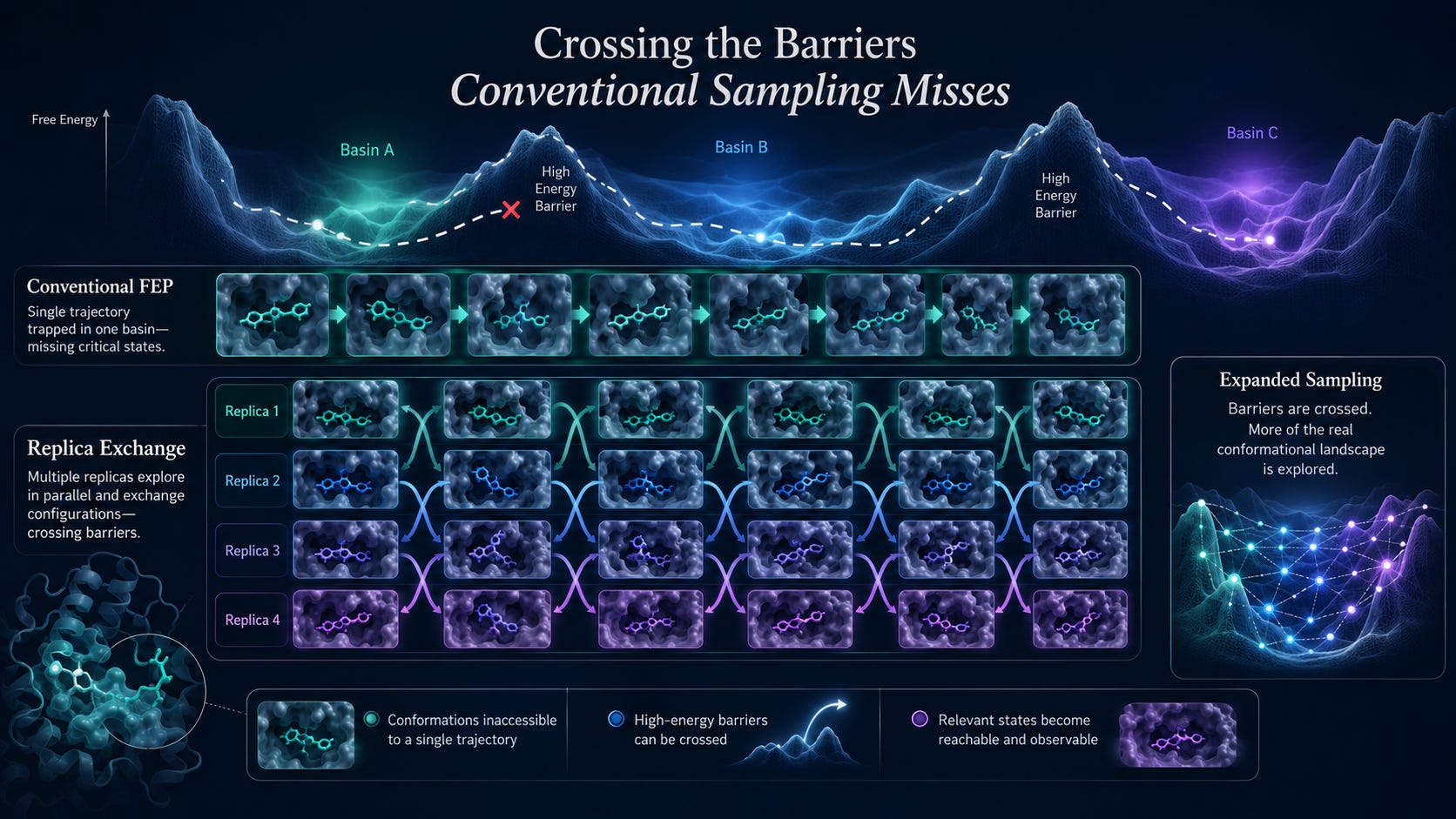
A central challenge in conventional FEP is achieving sufficient conformational sampling, especially when mutations induce significant structural or dynamic changes. Limited sampling can lead to incomplete exploration of relevant protein-ligand and solvent configurations, resulting in inaccurate free energy estimates.
Replica Exchange (RE) methods enhance sampling efficiency by simulating multiple replicas of the system at different thermodynamic states (e.g., temperatures or Hamiltonians) and allowing exchanges between them. This approach facilitates crossing energy barriers and accessing diverse conformational states that might be inaccessible in single-trajectory FEP runs.
Integrating replica exchange with FEP (FEP-RE) thus improves the exploration of the conformational landscape relevant to mutation-induced binding affinity changes, potentially yielding more reliable predictions than conventional FEP.
Molecular and Thermodynamic Effects of Kinase Mutations on Binding Affinity
Mutations within kinase domains can reshape the conformational ensemble of the protein, altering both local and global structural features. For example, a mutation at the gatekeeper residue may restrict access to hydrophobic pockets or change the orientation of key side chains, affecting ligand accommodation.
These structural perturbations influence ligand binding modes, potentially causing shifts in hydrogen bonding patterns, van der Waals contacts, or electrostatic interactions. Additionally, mutations can modify solvent organization around the binding site, impacting desolvation penalties and water-mediated interactions.
Thermodynamically, these changes manifest as alterations in enthalpic and entropic contributions to binding free energy. Some mutations may destabilize the bound state or stabilize alternative conformations, thereby reducing affinity. Others might induce compensatory effects, complicating straightforward predictions.
Understanding these molecular and thermodynamic consequences is critical for interpreting simulation results and designing inhibitors resilient to resistance.

Computational Challenges and Resource Considerations for FEP-RE Adoption
While FEP-RE offers improved sampling, it comes with increased computational demands. Running multiple replicas simultaneously requires substantial hardware resources, including high-performance CPUs or GPUs and efficient parallelization strategies.
Setting up FEP-RE simulations involves complex parameterization, such as defining appropriate replica states, exchange frequencies, and convergence criteria. This complexity necessitates specialized expertise in molecular simulation protocols and data analysis.
Moreover, integrating FEP-RE into routine drug discovery workflows can be challenging due to longer turnaround times and the need to balance computational throughput with accuracy.
These practical barriers have historically limited widespread adoption, although advances in computational infrastructure and software automation are gradually mitigating these issues.
Evaluating Predictive Performance: FEP-RE Versus Conventional FEP
Benchmark studies comparing FEP-RE with conventional FEP have demonstrated that enhanced sampling via replica exchange can improve the accuracy of mutation-induced binding affinity predictions. Cases where conventional FEP struggles—such as mutations causing significant conformational rearrangements—often benefit from the broader conformational exploration enabled by FEP-RE.
For example, simulations incorporating replica exchange have better captured shifts in ligand binding poses and solvent configurations that directly influence free energy estimates.
Nonetheless, variability remains due to differences in simulation protocols, force fields, and system complexity. Some highly flexible or allosteric mutations may still pose sampling challenges despite replica exchange.
Experimental datasets for validating these predictions across diverse kinase families are limited, underscoring the need for continued benchmarking and methodological refinement.
Integrating FEP-RE into Kinase Inhibitor Drug Discovery Pipelines
Incorporating FEP-RE into drug discovery workflows requires adaptations to accommodate its computational intensity and setup complexity. Automation of replica exchange setup, monitoring, and analysis is essential to streamline operations.
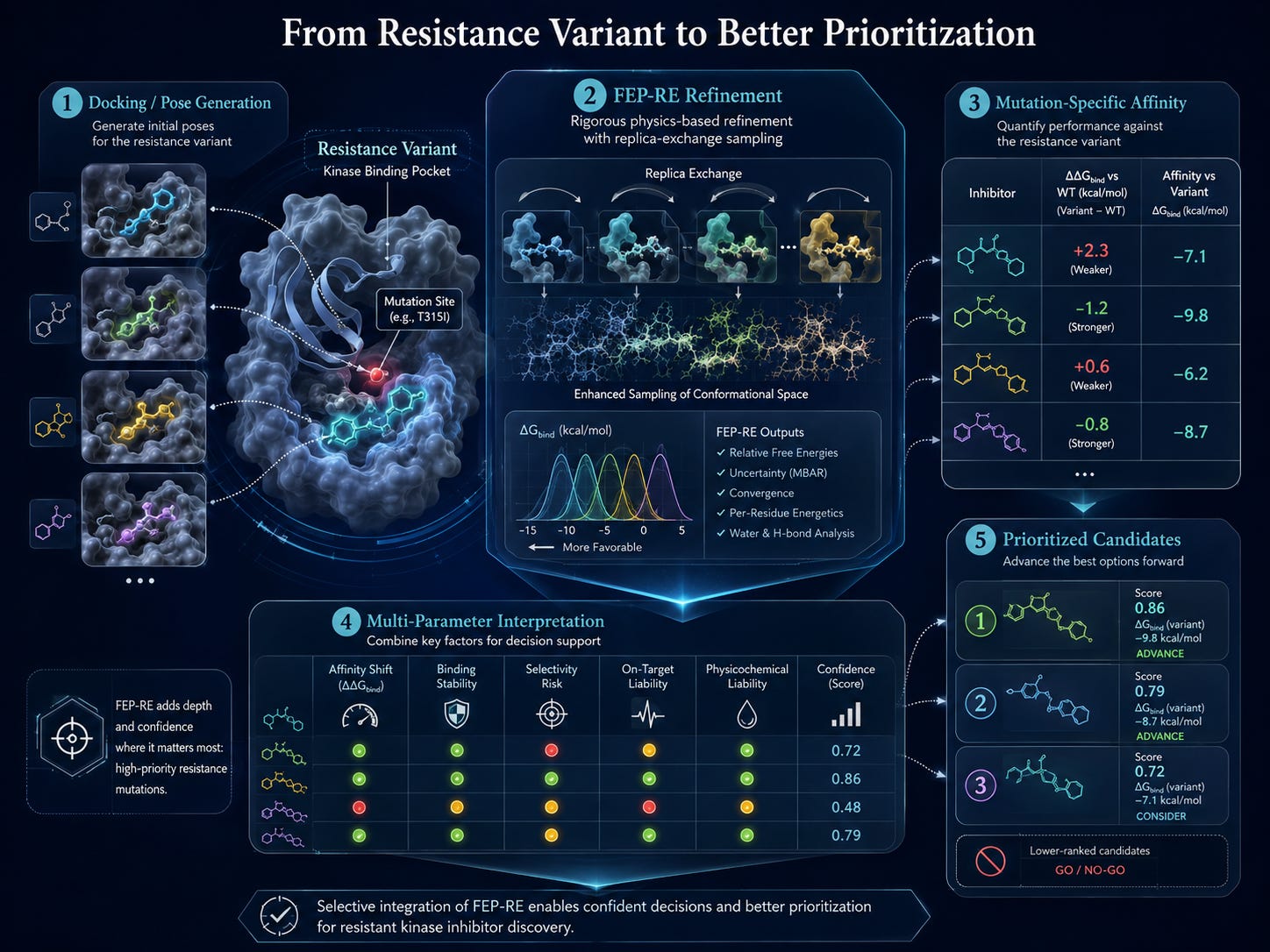
Balancing throughput and accuracy involves strategic selection of mutation-inhibitor pairs for FEP-RE evaluation, focusing on high-priority resistance variants where enhanced sampling is most impactful.
FEP-RE can be combined synergistically with complementary computational approaches such as molecular docking for initial pose generation and machine learning models for rapid affinity estimation, reserving FEP-RE for detailed free energy refinement.
Such integrated workflows can provide a multi-layered assessment of mutation impacts, supporting informed candidate prioritization and medicinal chemistry guidance.
Medvolt’s Computational Tools Supporting FEP-RE Implementation
Medvolt offers physics-based molecular dynamics and free energy perturbation simulation platforms that support replica exchange methodologies. These tools facilitate the setup, execution, and analysis of FEP-RE simulations tailored to kinase-inhibitor systems.
By integrating replica exchange within free energy workflows, Medvolt enables improved conformational sampling critical for capturing mutation-induced binding affinity changes.
Furthermore, Medvolt’s platforms support multi-parameter optimization frameworks, allowing FEP-RE results to be contextualized alongside other drug-like properties and experimental data.
This capability aligns with Medvolt’s science-first philosophy, emphasizing rigorous physics-based simulation combined with expert interpretation to inform drug discovery decisions.
Current Limitations and Areas for Further Research in FEP-RE Application
Despite its advantages, FEP-RE adoption faces limitations. The increased computational cost restricts its routine use in large-scale screening campaigns.
Highly flexible or allosteric kinase mutations may still evade comprehensive sampling, even with replica exchange, necessitating further methodological innovations.
Variability in simulation protocols and force field parameters can affect reproducibility and comparability of results across studies.
Additionally, the scarcity of extensive experimental datasets for diverse kinase mutations limits validation and benchmarking efforts.
Addressing these challenges requires ongoing research to optimize sampling strategies, improve force field accuracy, and expand experimental collaborations.

Prospective Impact of FEP-RE Adoption on Oncology Drug Development
Widespread adoption of FEP-RE has the potential to enhance prioritization of kinase inhibitor candidates effective against resistant mutations, thereby supporting more informed resource allocation in oncology drug development.
By providing detailed thermodynamic insights into mutation effects, FEP-RE can guide rational inhibitor design strategies aimed at overcoming resistance.
Integration with emerging AI-driven molecular design approaches may further amplify the value of enhanced sampling data, enabling iterative cycles of design and evaluation.
Ultimately, FEP-RE represents a promising computational advancement that, when judiciously applied, can contribute an additional layer of evidence to the complex challenge of managing kinase inhibitor resistance.
Conclusion
Replica exchange integration into free energy perturbation simulations addresses a critical bottleneck in conformational sampling, enabling more reliable prediction of mutation-induced changes in kinase inhibitor binding affinities. This enhanced sampling capability is particularly valuable for mutations that induce significant structural or dynamic alterations, which conventional FEP methods may inadequately capture.
However, the increased computational cost and technical complexity of FEP-RE necessitate careful consideration in drug discovery workflows. Balancing accuracy gains against resource demands and throughput constraints remains a key practical challenge.
Medvolt’s simulation platforms provide operational support for implementing FEP-RE, facilitating the setup and analysis of these advanced simulations within multi-parameter optimization frameworks. This capability aligns with the broader goal of integrating physics-based methods into drug discovery pipelines to support informed candidate prioritization.
Future research should focus on expanding validation datasets, refining sampling protocols, and improving force field accuracy to broaden the applicability and robustness of FEP-RE. Such efforts will help clarify where and how this technology can most effectively contribute to overcoming kinase inhibitor resistance in oncology.
Researchers and computational chemists are encouraged to explore the scientific challenges and computational strategies involved in adopting replica exchange free energy perturbation for mutation-driven affinity prediction, leveraging platforms like Medvolt’s to advance this promising approach.

