


Balancing Accuracy and Practicality: Adoption Challenges and Scientific Insights of Replica Exchange Free Energy Perturbation for Mutation-Driven Binding Affinity Predictions
Explore how replica exchange free energy perturbation (RE-FEP) improves mutation-driven binding affinity predictions, its scientific benefits and adoption challenges.
Challenges in Predicting Mutation-Induced Binding Affinity Changes
Predicting how mutations affect protein-ligand binding affinities is a critical task in drug discovery, influencing target validation and lead optimization. Mutations can alter binding sites subtly or dramatically, impacting therapeutic efficacy and resistance profiles. However, accurately forecasting these effects remains challenging due to the intrinsic conformational heterogeneity of proteins and the limitations of traditional computational methods.
Conventional free energy perturbation (FEP) approaches often struggle to capture the full range of conformational states accessible to a protein-ligand complex, especially when mutations induce rare but functionally relevant conformations. Insufficient sampling can lead to inaccurate free energy estimates, undermining confidence in mutation effect predictions. This sampling bottleneck is exacerbated by the dynamic nature of proteins and the complex interplay of enthalpic and entropic contributions to binding.
Consequently, there is a pressing need for computational strategies that can more comprehensively explore conformational landscapes to improve the reliability of mutation-driven binding affinity predictions.
Fundamentals and Workflow of Replica Exchange Free Energy Perturbation
Replica Exchange Free Energy Perturbation (RE-FEP) integrates two established computational techniques: free energy perturbation and replica exchange molecular dynamics (REMD). FEP calculates the relative free energy differences between molecular states, such as wild-type and mutant proteins bound to a ligand, by simulating alchemical transformations. REMD enhances sampling by simulating multiple replicas of the system at different temperatures or Hamiltonian parameters, allowing exchanges between replicas to overcome energy barriers and access diverse conformations.

In RE-FEP, multiple replicas of the protein-ligand complex are simulated simultaneously, each exploring different regions of the conformational space. Periodic exchanges between replicas enable the system to escape local minima, facilitating the sampling of rare but relevant conformations that may be critical for accurately capturing mutation effects.
The computational workflow typically involves:
- Preparing structural models of wild-type and mutant complexes.
- Setting up multiple replicas with varying temperatures or Hamiltonians.
- Running parallel molecular dynamics simulations with periodic replica exchanges.
- Performing alchemical free energy calculations across replicas to estimate mutation-induced binding affinity changes.
- Analyzing convergence and validating results against experimental data when available.
This combined approach aims to overcome the sampling limitations of conventional FEP by leveraging enhanced conformational exploration.
Scientific Benefits of RE-FEP for Binding Affinity Prediction
By integrating replica exchange with free energy perturbation, RE-FEP offers improved conformational sampling that can capture a broader ensemble of protein-ligand states. This enhanced sampling is particularly valuable for mutation-driven affinity predictions where mutations may stabilize or destabilize rare conformations that significantly influence binding thermodynamics.
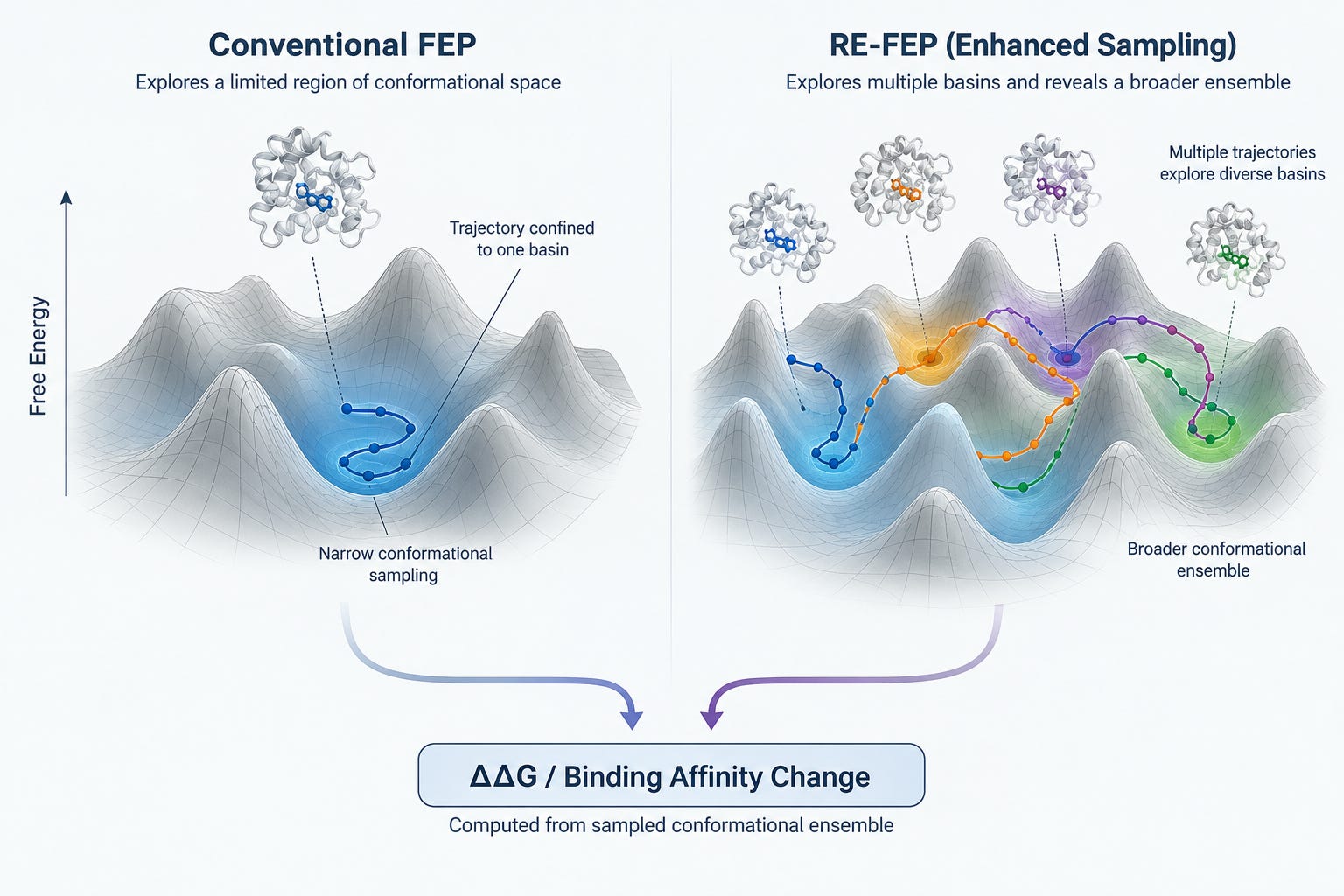
RE-FEP’s ability to access these conformations leads to more reliable and reproducible free energy estimates compared to traditional FEP methods, which may become trapped in local minima. Benchmark studies have demonstrated that RE-FEP can better predict the direction and magnitude of binding affinity changes induced by mutations, especially in challenging systems such as kinase inhibitors where resistance mutations alter binding pockets dynamically.
Moreover, RE-FEP can reveal mechanistic insights by identifying conformational states that contribute disproportionately to binding affinity changes, guiding medicinal chemistry efforts and experimental design.
Computational and Methodological Challenges in RE-FEP Adoption
Despite its scientific advantages, RE-FEP adoption in drug discovery workflows faces significant hurdles. The primary challenge is the high computational cost associated with running multiple replicas in parallel over extended simulation times. This requirement demands substantial computational infrastructure, often limiting throughput and scalability.
Methodologically, setting up RE-FEP simulations is complex. It requires careful parameterization, selection of appropriate replica exchange schemes and rigorous convergence assessment. These steps necessitate specialized expertise in molecular dynamics and free energy calculations, which may not be readily available in all discovery teams.
Additionally, integrating RE-FEP into existing pipelines involves adapting data management, analysis workflows and interpretation frameworks to accommodate the increased complexity and volume of simulation data.
These factors collectively contribute to a cautious approach toward RE-FEP adoption, balancing anticipated accuracy gains against resource investment.

Advances Facilitating RE-FEP Integration into Drug Discovery
Recent developments have begun to mitigate the barriers to RE-FEP adoption. Algorithmic improvements, such as optimized replica exchange protocols and enhanced sampling schemes, have reduced the computational overhead without compromising sampling quality.
Automation tools and workflow management platforms now simplify the setup, execution and analysis of RE-FEP simulations, lowering the expertise threshold and improving reproducibility. Hybrid approaches that combine RE-FEP with faster, approximate predictive methods enable strategic allocation of computational resources, focusing RE-FEP on the most critical mutation predictions.
These advances collectively improve the practicality of RE-FEP, making it more accessible to drug discovery projects that require detailed mutation effect characterization.
Case Studies Demonstrating RE-FEP Applications
Practical applications of RE-FEP have been reported in kinase inhibitor research, where mutation-driven resistance poses a significant challenge. In these cases, RE-FEP simulations have been employed to predict how specific point mutations alter inhibitor binding affinity, with predictions compared against experimental binding data.
These studies illustrate that RE-FEP can capture subtle conformational rearrangements and energetic shifts induced by mutations, providing insights into resistance mechanisms and guiding the design of next-generation inhibitors. They also highlight the importance of careful protocol optimization and validation to ensure meaningful interpretation of simulation results within the drug discovery context.
While these case studies demonstrate promise, they also underscore the need for continued methodological refinement and integration strategies to maximize RE-FEP’s impact.
Medvolt’s Computational Support for RE-FEP Adoption
Medvolt offers expertise and computational workflows that align with the requirements of RE-FEP simulations. Our capabilities in molecular dynamics and physics-based free energy calculations support the setup, execution and interpretation of RE-FEP protocols tailored to mutation-driven binding affinity prediction.
By integrating RE-FEP within broader computational pipelines, Medvolt can assist in optimizing simulation parameters, managing computational resources and analyzing complex output data. This support facilitates informed decision-making and hypothesis generation, complementing experimental efforts.
While Medvolt does not claim exclusive facilitation of RE-FEP adoption or guaranteed accuracy improvements, our operational framework provides a scientifically grounded foundation for teams seeking to incorporate enhanced sampling free energy methods into their discovery workflows.
Limitations and Uncertainties in RE-FEP Predictions
Despite improved sampling, RE-FEP predictions remain subject to limitations. Force field inaccuracies can introduce systematic errors, particularly for mutations involving charged or unusual residues. Incomplete sampling, even with replica exchange, may miss extremely rare conformations or long-timescale events.
Modeling large or complex mutations, such as insertions or deletions, poses additional challenges due to the difficulty in defining alchemical transformations and ensuring convergence.
Continuous validation against experimental binding data is essential to contextualize RE-FEP predictions and refine protocols. Users should interpret results as probabilistic estimates rather than definitive measures, integrating them with complementary computational and experimental evidence.

Future Directions for RE-FEP in Drug Discovery
Looking ahead, advances in hardware, including GPU acceleration and cloud computing, are expected to reduce the computational burden of RE-FEP, enabling higher throughput and broader application.
Integration with machine learning approaches offers potential to guide sampling strategies, predict convergence and prioritize mutations for detailed simulation, further enhancing efficiency.
As resource requirements decrease and workflow automation improves, RE-FEP may become a more routine component of mutation-driven binding affinity prediction pipelines, supporting more nuanced and reliable drug discovery decisions.

