


Beyond Scale: Leveraging Physics-Based Post-Screening Validation to Improve Virtual Screening Hit Reliability
Explore how molecular dynamics and free-energy calculations improve virtual screening hit reliability, reduce false positives and strengthen drug discovery.
The Challenge of False Positives in Large-Scale Virtual Screening
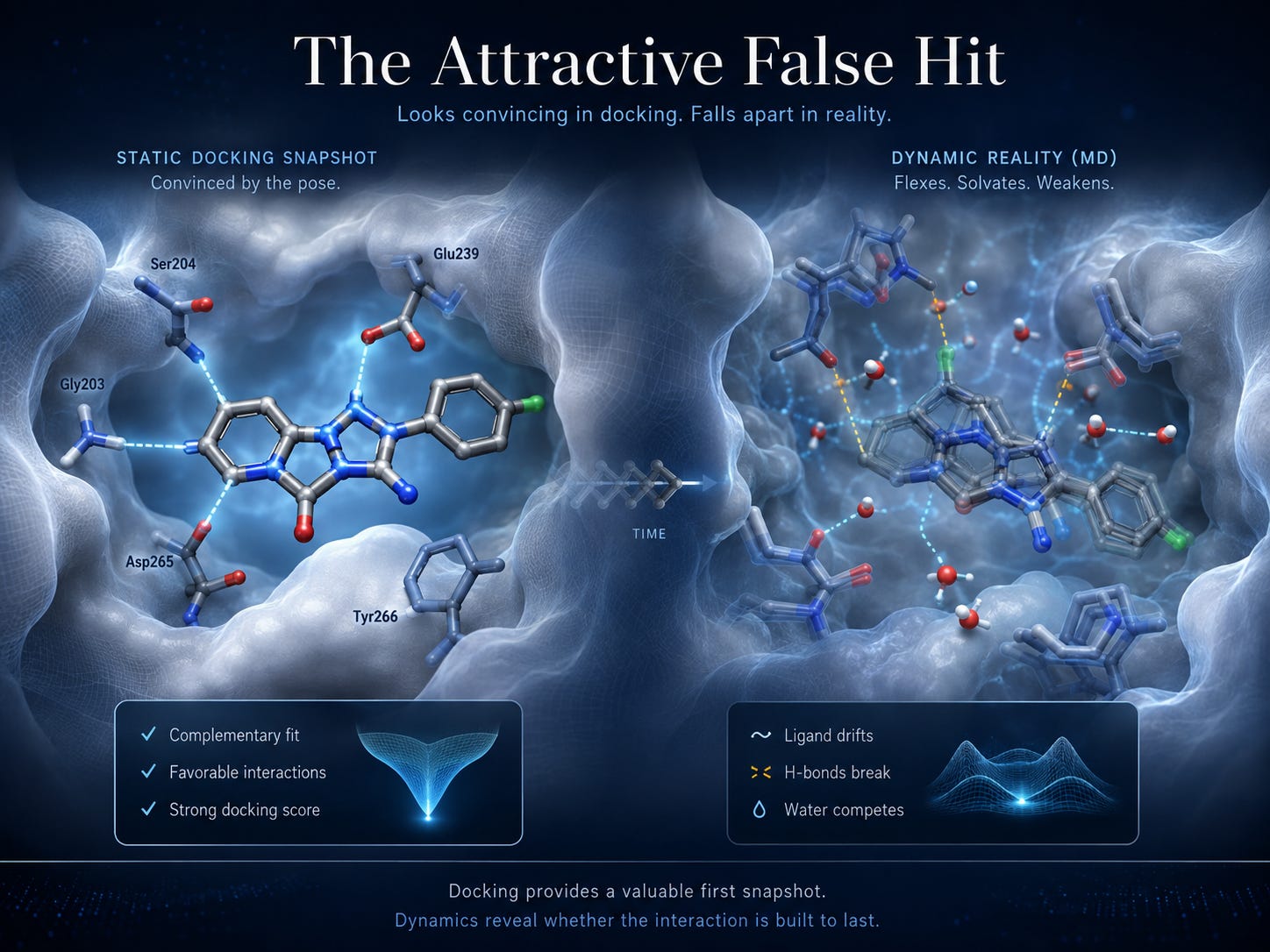
Virtual screening is a foundational computational technique in early-stage drug discovery, enabling the rapid evaluation of extensive compound libraries against biological targets. By employing molecular docking, researchers can predict how small molecules might fit into a protein’s binding site and estimate their binding potential. However, despite its throughput advantages, docking relies on simplified scoring functions and static representations of protein-ligand complexes. This often results in a high rate of false positives—compounds predicted to bind well but failing to do so experimentally.
As virtual screening campaigns scale to millions of compounds, the absolute number of false positives increases, potentially overwhelming downstream experimental validation efforts. Simply expanding the size of the screened library does not inherently improve the quality or reliability of hits. Instead, it can dilute resources and reduce confidence in computational predictions. This limitation highlights a critical need for approaches that go beyond scale to enhance hit prioritization.
How Physics-Based Post-Screening Validation Provides Mechanistic Insight
Physics-based computational methods, including molecular dynamics (MD) simulations and free-energy calculations, offer a more detailed and realistic assessment of ligand-protein interactions. Unlike docking, which typically treats the protein and ligand as rigid or semi-flexible entities in a static snapshot, MD simulates the time-dependent behavior of the molecular system, capturing conformational flexibility, solvent effects, and dynamic interactions.
Free-energy methods, such as alchemical free energy perturbation (FEP), estimate binding affinities by rigorously accounting for thermodynamic parameters. These calculations consider the energetic cost and gain associated with ligand binding, providing a quantitative framework to rank compounds more accurately.
By applying these physics-based techniques after an initial docking screen, researchers can refine hit lists by filtering out false positives that do not maintain stable interactions under dynamic and solvent-inclusive conditions. This post-screening validation thus complements docking by introducing mechanistic rigor and energetic realism.
Contrasting Docking and Physics-Based Approaches: Throughput Versus Accuracy
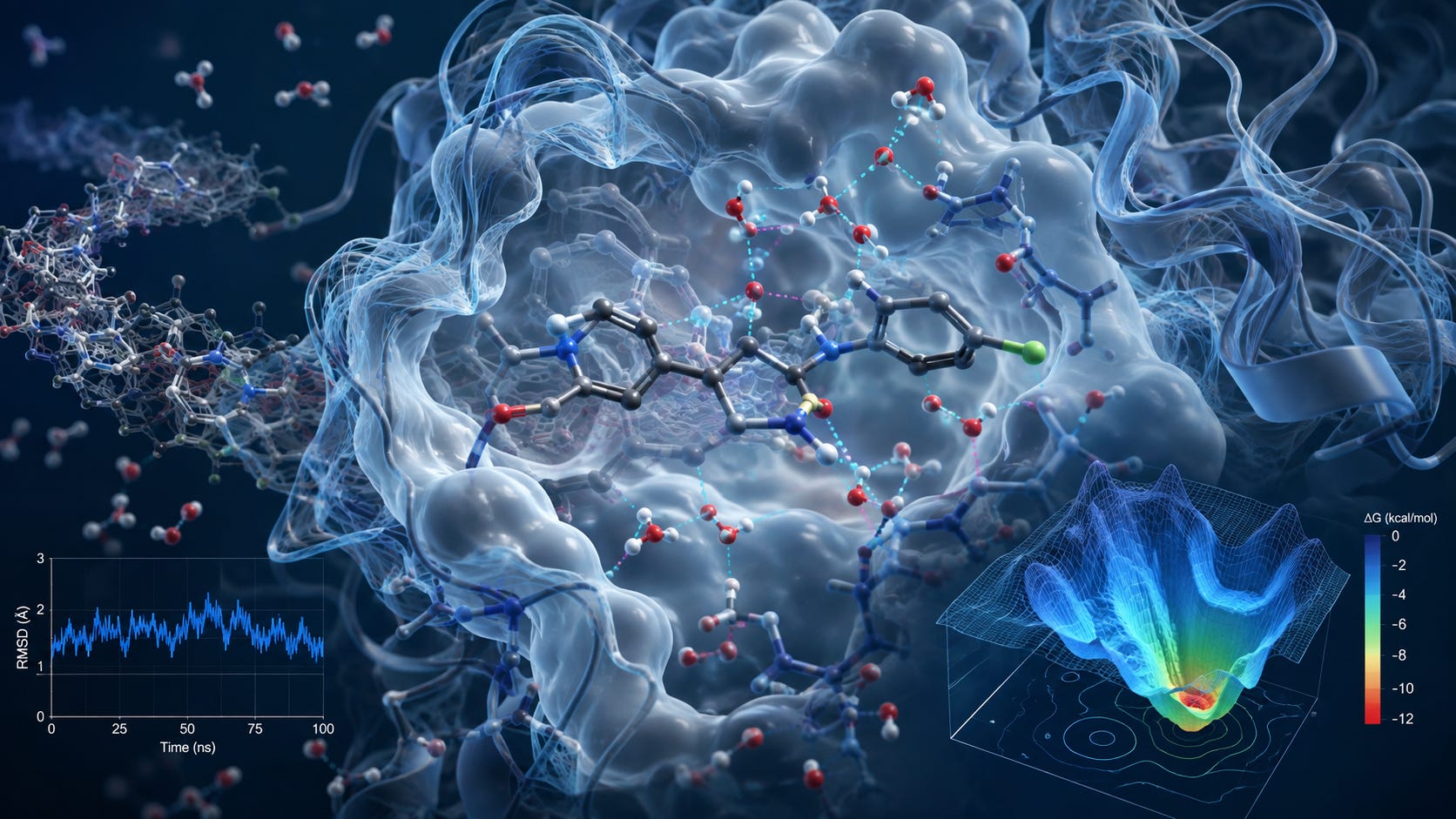
Traditional docking excels in speed and scale, allowing the evaluation of millions of compounds within practical timeframes. However, its approximations—such as simplified scoring functions and limited treatment of protein flexibility—constrain its predictive accuracy.
Physics-based methods, while computationally intensive, provide deeper mechanistic insights. MD simulations reveal how ligand and protein conformations evolve, how solvent molecules mediate interactions, and whether binding poses remain stable over time. Free-energy calculations offer thermodynamically grounded affinity estimates that can better correlate with experimental binding data.
A tiered workflow that combines rapid docking for initial screening with targeted physics-based validation for prioritized hits balances throughput and reliability. This approach leverages the strengths of each method while mitigating their individual limitations.
Practical Barriers to Scaling Physics-Based Validation
Despite their advantages, physics-based methods have historically faced challenges that limit their widespread adoption in post-screening workflows. The primary barrier is computational cost; MD simulations and free-energy calculations require substantial processing time and resources, restricting the number of compounds that can be feasibly evaluated.
Additionally, setting up these simulations demands specialized expertise in system preparation, parameterization, and result interpretation. The complexity of these methods can introduce variability and uncertainty if not carefully managed.
Integrating physics-based validation into existing virtual screening pipelines also requires workflow automation and standardization to handle data flow, candidate selection, and result reporting efficiently.
Advances Enabling More Practical Physics-Based Validation
Recent developments have begun to address these challenges. Algorithmic improvements and hardware acceleration, including GPU computing, have substantially reduced simulation times. Automated software tools now streamline system setup, parameter assignment, and trajectory analysis, lowering the expertise barrier.
Hybrid workflows that combine artificial intelligence with physics-based simulations optimize candidate prioritization by focusing computationally intensive methods on the most promising compounds. These advances collectively enhance the feasibility of incorporating physics-based validation at scale.
Scientific Cases Demonstrating Improved Hit Prioritization
Empirical examples illustrate the value of physics-based post-screening validation. In one scenario, molecular dynamics simulations revealed that several top-scoring docking hits rapidly lost key interactions or adopted unstable binding poses, identifying them as false positives.
Conversely, compounds that maintained stable interactions and favorable binding conformations in MD trajectories showed better correlation with experimental binding affinities. Free-energy calculations further refined ranking within this subset, supporting more confident lead selection.
These cases underscore how physics-based methods provide an additional layer of evidence that can improve decision-making and resource allocation in drug discovery.
Designing Effective Post-Screening Validation Workflows
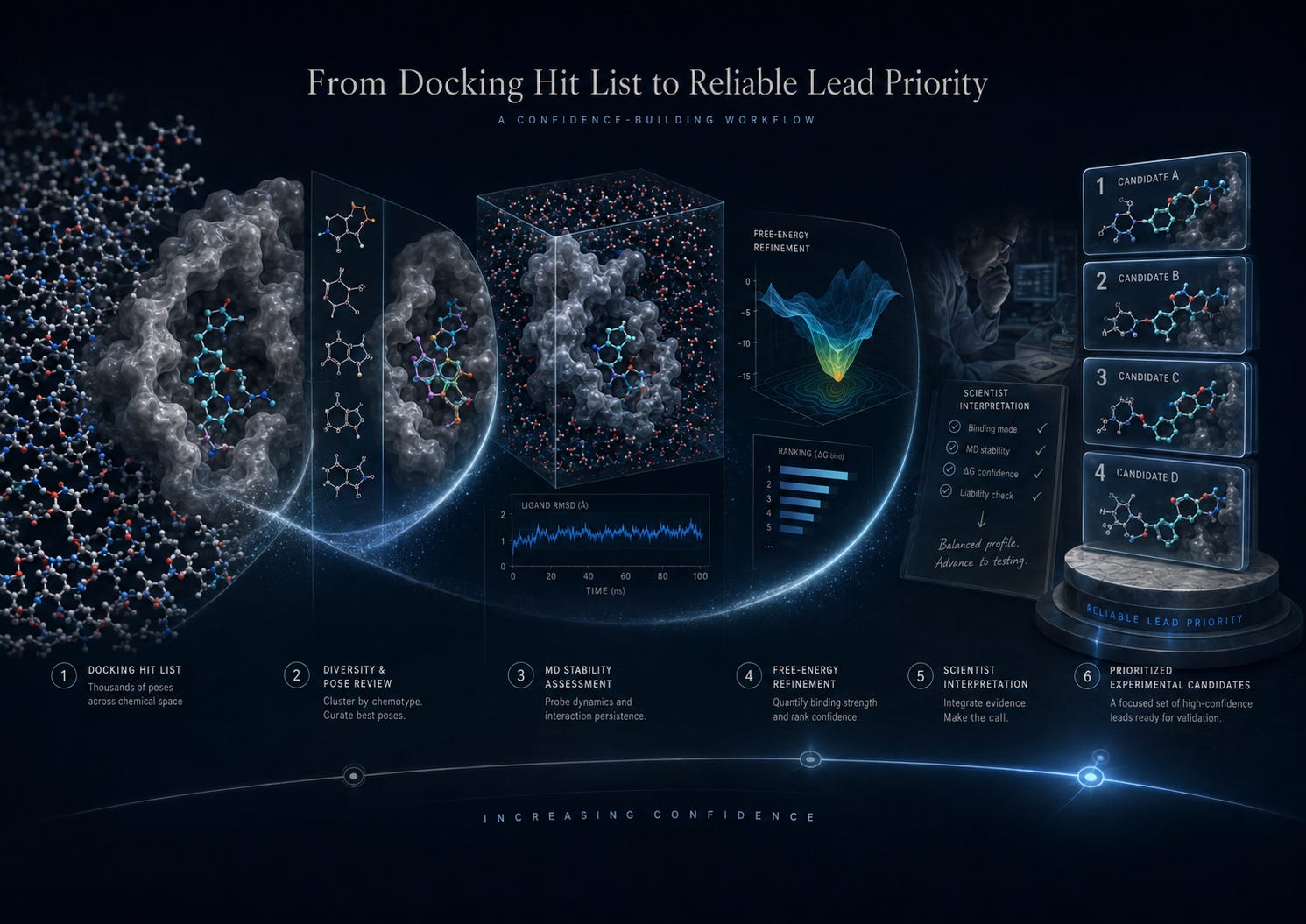
Integrating physics-based validation requires thoughtful workflow design. Typically, a large-scale docking screen generates an initial hit list. Selection criteria—such as docking score thresholds, chemical diversity, and predicted binding modes—guide the choice of compounds for detailed evaluation.
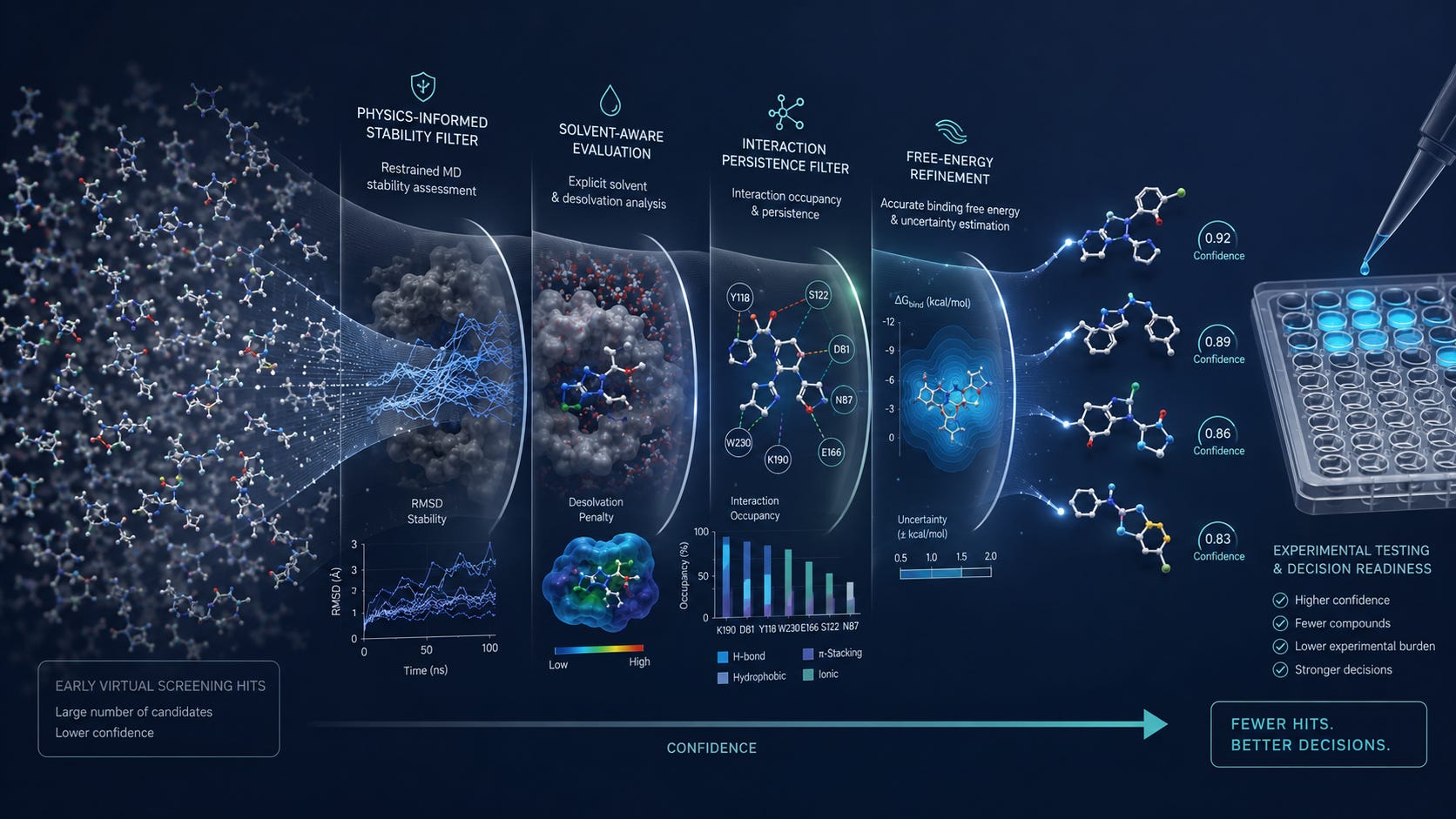
Subsequent MD simulations assess the dynamic stability of ligand-protein complexes, examining conformational flexibility, interaction persistence, and solvent effects. Compounds demonstrating favorable dynamics proceed to free-energy calculations to estimate binding affinities with thermodynamic rigor.
Balancing throughput demands with accuracy needs involves limiting physics-based evaluation to a manageable subset of candidates, informed by docking and cheminformatics filters. Automation and standardized protocols facilitate reproducibility and integration.
Medvolt’s Computational Framework for Physics-Informed Validation
Medvolt supports physics-based post-screening validation through dedicated computational modules that integrate with virtual screening workflows. The platform offers physics-aware validation and quality control tools designed to evaluate docking hits using molecular dynamics and free-energy calculation workflows.
Medvolt’s Oopal-cMD module enables classical molecular dynamics simulations that capture protein and ligand flexibility, solvent behavior, and interaction dynamics. Complementing this, the Oopal-FEP workflow facilitates alchemical free-energy perturbation calculations to estimate relative binding free energies across ligand series.
By embedding these physics-based methods within AI-enabled screening pipelines, Medvolt provides a connected discovery workflow that enhances hit assessment beyond static docking scores. This integration supports scientist interpretation and experimental planning by providing mechanistic insights and refined prioritization.
Limitations and Areas for Further Research
While physics-based validation offers substantial benefits, several limitations remain. Computational resource requirements continue to constrain the number of compounds that can be evaluated, necessitating efficient candidate selection strategies.
Force field accuracy and simulation parameterization influence the reliability of MD and free-energy results. These factors require ongoing refinement and benchmarking to improve predictive performance.
Interpreting dynamic simulation data demands expertise and standardized protocols to avoid misclassification of hits. Moreover, current methods may not fully capture complex biological phenomena such as binding kinetics, allosteric effects, or cellular context.
Developing standardized benchmarks and best practices will be essential to guide broader adoption and ensure consistent application.
Implications for Computational Chemistry and Drug Discovery
Incorporating physics-based post-screening validation into virtual screening workflows can improve the reliability of computational predictions by mechanistically distinguishing true binders from false positives. This refinement supports more informed prioritization, potentially increasing experimental success rates and optimizing resource allocation.
Beyond hit identification, physics-based methods provide mechanistic understanding that can inform rational lead optimization and design strategies. Their integration encourages collaborative development of computational pipelines that balance speed, accuracy, and interpretability.
As these approaches mature and become more accessible, they offer a valuable complement to traditional docking, advancing the scientific rigor and practical impact of virtual screening in drug discovery.
Conclusion
Large-scale virtual screening remains a powerful tool for exploring chemical space, but its reliance on approximate docking methods limits hit quality due to false positives. Physics-based post-screening validation, through molecular dynamics and free-energy calculations, addresses this limitation by evaluating ligand-protein interactions under realistic dynamic and energetic conditions.
While computational demands and methodological complexities pose challenges, recent technological advances and workflow automation have improved the practicality of integrating physics-based validation into screening pipelines. Empirical examples demonstrate its capacity to refine hit lists, enhance correlation with experimental data, and support confident decision-making.
Medvolt’s computational platform exemplifies how physics-aware modules can be embedded within AI-enabled virtual screening workflows to provide mechanistic insight and quality control. Continued research to improve force fields, standardize protocols, and optimize resource allocation will further enable broader adoption.
Ultimately, physics-based post-screening validation offers a scientifically grounded strategy to enhance the reliability of virtual screening outputs, fostering more efficient and informed drug discovery efforts. Researchers are encouraged to explore and collaborate on advancing these methods to realize their full potential in practical applications.

