


Evaluating AI-Enabled Biomedical Knowledge Graphs for Uncovering Complex Synthetic Lethality Networks in DNA Repair-Deficient Cancers
Explore how AI-enabled biomedical knowledge graphs reveal synthetic lethality networks in DNA repair-deficient cancers to advance precision oncology.
Synthetic Lethality as a Therapeutic Strategy in DNA Repair-Deficient Cancers
DNA repair pathways are fundamental to maintaining genomic integrity by correcting DNA damage caused by endogenous and exogenous insults. Deficiencies in these pathways occur frequently across various cancer types, leading to genomic instability that drives tumor progression but also creates specific vulnerabilities. These DNA repair-deficient cancers present unique therapeutic opportunities by exploiting synthetic lethality a biological phenomenon where simultaneous perturbation of two genes leads to cell death, whereas disruption of either gene alone is tolerated.
The therapeutic rationale for targeting synthetic lethality in such cancers is to selectively kill tumor cells harboring DNA repair defects while sparing normal cells. Classical examples include targeting PARP enzymes in BRCA1/2-mutated tumors. However, traditional approaches have largely focused on isolated gene pairs, which limits the scope of discoverable synthetic lethal interactions. The biological reality is more complex, involving higher-order genetic and pathway-level interactions that require integrative methods to uncover.
Diverse Data Sources Underpinning Synthetic Lethality Discovery
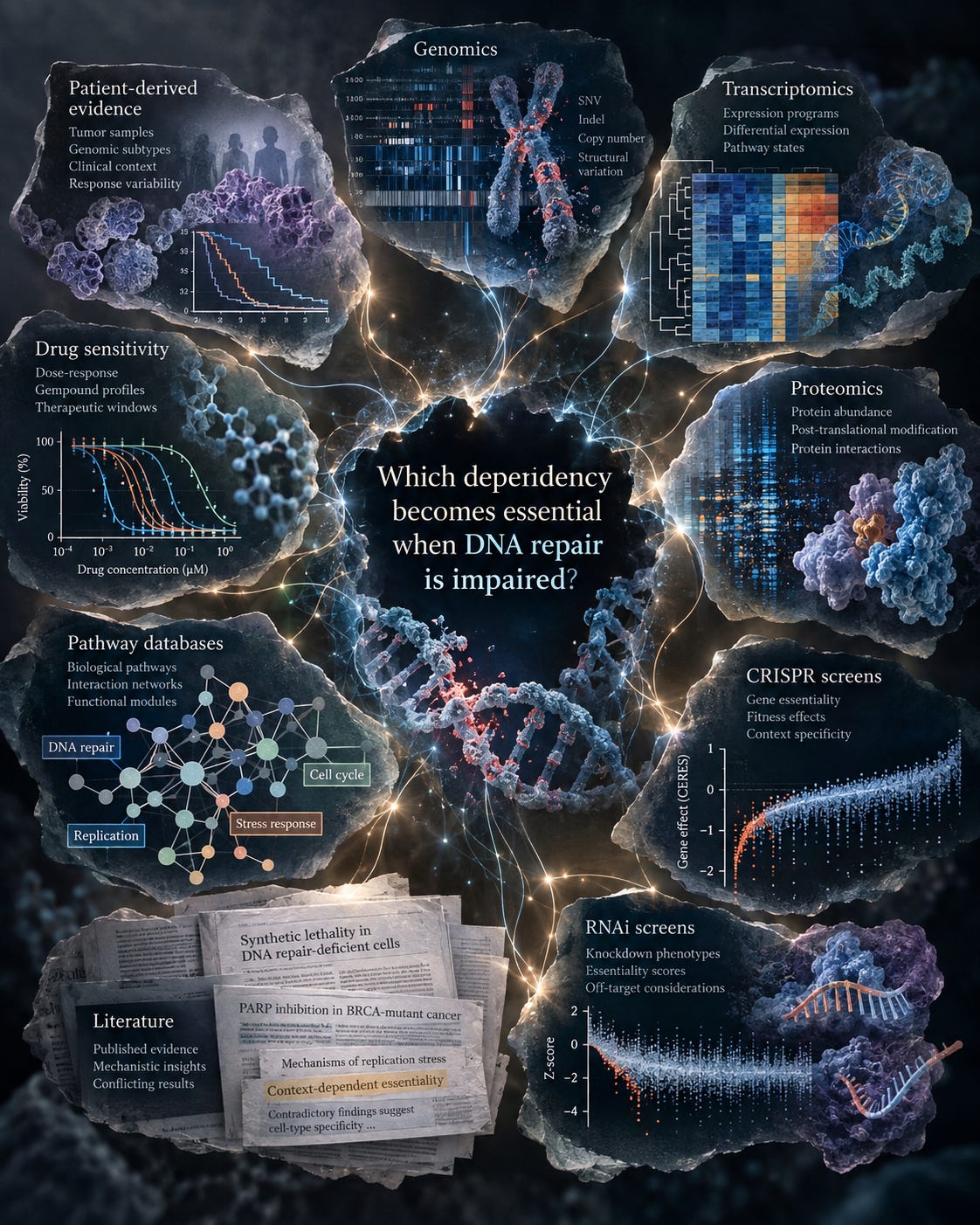
Identifying synthetic lethal networks beyond simple gene pairs necessitates integrating heterogeneous biological data types. Multi-omics datasets such as genomics, transcriptomics and proteomics provide complementary views of cellular states and alterations in DNA repair-deficient cancers. Functional genetic screens, including CRISPR and RNAi-based perturbations, offer experimental evidence of gene dependencies and interactions.
Curated knowledge from literature and biological pathway databases further enriches this landscape by providing mechanistic context and previously reported interactions. However, these data sources vary widely in scale, quality, format and coverage, posing significant challenges for harmonization and interoperability. Data heterogeneity and noise can obscure true synthetic lethal relationships and complicate downstream analyses.
Architecture and Function of AI-Enabled Biomedical Knowledge Graphs
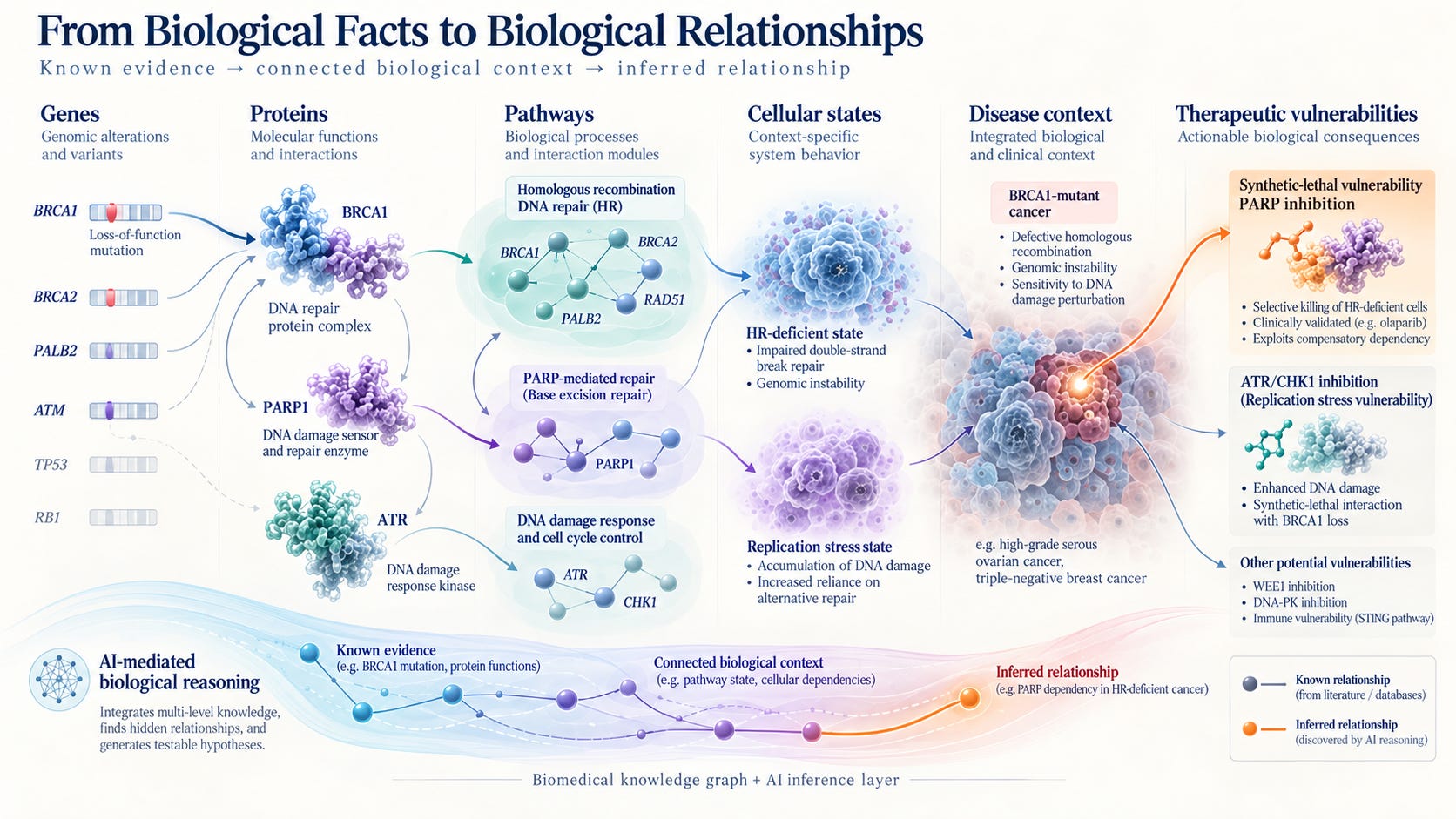
AI-enabled biomedical knowledge graphs (KGs) provide a structured computational framework to integrate and represent these diverse data types. In such graphs, nodes correspond to biological entities genes, proteins, pathways, diseases while edges represent relationships such as physical interactions, regulatory influences or synthetic lethal associations.
Advanced AI algorithms facilitate data integration by harmonizing heterogeneous inputs, inferring missing or latent relationships and expanding the network with predicted interactions. Graph neural networks and network inference methods enable modeling of complex, higher-order interactions beyond classical gene pairs, capturing pathway-level dependencies and context-specific vulnerabilities.
By constructing these integrative network models, knowledge graphs can generate hypotheses about synthetic lethal vulnerabilities specific to DNA repair-deficient cancer contexts, guiding target discovery efforts.
Approaches and Challenges in Validating Predicted Synthetic Lethal Interactions
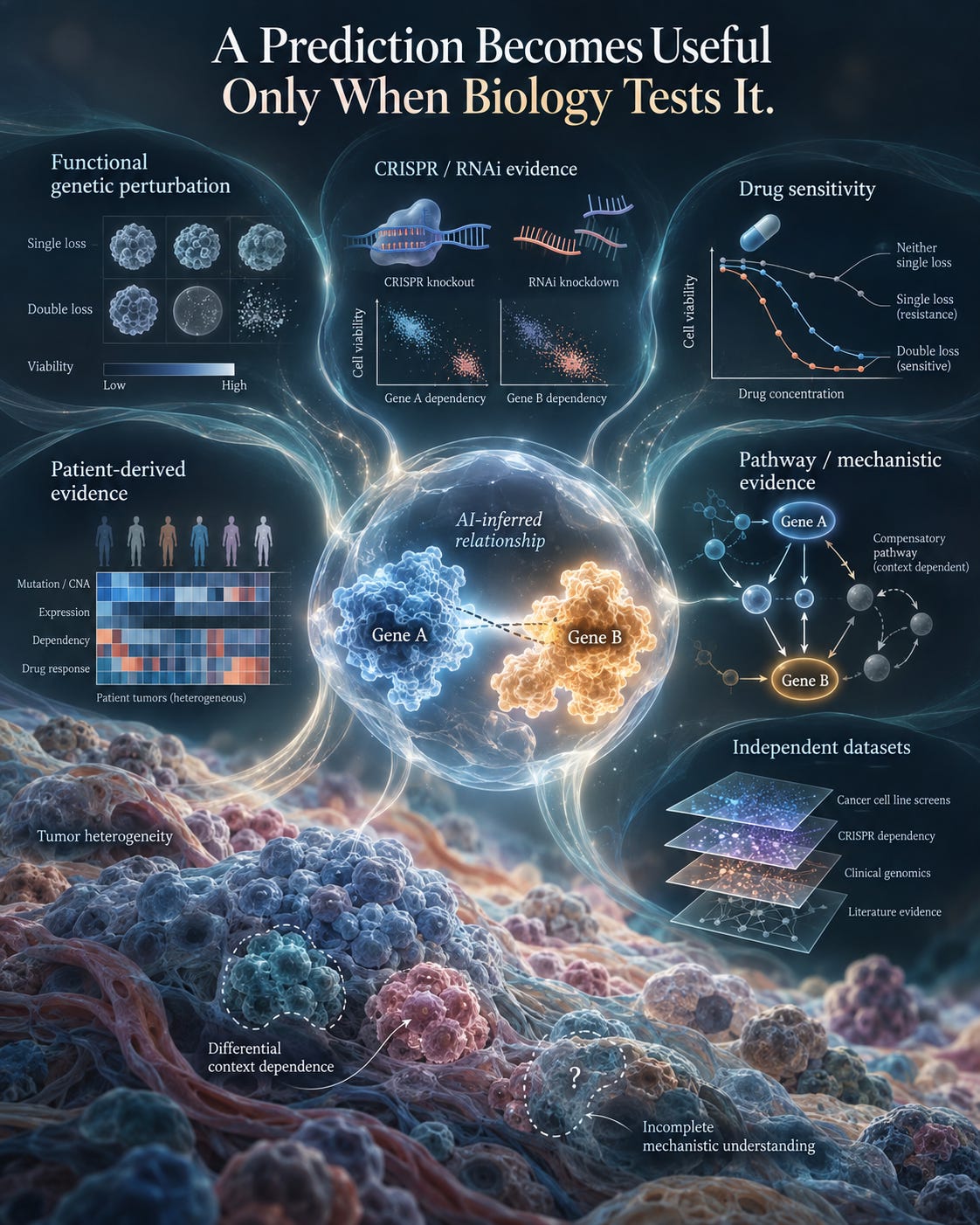
Predictions from AI-enabled KGs require rigorous validation to establish biological relevance and therapeutic potential. Functional genetic screens serve as a primary experimental approach, testing candidate synthetic lethal pairs or networks in relevant cellular models. Orthogonal datasets, such as drug sensitivity profiles and patient-derived data, can provide additional support.
However, validation faces limitations including throughput constraints, variability across biological contexts and incomplete mechanistic understanding of inferred interactions. Synthetic lethality often depends on cellular state, tumor heterogeneity and compensatory pathways, complicating interpretation. Pathway-level and mechanistic validation strategies are critical to confirm that predicted interactions reflect actionable vulnerabilities rather than correlative associations.
Barriers to Adoption of AI-Enabled Knowledge Graphs in Drug Discovery
Despite their promise, adoption of AI-enabled biomedical knowledge graphs in oncology drug discovery remains limited by several technical and organizational challenges. Integrating disparate data sources with varying standards and formats demands substantial computational infrastructure and expertise.
Trust in AI-generated predictions is hindered by issues of interpretability and transparency, as complex models may produce relationships difficult to rationalize biologically. Furthermore, embedding these tools into established R&D workflows requires alignment with decision-making processes, data governance and cross-disciplinary collaboration.
These barriers constrain the practical utility of knowledge graphs and necessitate ongoing efforts to improve usability and integration.
Recent Advances Facilitating Adoption of AI-Enabled Knowledge Graphs
Technological and scientific progress is gradually addressing these challenges. The increasing availability and standardization of multi-omics datasets improve data quality and interoperability. Advances in AI algorithms enhance the construction, reasoning and explainability of knowledge graphs.
Several case studies have demonstrated the identification of novel synthetic lethal targets in DNA repair-deficient cancers using AI-enabled knowledge graphs, illustrating their potential to uncover complex dependencies inaccessible to traditional methods. These developments support broader adoption by providing more reliable and interpretable outputs.
Integrating AI-Enabled Knowledge Graphs into Oncology Target Discovery Pipelines
Effective incorporation of knowledge graphs into drug discovery requires carefully designed workflows that combine AI predictions with experimental validation. Computational prioritization frameworks can rank candidate synthetic lethal interactions based on integrated evidence, guiding resource allocation.
Iterative learning cycles, where experimental results feed back into model refinement, enhance predictive accuracy and contextual relevance. This integration supports more informed decision-making, enabling teams to focus on the most promising targets and hypotheses.
Medvolt’s Support for AI-Guided Synthetic Lethality Discovery
Within this evolving landscape, Medvolt contributes computational capabilities that support the integration of multi-omics and literature data into biomedical knowledge graphs. MedGraph EDGE facilitates the organization, connection and prioritization of heterogeneous evidence, enabling the construction and interrogation of synthetic lethality networks.
Medvolt’s workflows enable network analysis and computational target prioritization, providing actionable insights to guide experimental validation planning. By supporting human-in-the-loop interpretation and traceable scientific reasoning, Medvolt helps bridge the gap between AI-generated hypotheses and practical oncology R&D workflows.
It is important to note that Medvolt’s platform does not guarantee experimental validation or clinical success but provides operational support for advancing synthetic lethality discovery in DNA repair-deficient cancers.
Future Challenges and Research Directions in Synthetic Lethality Target Discovery
Ongoing challenges include enhancing validation frameworks to better capture biological context and mechanistic detail, addressing data gaps and biases in integrated knowledge graphs and improving standards for multi-omics data harmonization.
Further research is needed to refine AI algorithms for more accurate and interpretable network inference, as well as to develop scalable experimental approaches for validating complex synthetic lethal interactions.
Advances in these areas will be critical to translating AI-enabled synthetic lethality discoveries into precision oncology strategies tailored to individual tumor genotypes and phenotypes.
Conclusion
AI-enabled biomedical knowledge graphs offer a promising avenue to uncover complex synthetic lethality networks in DNA repair-deficient cancers, extending beyond classical gene pair interactions to pathway-level dependencies. By integrating heterogeneous multi-omics, functional screening and curated literature data, these platforms can generate hypotheses about cancer-specific vulnerabilities that are otherwise difficult to detect.
However, realizing their potential in drug discovery requires overcoming significant challenges related to data integration, model interpretability and rigorous experimental validation. The biological complexity of synthetic lethality and context dependence of interactions necessitate careful mechanistic and pathway-level confirmation.
Recent technological advances and case studies demonstrate progress toward broader adoption, yet embedding these tools into practical oncology R&D workflows remains a work in progress. Medvolt’s computational capabilities provide operational support for integrating multi-omics data and guiding target prioritization within AI-enabled knowledge graph frameworks.
Continued collaborative efforts to improve data standards, validation methodologies and workflow integration will be essential to translate AI-driven synthetic lethality discoveries into actionable therapeutic targets, ultimately advancing precision oncology for DNA repair-deficient cancers.

