


Expanding Synthetic Lethality Horizons: AI-Driven Multi-Omics and Network Modeling Illuminate Pathway-Level Vulnerabilities in Cancer
Explore how AI-driven multi-omics integration and network modeling uncover pathway-level synthetic lethality in cancer to advance precision oncology.
Introduction: From Single-Gene Synthetic Lethality to Pathway-Level Vulnerabilities
Synthetic lethality has emerged as a compelling concept in oncology, where the simultaneous perturbation of two genes leads to cancer cell death while sparing normal cells. Traditionally, research has focused on identifying such lethal interactions at the level of gene pairs, uncovering dependencies that can be exploited therapeutically. However, cancer cells operate within intricate molecular networks, where compensatory pathways and multifaceted genetic interactions modulate cellular survival.
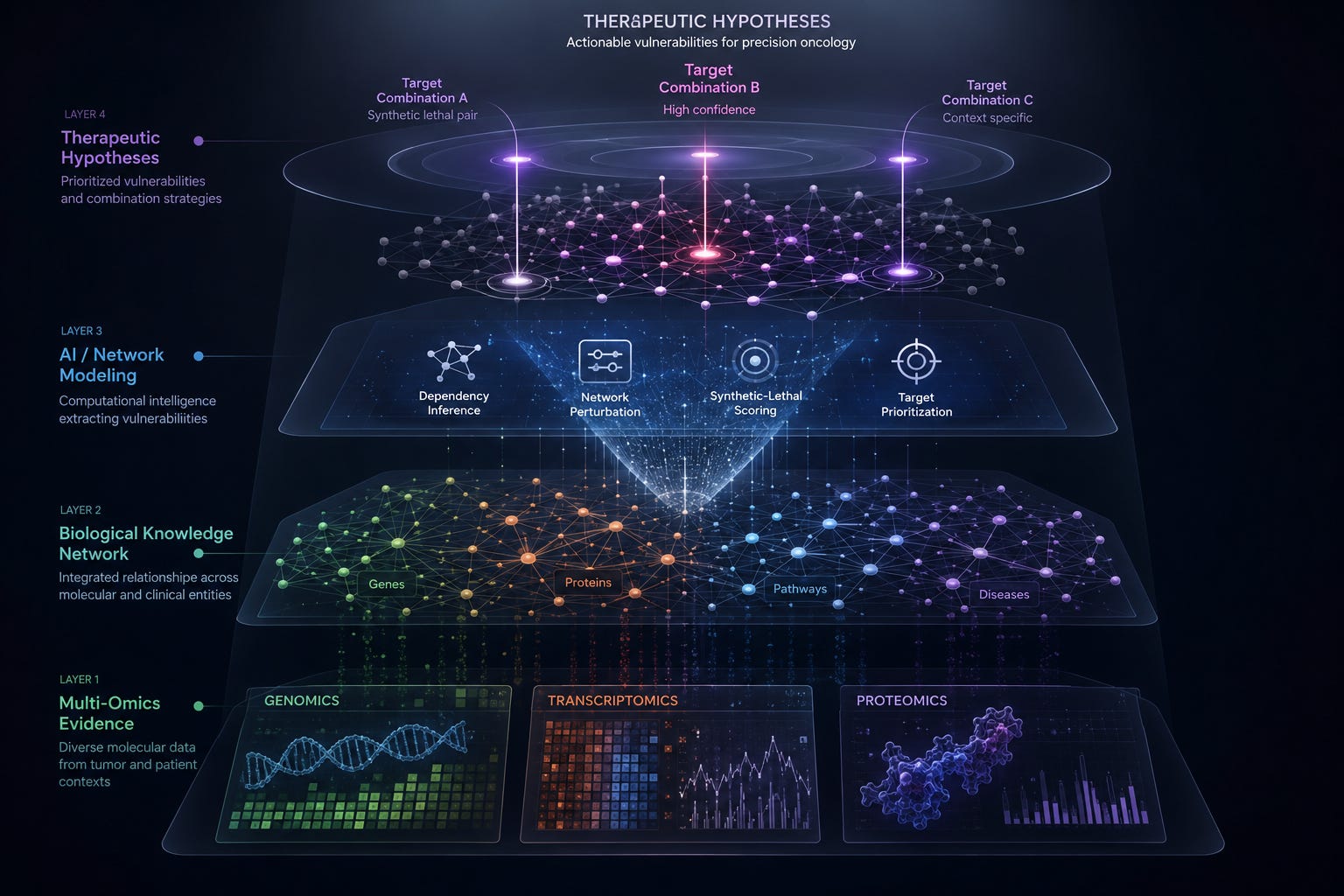
This complexity challenges the single-gene pair paradigm, as it often overlooks broader pathway interactions that contribute to cancer cell resilience or vulnerability. Recent advances in artificial intelligence (AI) and multi-omics technologies have enabled the integration of diverse molecular data types—genomic, transcriptomic and proteomic—facilitating a shift toward pathway-level synthetic lethality analysis. By combining AI-driven multi-omics integration with computational network modeling, researchers can now capture complex genetic dependencies and compensatory mechanisms, offering a richer biological context for identifying therapeutic targets.
This article explores the scientific mechanisms underpinning pathway-level synthetic lethality, the computational methodologies enabling its discovery and the implications for precision oncology, with a focus on DNA repair-deficient tumors where such vulnerabilities are particularly pronounced.
Historical Perspectives on Synthetic Lethality: From Gene Pairs to Pathways
Synthetic lethality was first conceptualized as a genetic interaction between two genes where the loss of either alone is tolerated, but their combined perturbation results in cell death. Early studies concentrated on identifying such gene pairs, leveraging genetic screens and functional assays to uncover actionable dependencies in cancer cells.
While this approach has yielded important therapeutic targets, including PARP inhibitors in BRCA-mutated cancers, it has intrinsic limitations. Single-gene analyses often fail to account for the redundancy and robustness of cellular networks. Cancer cells can activate alternative pathways or engage compensatory mechanisms that buffer the effect of targeting a single gene pair, leading to therapeutic resistance.
Recognizing these challenges, the scientific rationale has evolved toward considering synthetic lethality at the pathway or network level. This perspective acknowledges that multiple genes within interconnected pathways collectively influence cell viability. Targeting synthetic lethal interactions at this broader scale can reveal vulnerabilities masked by network compensation and provide more durable therapeutic strategies.
AI-Enabled Multi-Omics Integration for Comprehensive Molecular Profiling
The transition to pathway-level synthetic lethality necessitates comprehensive molecular profiling that captures the multifaceted nature of cancer biology. Relevant omics data types include:
- Genomics: DNA mutations, copy number variations and structural alterations.
- Transcriptomics: Gene expression patterns reflecting cellular state and regulatory dynamics.
- Proteomics: Protein abundance, modifications and interaction states that directly influence function.
AI methodologies facilitate the integration of these heterogeneous data layers, addressing challenges such as high dimensionality, noise and data sparsity. Techniques such as deep learning, manifold learning and matrix factorization enable dimensionality reduction and feature extraction, preserving biologically meaningful signals.
Multi-omics synthesis enhances the detection of pathway interactions by capturing coordinated changes across molecular layers. For example, a genomic mutation may not manifest as a vulnerability unless accompanied by transcriptomic dysregulation and proteomic alterations within the same pathway. AI-driven integration thus provides a holistic molecular landscape, essential for identifying synthetic lethal dependencies beyond isolated gene pairs.

Computational Network Modeling Techniques to Identify Synthetic Lethality
Network biology offers a framework to model the complex interactions among genes, proteins and pathways. Graph-based models represent molecular entities as nodes and their interactions as edges, enabling the application of network topology metrics to identify critical dependencies.
Key computational approaches include:
- Graph theory metrics: Centrality, modularity and connectivity analyses to detect essential nodes and subnetworks.
- Functional interaction data: Incorporation of experimentally validated protein–protein interactions, signaling pathways and curated databases to contextualize molecular relationships.
- AI algorithms: Machine learning models infer synthetic lethality by simulating network perturbations and predicting the impact of multi-gene disruptions on cellular viability.
These methods collectively enable the reconstruction of pathway-level synthetic lethality networks, capturing compensatory modules and revealing candidate targets that single-gene analyses might miss.
Biological Insights from Pathway-Level Synthetic Lethality in DNA Repair-Deficient Cancers
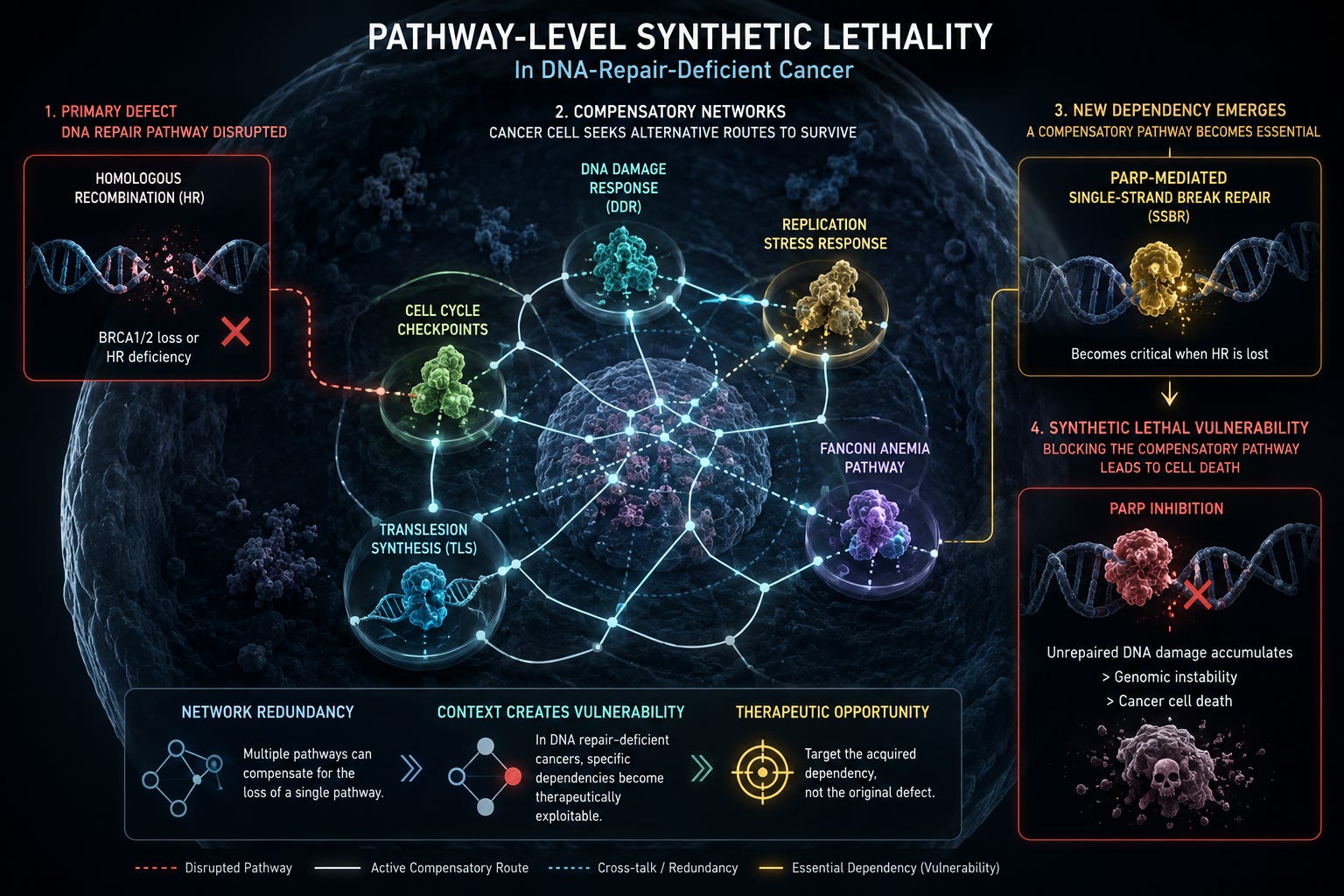
DNA repair-deficient tumors, such as those harboring BRCA1/2 mutations, exemplify contexts where pathway-level synthetic lethality is particularly informative. Defects in homologous recombination repair sensitize cancer cells to perturbations in complementary DNA damage response pathways.
Pathway-level analyses have uncovered compensatory mechanisms involving alternative repair pathways, cell cycle checkpoints and replication stress responses. For instance, synthetic lethal modules may include genes involved in the Fanconi anemia pathway or translesion synthesis, whose inhibition can selectively kill DNA repair-deficient cells.
These insights illuminate tumor heterogeneity and mechanisms of therapy resistance, as cancer cells may rewire pathways to evade single-target interventions. Understanding the network of synthetic lethal dependencies enables the design of combination therapies targeting multiple nodes within compensatory pathways, potentially overcoming resistance and improving clinical outcomes.
Challenges in Experimental Validation and Clinical Translation of Pathway-Level Synthetic Lethality
Despite the promise of pathway-level synthetic lethality, several scientific and technical challenges impede experimental validation and clinical application:
- Complexity of multi-gene interactions: Validating synthetic lethality involving multiple genes requires sophisticated genetic perturbation systems and combinatorial assays, which are labor-intensive and technically demanding.
- Data quality and heterogeneity: Multi-omics datasets vary in quality, coverage and batch effects, introducing biases that complicate integration and interpretation.
- Integration biases: Differences in data modalities and measurement platforms can skew network reconstructions and synthetic lethality inference.
- Clinical translation barriers: Prioritizing targets for drug development requires robust evidence of tractability, safety and efficacy, which is challenging for multi-gene or pathway-level targets.
Addressing these challenges necessitates iterative cycles of computational prediction, experimental validation and clinical assessment.
Computational Opportunities and Medvolt’s Contributions in Multi-Omics and Network Analyses
Medvolt’s AI-driven multi-omics integration and knowledge graph technologies provide computational frameworks to synthesize heterogeneous biomedical data and model pathway-level synthetic lethality networks. By organizing multi-layered molecular data and functional interactions, Medvolt supports oncology R&D workflows including:
- Multi-omics data synthesis: Integrating genomic, transcriptomic and proteomic evidence to build comprehensive molecular profiles.
- Knowledge graph construction and querying: Connecting genes, pathways, diseases and experimental findings to facilitate hypothesis generation.
- Network modeling of biological pathways: Applying graph-based analyses to identify synthetic lethal modules and compensatory mechanisms.
- AI-guided target prioritization: Ranking candidate vulnerabilities based on integrated evidence to inform experimental design.
While these computational tools enhance systematic exploration, Medvolt emphasizes that predictive outputs require experimental validation and do not replace functional genomics or clinical studies. The platform aids in clarifying where validation efforts are most valuable and supports connected discovery workflows aligned with scientific rigor.
Future Perspectives: Leveraging Pathway-Level Synthetic Lethality for Precision Oncology
Looking ahead, integrating pathway-level synthetic lethality networks with functional genomics and molecular simulations may deepen mechanistic understanding and refine target selection. The development of combination therapies targeting multiple nodes within synthetic lethal pathways holds promise for overcoming tumor heterogeneity and resistance.
Advances in computational methods, including improved AI algorithms and enhanced network modeling, will be critical to capture dynamic pathway interactions and context-specific dependencies. Collaborative efforts across computational biology, experimental oncology and clinical research are essential to translate pathway-level synthetic lethality discoveries into effective precision therapies.
As these approaches mature, they may provide another layer of evidence to support more informed target prioritization and experimental sequencing in oncology drug discovery.
Conclusion
The integration of AI-powered multi-omics data with computational network modeling marks a significant advance in synthetic lethality research, expanding the focus from single-gene pairs to pathway-level networks. This approach captures complex genetic dependencies and compensatory mechanisms that underlie cancer cell vulnerabilities, particularly in DNA repair-deficient tumors.
However, the complexity of multi-gene interactions and the heterogeneity of multi-omics data present substantial challenges for experimental validation and clinical translation. Computational predictions must be interpreted cautiously and complemented by rigorous functional studies.
Medvolt’s AI-driven multi-omics integration and knowledge graph capabilities offer a structured framework to organize heterogeneous data and model synthetic lethal pathways, supporting oncology R&D workflows without overstating predictive certainty.
Continued innovation in computational strategies, combined with collaborative experimental efforts, will be vital to realize the therapeutic potential of pathway-level synthetic lethality and advance precision oncology.
Engaging with these scientific challenges and computational methodologies will be key for researchers aiming to uncover novel cancer vulnerabilities and design effective combination therapies.

