India’s Leap from Coders to AI-Driven Innovation: Opportunities for Life Sciences R&D
India is transitioning from an IT outsourcing hub to an AI-driven innovation ecosystem, with life sciences offering a major opportunity for global leadership.
Introduction
For decades, India’s global identity as an economic powerhouse has been tethered to its IT and software services industry. Companies such as Infosys and Tata Consultancy Services (TCS) have positioned India as a leader in software exporting, with coding serving as the backbone of this success. However, as the artificial intelligence (AI) revolution reshapes industries and automates routine programming tasks, India faces a critical crossroads. The question arises: how can the country shift from an IT outsourcing giant to a global innovator in AI-driven technologies, specifically in sectors like life sciences, computational chemistry, and drug discovery?
Beyond coding, AI promises unparalleled breakthroughs in biotechnological R&D. With the rise of enzyme engineering, multi-omics data integration, molecular simulations, and quantum-inspired drug design, the integration of AI into life sciences offers India a chance to build a new identity. But are policy decisions, infrastructure, and scientific focus equipped to meet this demand?
This article delves into India’s evolving role in the AI era, analyzing its shifts and highlighting untapped opportunities in accelerating innovations in biopharma and computational R&D.
The Transition from Coders to AI: Beyond the Software Economy
Over the years, programming careers have been considered among the most stable and lucrative jobs in India. Fueled by domestic education systems, millions of STEM graduates annually enter IT roles, driving a $200 billion software export market as of 2023. However, automation is eroding this economic bulwark. Modern AI models, such as Codex, AlphaCode, and ChatGPT, have commoditized standard coding practices, delivering solutions faster, around the clock, and at scale.
This transition has significant implications. Instead of writing scripts or debugging Java applications, the next generation of engineers must create and oversee autonomous AI frameworks. India’s challenge is to preserve its economic leverage while aligning with a world where token-based AI, automation, and machine learning power multiple sectors.
This shift could redefine India’s employment ecosystem, particularly in the life sciences where computational tools—ranging from AI-powered molecular dynamics simulations to AI-curated biological datasets—are transforming how drugs and enzymes are designed.
AI-Driven Life Sciences: A New Frontier for India
Discovering novel therapeutics, creating customized enzymes, and optimizing biomanufacturing workflows are critical challenges in the life sciences sector. Historically reliant on experimental trial-and-error, these tasks require massive computational bandwidth and intelligent frameworks. Enter AI and computational chemistry. Advanced technologies are disrupting traditional R&D models by offering:
- Predictive Power for Drug Design: Leveraging AI frameworks such as Transformer-based models, researchers can predict protein structures, analyze drug-target interactions, and prioritize lead compounds in significantly reduced timelines. With breakthroughs like AlphaFold solving protein structures at scale, India can strategically position itself as a leader in protein-ligand optimization.
- AI-Enhanced Molecular Simulations: Paired with free energy perturbation (FEP) methods and molecular docking, AI-driven quantum simulations provide new avenues for high-throughput, low-cost drug screening. Companies worldwide are moving beyond wet-lab experiments to embrace predictive workflows powered by GPUs and cloud-based inference infrastructure.
- Integration of Multi-Omics Data: In enzyme engineering and synthetic biology, systems-level approaches are essential for metabolic pathway optimization. AI excels in integrating vast omics datasets—genomics, proteomics, transcriptomics—to model cellular behavior and identify engineering targets for sustainable biochemical production, including biofuels, bioplastics, and specialty enzymes.
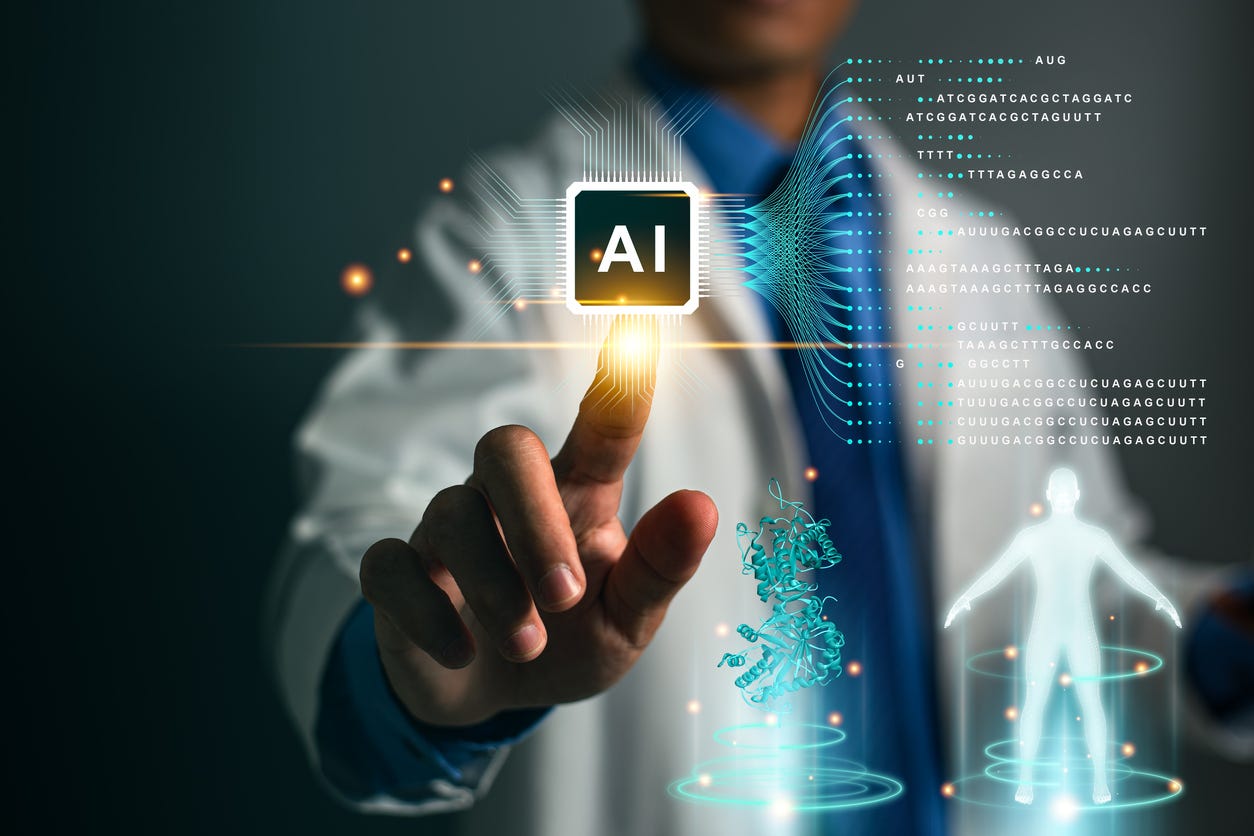
Medvolt, as a pioneer in this space, exemplifies these opportunities, employing AI-based systems for faster iteration of chemical and biological designs, reducing R&D cycles from years to months and enabling commercially viable solutions.
Energy, Infrastructure & AI Token-Driven Research
To support AI workloads, which are computationally and energy-intensive, infrastructure becomes paramount. AI inference hubs in India are increasingly being used by global hyperscalers like Microsoft and Google to enable tasks such as AI token generation. Recent policy incentives underwrite India’s burgeoning role, granting tax holidays to data centers that power large-scale AI applications.
However, life sciences and biotech research have largely remained untouched by these government industrial policies. By contrast, integrating AI into life sciences demands not only high-performance computing resources but also domain-specific infrastructure, such as biopharmaceutical-grade secure datasets and validated algorithms. Ensuring equitable access to state-of-the-art computational frameworks across universities, research centers, and small biotech startups remains crucial.
Policymakers must also rethink how AI infrastructure can actively stimulate innovation pipelines. For instance, requiring data-center operators to allocate a small percentage of GPU or tensor-processing capacity to national biotech research teams could be a bold yet pragmatic step. Such initiatives would alleviate R&D bottlenecks and foster transformational science, potentially enabling world-class laboratory discoveries in computational drug discovery, target validation, and biocatalyst innovation.
Creating a Skilled Workforce for AI-Driven Biotech
India’s passage from producing coders to developing AI-fluent scientists will require coordinated initiatives at academic, industrial, and vocational levels. New career pathways must combine interdisciplinary expertise across computational chemistry, AI, and molecular biology. Upskilling professionals for next-generation roles such as AI model trainers, molecular AI auditors, and bioinformatics managers will also reshape talent pipelines.
More pressing, however, is the education gap. Countries such as the United States and China are investing heavily in chip-based AI developments and applied computational disciplines within academia. India must accelerate its AI-adoption strategy in higher education. A productive measure could involve importing AI research capacities into top public institutions by partnering with foreign hyperscalers or incentivizing cloud-based R&D initiatives via governments’ AI cloud consortiums.
The Role of Biotech Startups: A Paradigm Shift
Startups in the biotechnology and AI niches represent a critical inflection point for this transition. In particular, agile firms excel at leveraging AI frameworks like generative adversarial networks (GANs), reinforcement learning (RL) for molecule generation, and deep learning-based optimization landscapes for lead discovery. By fostering collaborations among academic R&D institutions, private players, and Medvolt-like enablers, India can emerge as a global hotspot for biopharma development.
However, the scale of impact demands more than technological ingenuity; it requires systemic incentives to actively involve private sector pioneers. For example, collaborations among local research teams and global pharmaceutical leaders in creating AI-driven combinatorial libraries of enzyme designs or antibody formulations can yield globally impactful therapies while keeping costs low.
Conclusion: Closing the Loop
India’s AI journey in life sciences will not be without its challenges, including workforce disruptions and systemic gaps in research funding. However, by channeling the country’s scientific talent into high-value fields such as AI-assisted drug discovery and multi-omics data integration, policymakers and innovators can achieve a balanced transformation.
Medvolt and similar leaders in AI and computational R&D now stand at the frontline of this shift—leveraging the confluence of AI, biotechnology, and computational chemistry to set the building blocks that could redefine India’s scientific future.
Building robust partnerships among academia, government initiatives, and startups will be vital to transitioning from coding factories to innovation factories. As India evolves its global role as both a knowledge hub and an AI R&D exporter, trade-offs such as reallocated traditional IT duties may well give way to greater gains in life sciences innovation, international scientific prestige, and biopharmaceutical breakthroughs.