


Physics-First vs. Data-First: Why AI Drug Discovery Needs Both
Explore why AI drug discovery needs both data-driven intelligence and physics-based simulations to improve molecular predictions, lead optimization, and decision-making.
Artificial intelligence has changed what is computationally possible in drug discovery. Machine learning models can screen enormous chemical libraries, predict molecular properties, generate new compounds, infer protein structures, identify patterns across complex biological datasets and prioritize candidates at speeds that would have been difficult to achieve with conventional computational approaches alone.
At the same time, another computational tradition has been advancing for decades. Molecular docking, molecular dynamics (MD), quantum chemistry, statistical mechanics and free energy calculations seek to understand molecular systems through the physical principles that govern their behaviour. Rather than learning primarily from patterns in existing observations, these methods attempt to model how molecules interact, move, reorganize and respond to their environments.
The distinction can be framed simply: data-first discovery asks what can be learned from what has already been observed, while physics-first discovery asks what should happen according to the physical rules governing the molecular system.
The rapid rise of AI has sometimes created the impression that data-driven approaches will eventually replace physics-based computation. The scientific direction, however, appears more nuanced. Recent reviews increasingly describe machine learning and physics-based approaches as complementary rather than competing paradigms, with each offering capabilities that can address limitations in the other.
The most capable drug discovery systems may therefore be neither purely AI-driven nor purely physics-driven. Their advantage may come from knowing when each approach is appropriate, what level of confidence it can provide and how information should move between them.
The Data-First Revolution
The appeal of data-first drug discovery is easy to understand. Pharmaceutical research has accumulated enormous volumes of chemical and biological information, including molecular structures, protein sequences, binding measurements, biological assays, toxicity observations, clinical outcomes and disease associations. Scientific literature adds another vast layer of knowledge, creating an information landscape far too large and complex to navigate manually.
Machine learning provides a powerful way to extract patterns from this complexity. Given sufficient high-quality training data, models can learn relationships between molecular structure and biological activity, predict properties of previously unseen compounds, identify promising chemical series and generate new molecular structures. Once trained, these models can also operate at remarkable speed, making it possible to evaluate or generate candidates across chemical spaces that would be impractical to explore using computationally intensive physical simulations alone.
This scalability makes AI particularly valuable during early-stage exploration, when researchers may need to reason across enormous numbers of potential targets, mechanisms, compounds and molecular modifications. Instead of examining each possibility individually, data-driven systems can help narrow the search space and identify regions that warrant deeper investigation.
Yet this strength comes with an important limitation: a model learns from the world represented in its data and that representation is rarely complete.
The Fundamental Weakness of Data-First Discovery
Drug discovery datasets are imperfect representations of biological reality. They contain experimental noise, inconsistent assay conditions, missing negative results, chemical and target-specific biases and substantial differences in the amount and quality of information available across therapeutic areas.
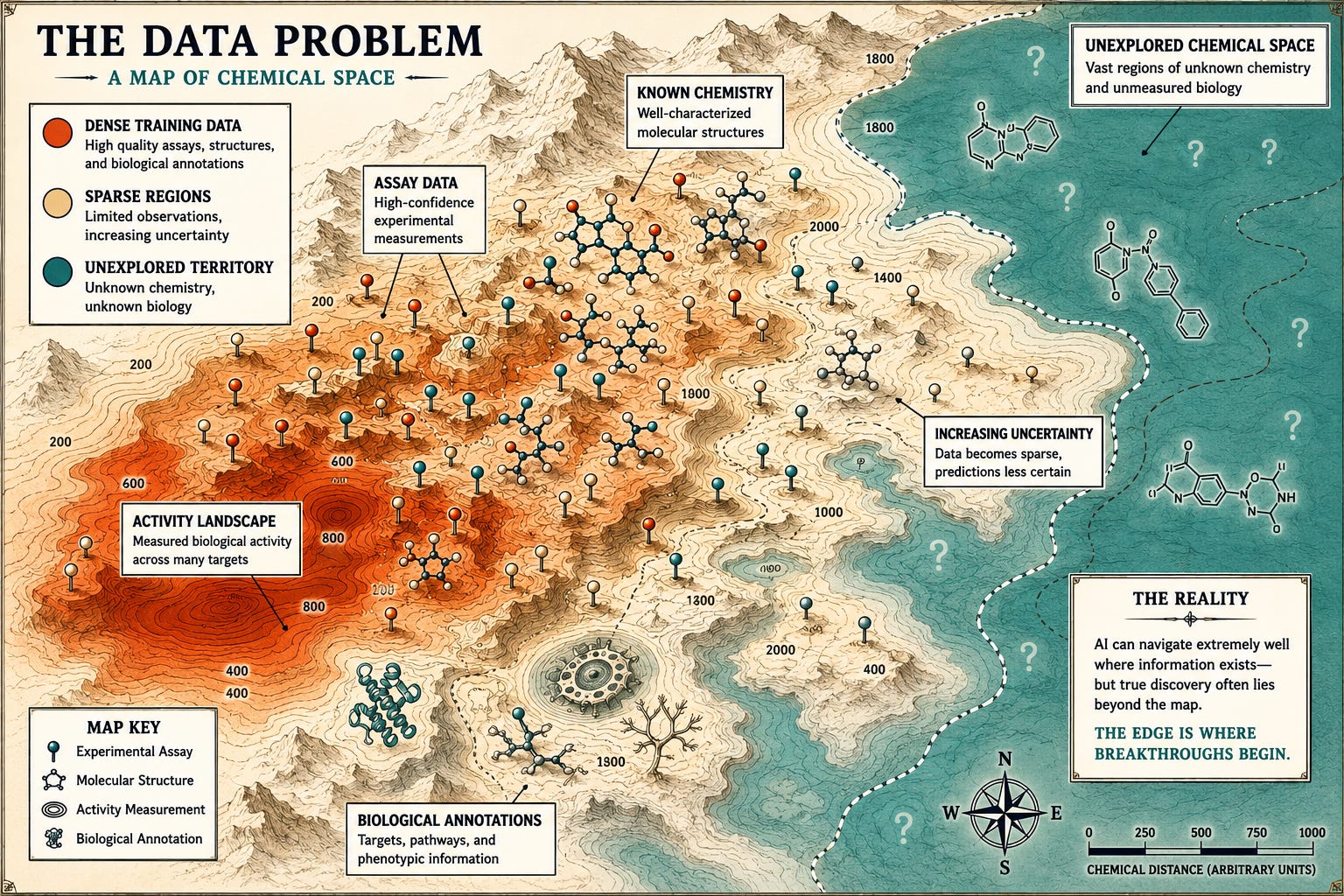
More fundamentally, high-quality experimental data is often scarce precisely where drug discovery becomes most interesting: new targets, novel mechanisms, unexplored chemical series and emerging therapeutic hypotheses. A 2026 review characterized limited high-quality experimental data as an inherent feature of drug discovery and discussed how conventional machine- and deep-learning approaches can struggle with overfitting and generalization in data-limited settings.
The challenge becomes even more pronounced when a model encounters chemistry substantially different from its training distribution. Strong performance on molecules resembling previously observed compounds does not guarantee equally strong performance when the model is asked to extrapolate into genuinely novel chemical space. In such cases, statistical confidence can become disconnected from experimental reality.
Activity cliffs illustrate the problem particularly well. Small structural modifications can sometimes produce unexpectedly large changes in biological activity, making these relationships difficult for models that learn smoother statistical patterns across chemical space.
None of this diminishes the value of machine learning. Instead, it highlights why statistical prediction alone may be insufficient for some of the most consequential decisions in drug discovery. When the available data becomes sparse, unfamiliar or ambiguous, a different source of information becomes increasingly valuable: the physical behaviour of the molecular system itself.
What Physics-First Drug Discovery Does Differently
Physics-based methods approach the problem from another direction. Rather than beginning with what similar molecules have done historically, they examine the molecular system and ask how its components should behave under physical constraints.
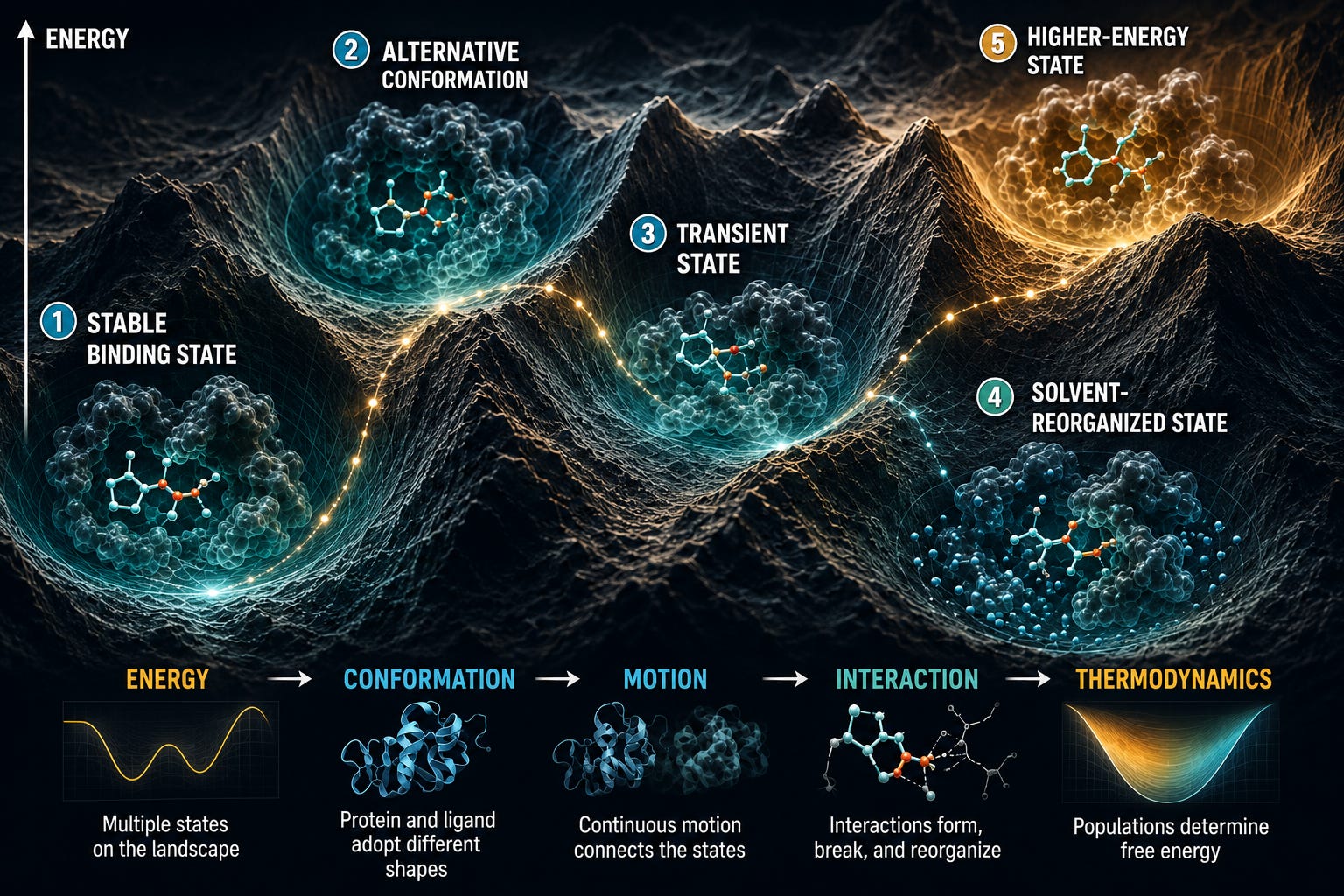
For a protein–ligand interaction, this means considering questions such as whether a proposed binding configuration is energetically plausible, how the protein and ligand reorganize over time, whether important interactions remain stable, how surrounding water molecules respond and how electrostatics, conformational changes, entropy,and solvent effects influence the system.
Different computational methods interrogate different aspects of this behaviour. Molecular docking can propose and evaluate plausible binding configurations, while molecular dynamics simulations allow molecular systems to evolve over time. Free energy methods can provide a thermodynamic framework for comparing molecular interactions or chemical modifications, particularly in carefully selected lead-optimization problems.
The value of these approaches lies partly in their mechanistic grounding. A statistical model may infer that a particular molecular feature correlates with stronger activity, whereas physics-based computation can help investigate why a particular interaction might be favourable, unstable or sensitive to structural change.
This becomes particularly relevant in unfamiliar chemical space. A novel scaffold does not stop obeying thermodynamics because it lies outside a machine-learning model’s training distribution. Likewise, a previously unexplored protein conformation remains subject to physical constraints and solvent molecules continue to reorganize around a ligand. Physics therefore provides a source of information that is not dependent in the same way on the existence of closely related historical examples.
That does not make physics infallible. It simply gives drug discovery a different lens through which to interrogate molecular hypotheses.
But Physics-First Has Its Own Limitations
If physics provides such valuable mechanistic insight, an obvious question follows: why not simply simulate everything?
The practical answer is computational cost and complexity. Chemical space is enormous, while rigorous molecular simulations can require substantial computational resources. Molecular dynamics must adequately sample relevant conformational states to produce useful insight and accurate free energy calculations may require multiple simulations for individual molecular transformations. Applying the highest level of physical rigor to every candidate in a large discovery campaign would therefore be impractical.
Physics-based methods also contain their own approximations and sources of uncertainty. Force fields are imperfect, sampling may be incomplete and results can be sensitive to starting structures, protonation states, protein flexibility, solvent treatment and simulation protocols. A calculation may be grounded in physical principles while still being limited by the assumptions and approximations used to represent the underlying system.
A recent review of protein–ligand modelling captures this trade-off: physics-based methods provide valuable mechanistic foundations, while practical application can be constrained by computational expense, scalability and methodological limitations. Deep-learning approaches, by contrast, offer complementary strengths in speed and exploration.
Physics alone therefore does not solve the discovery problem any more than AI alone does. The more useful question is how the strengths of one can compensate for the limitations of the other.
Scale and Confidence: Different Tools for Different Questions
One useful way to understand this relationship is through two complementary objectives: data-driven AI provides scale, while physics-based computation can provide additional mechanistic scrutiny and confidence.
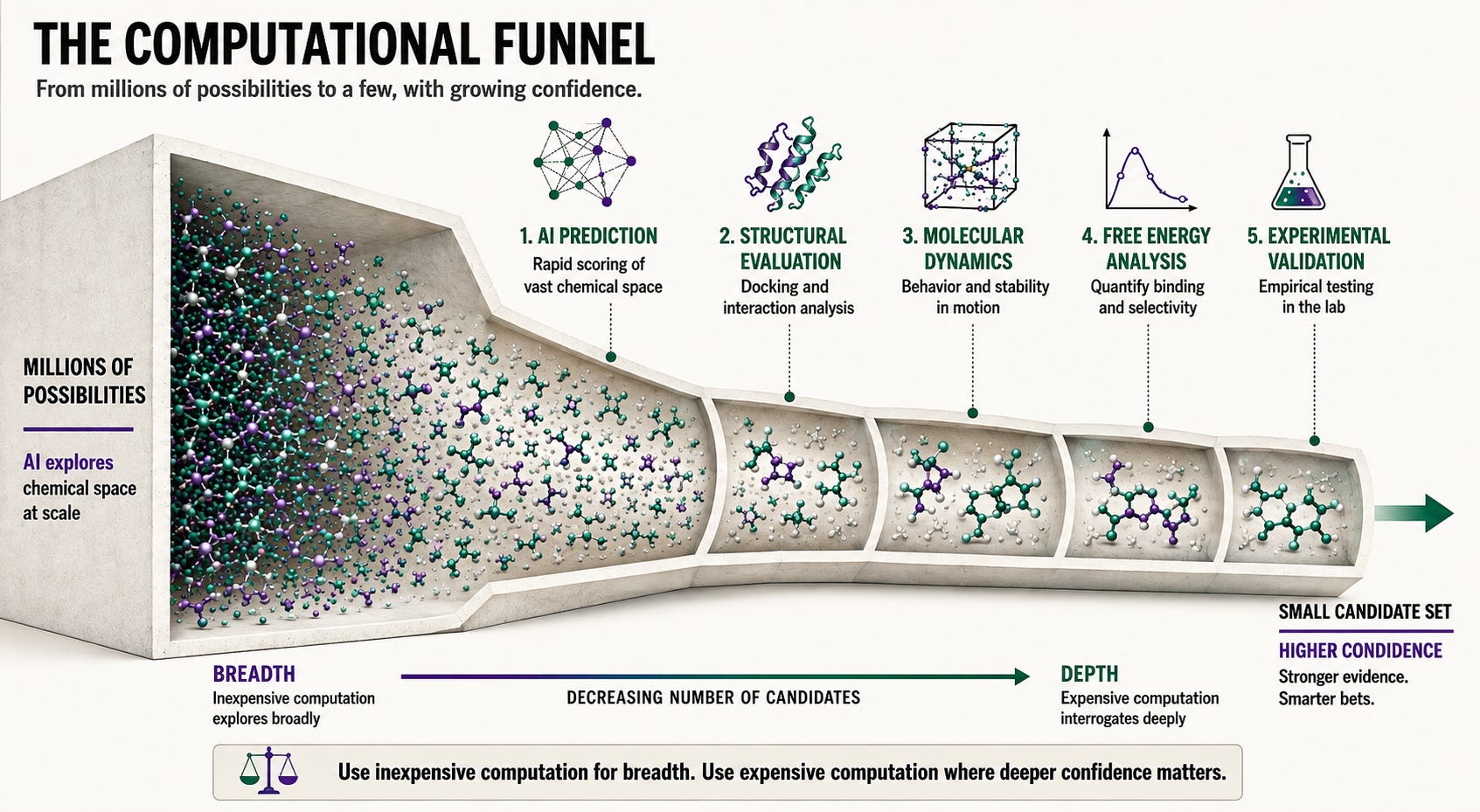
Imagine a discovery program exploring millions of potential molecules. Running extensive molecular dynamics and free energy calculations on every candidate would be unrealistic. AI, however, can rapidly explore this chemical space, identify patterns, generate molecular hypotheses and prioritize candidates for further investigation.
Once the search space has narrowed, more computationally demanding approaches become increasingly practical. Structure-based methods can examine plausible binding configurations, molecular dynamics can investigate how those configurations behave as the protein and ligand move and free energy calculations can provide deeper thermodynamic assessment for carefully selected lead series.
The resulting workflow is not built around choosing one methodology over another. Instead, it progressively increases computational rigor as the number of candidates decreases and the importance of individual decisions increases. Fast, scalable methods are used where breadth matters most, while more expensive methods are reserved for questions where deeper physical interrogation can meaningfully change a decision.
This allocation of computational effort is central to an integrated discovery strategy. The goal is not to run the most sophisticated calculation everywhere, but to use the appropriate level of computation for the appropriate scientific question.
Why Retrospective Accuracy Can Be Misleading
The distinction between prediction and decision-making becomes especially important when evaluating AI drug discovery platforms. An algorithm may perform exceptionally well on a retrospective benchmark, but retrospective accuracy is not equivalent to prospective discovery performance.
In retrospective evaluation, the experimental outcomes already exist and the computational method is tested on its ability to recover, classify or rank those known observations. Prospective discovery presents a fundamentally different challenge: researchers must make decisions about molecules for which the experimental answers are genuinely unknown.
This gap can be substantial. A 2025 perspective on structure-based drug discovery noted that impressive retrospective enrichment metrics do not necessarily translate into equally strong prospective screening performance. In realistic chemical libraries, where non-binders may vastly outnumber binders, even apparently strong computational performance can still produce a substantial number of false positives.
For discovery teams, the implication is important. The value of a computational platform should not be judged only by how quickly it generates predictions or how well it performs on a historical benchmark. It should also be judged by how effectively it helps researchers understand how much confidence to place in a prediction and whether that prediction is strong enough to justify the next experimental investment.
The Better Architecture Is AI + Physics
The emerging opportunity is therefore not physics-first versus data-first. It is physics-first and data-first, connected in a way that allows each approach to contribute where it is most useful.
Lead optimization provides a useful example. Machine learning can rapidly analyze structure–activity relationships across an existing chemical series and suggest promising molecular modifications. Rather than applying an expensive physical calculation to every conceivable modification, researchers can use those predictions to identify a smaller set of high-value hypotheses. Physics-based free energy calculations can then interrogate selected transformations with greater thermodynamic rigor.
The integration is becoming even deeper. Recent research has explored incorporating machine learning directly into free energy perturbation workflows, including applications related to sampling, protocol optimization, force-field development and compound selection. Active-learning strategies also create the possibility of using computational models to determine which expensive calculations are likely to provide the greatest additional information.
This makes the relationship increasingly bidirectional. AI can help make physics-based computation more efficient by focusing expensive calculations on high-value questions, while physics can provide additional evidence that helps refine AI-generated hypotheses. The output of one approach can become an input to the other, creating an iterative system rather than a linear sequence of disconnected tools.
The boundary between data-driven and physics-based discovery is therefore becoming less rigid. What matters increasingly is not which paradigm dominates, but how effectively information moves between them.
Why Many AI-First Approaches Struggle
The temptation in AI drug discovery is to optimize around capabilities that produce the most visible demonstrations: generating thousands of molecules, predicting affinities almost instantly or ranking enormous compound libraries. These capabilities are technically impressive and can accelerate important parts of discovery. However, the success of a discovery program is ultimately not determined by the number of molecules a platform can generate or score. What matters is whether those computational outputs lead to better decisions about which molecules deserve synthesis, experimental validation and continued investment.
This distinction becomes increasingly important as generative and predictive models scale. A platform capable of producing 100,000 candidate molecules has not necessarily solved the discovery problem if it cannot reliably identify which small subset is worth pursuing. In that situation, computational scale may simply move the bottleneck downstream, replacing the challenge of generating molecular possibilities with the challenge of prioritizing them effectively.
Physics-based methods can strengthen this prioritization process, but simply adding them to the end of an AI pipeline does not automatically create an integrated physics–AI discovery system. Running molecular dynamics on a handful of AI-generated candidates, for example, is useful only to the extent that the resulting information influences subsequent decisions.
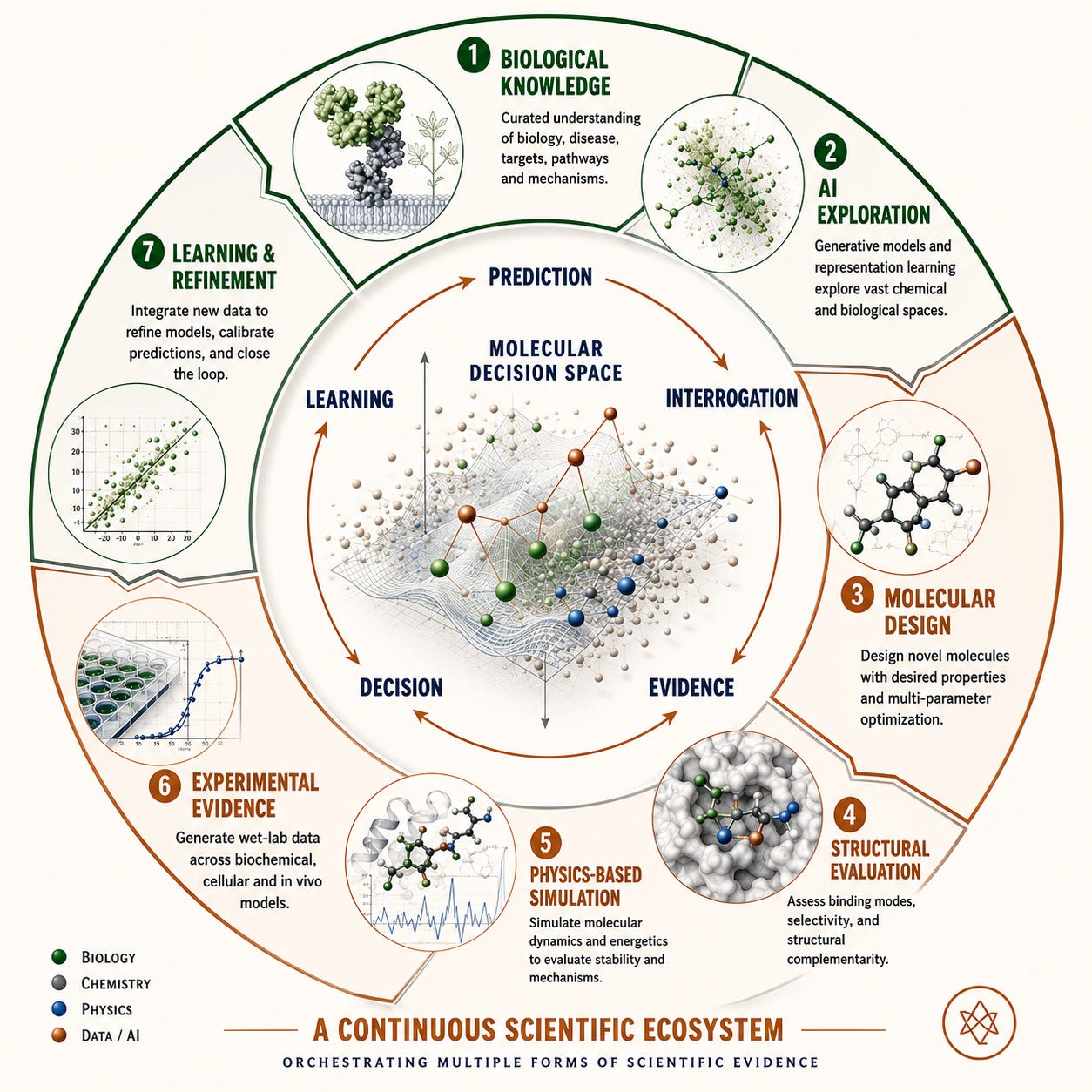
A stronger architecture allows biological reasoning, molecular generation, structural evaluation, dynamic simulation, property prediction and experimental evidence to inform one another throughout the discovery process. AI-generated hypotheses can be interrogated through structural and physics-based methods, while insights from those calculations can guide subsequent molecular design. Experimental evidence can then provide another layer of validation and help refine future computational exploration.
In this type of workflow, each stage has a specific purpose: to reduce uncertainty before additional resources are committed. Fast computational approaches can be used where breadth and scalability matter most, while deeper and more expensive methods can be reserved for questions where greater mechanistic or thermodynamic confidence is valuable.
Building such a system is considerably more difficult than developing a standalone predictive model. It requires not only strong individual algorithms, but also an architecture capable of determining how evidence should move between them. That orchestration is also where much of the potential value of integrated AI and physics lies.
How Medvolt Approaches the Physics–AI Intersection
This intersection is central to how we think about computational drug discovery at Medvolt. MedGraph™ is designed around the principle that different stages of discovery require different forms of computational intelligence. Rather than expecting a single AI model to answer every scientific question, the workflow brings together knowledge-driven biology, machine learning, generative design, structural modeling and physics-based simulation.
At the exploratory end of discovery, AI and biomedical knowledge can help navigate enormous biological and chemical search spaces. Knowledge graphs and disease-contextualized information can support reasoning about targets, mechanisms and biological relationships, while AI-guided approaches can help prioritize existing compounds or generate new molecular hypotheses.
As candidates progress and the search space narrows, the computational lens can become increasingly physical. Structure-based docking can evaluate potential binding configurations, while molecular dynamics allows protein–ligand systems to evolve over time and can help assess conformational stability, interaction persistence, flexibility and solvent-mediated behaviour. For appropriate lead-optimization problems, free energy calculations can add another layer of thermodynamic assessment when relatively small molecular changes need to be compared with greater confidence.
The result is a computational funnel in which the depth and expense of analysis can increase as the candidate space becomes smaller. Instead of applying the most expensive calculation everywhere, faster methods are used to explore broadly, while deeper physics is focused on decisions where additional rigor can provide the greatest value.
Importantly, the process need not operate in only one direction. Results from structural and physics-based calculations can inform subsequent molecular optimization, helping refine which regions of chemical space AI should explore next. Experimental results can further update those decisions, creating an iterative process in which prediction, physical interrogation and evidence continuously inform one another.
It is this feedback not merely the presence of multiple computational tools that transforms a collection of methods into a coherent discovery workflow.
The Real Competitive Advantage Is Orchestration
As foundation models, open-source algorithms, public datasets and cloud computing become increasingly accessible, simply possessing an AI model is likely to become less differentiated. The harder capability will be determining how multiple forms of computational and experimental evidence should work together.
A discovery system must decide when an ML prediction is sufficiently reliable to guide the next step, when docking should be treated primarily as a filtering method rather than an affinity predictor, when protein flexibility warrants molecular dynamics and when the expected information gained from an FEP calculation justifies its computational cost. Just as importantly, it must recognize when experimental evidence should override computational confidence.
These are not merely model-selection questions. They are workflow and decision-making questions. They concern how uncertainty is managed, how computational resources are allocated, how conflicting evidence is reconciled and how each result determines what should happen next.
Recent literature increasingly reflects this perspective, describing AI and physics-based computation as complementary technologies whose integration can improve the efficiency and predictive capability of molecular discovery workflows.
The future may therefore belong less to platforms with the single most impressive algorithm and more to those capable of intelligently orchestrating different forms of scientific reasoning into a coherent decision-making system.
From Artificial Intelligence to Molecular Intelligence
Perhaps the next evolution in computational drug discovery requires moving beyond the idea of being simply “AI-driven.” Drug discovery is too complex to be reduced to a single computational paradigm. Effective decisions require biological context, chemical reasoning, physical realism, uncertainty estimation, experimental feedback and human scientific judgment.
A 2026 review proposed the concept of “Molecular Intelligence,” emphasizing a decision-centric framework that connects prediction with validation, mechanistic understanding and domain knowledge.
That framing captures an important shift in emphasis. The objective of computational drug discovery should not be to maximize the amount of AI involved in a workflow. It should be to maximize the quality of the scientific decisions that the workflow enables.
In some situations, a fast data-driven prediction may provide exactly the information needed. In others, a question may require deeper physical interrogation. Increasingly, the strongest decisions will emerge when these approaches are connected, tested against experimental evidence and interpreted within the relevant biological and chemical context.
Conclusion
The debate between physics-first and data-first drug discovery presents a false choice. Data-driven AI offers extraordinary speed, pattern recognition and scalability, making it possible to explore biological and chemical spaces at unprecedented breadth. Physics-based methods provide a complementary perspective by introducing mechanistic grounding, molecular dynamics and thermodynamic reasoning into questions where statistical prediction alone may be insufficient.
Neither paradigm is complete on its own. AI can scale rapidly but may become unreliable when data are sparse, biased or far outside the training distribution. Physics-based methods can provide deeper molecular insight but are computationally expensive and subject to their own approximations. Their strengths become considerably more useful when they are treated not as competing alternatives, but as components of the same discovery architecture.
At Medvolt, this principle shapes how we approach computational discovery through MedGraph™. AI can help explore possibilities at scale, while structural and physics-based methods can interrogate selected hypotheses with increasing scientific rigor. Results from those analyses can, in turn, inform subsequent computational exploration and experimental decision-making.
The objective is not to prove that one computational philosophy is superior to the other. It is to build workflows in which each method is applied where it can contribute the greatest scientific value and where evidence from one stage improves decisions at the next.
Because the future of AI drug discovery will not be defined by choosing between data and physics. It will be defined by how effectively we make them work together.

