


The Combination Therapy Paradox: Why Synergy Prediction Is Harder Than We Think
Explore why drug synergy prediction is challenging and how AI, systems biology, and mechanistic insights can improve combination therapy discovery.
Two Drugs Can Look Perfect Together on Paper and Still Fail in the Real World
Combination therapy sounds deceptively simple. If Drug A works through one mechanism and Drug B works through another, combining them should produce a stronger therapeutic effect. In cancer, infectious disease, immunology and other complex conditions, this logic has driven some of the most successful treatment strategies in modern medicine.
Yet predicting which combinations will actually work remains extraordinarily difficult. The problem is not simply finding two individually effective drugs. It is determining whether they interact beneficially at the right doses, in the right biological context, in the right patients and without creating unacceptable toxicity. Even the word synergy is more complicated than it first appears.
A drug pair may be considered synergistic under one mathematical definition and merely additive under another. A combination that appears impressive in a cell line may fail in a tumor with a different molecular profile. Two agents may produce strong synergy at one concentration ratio and antagonism at another. Most importantly, a highly synergistic combination is not necessarily the most therapeutically effective one.
This is the combination therapy paradox: The more complex the disease biology becomes, the more attractive combination therapy becomes, but the harder its behavior becomes to predict.
Why Combination Therapy Makes Biological Sense
Most diseases are not driven by a single molecular event. Cancer cells can activate alternative signaling pathways when one pathway is inhibited. Pathogens evolve resistance. Tumors contain heterogeneous cellular populations. Feedback loops can restore signaling after an apparently successful intervention. This biological redundancy is one reason monotherapies often lose effectiveness over time.
Combination therapies can potentially overcome these limitations by attacking disease from multiple directions. One drug may inhibit a primary driver while another blocks a compensatory pathway. Two agents may target different subpopulations within a tumor. A second therapy may prevent the emergence of resistance to the first.
This principle is already deeply embedded in clinical medicine, from multidrug regimens in infectious diseases to chemotherapy combinations and targeted therapy plus immunotherapy in oncology. But there is a crucial difference between combining drugs and achieving true pharmacological synergy.
What Does “Synergy” Actually Mean?
At its simplest, synergy means that two drugs together produce an effect greater than expected from their individual effects. The problem is determining what “expected” means. There is no single universally correct mathematical definition of drug synergy.
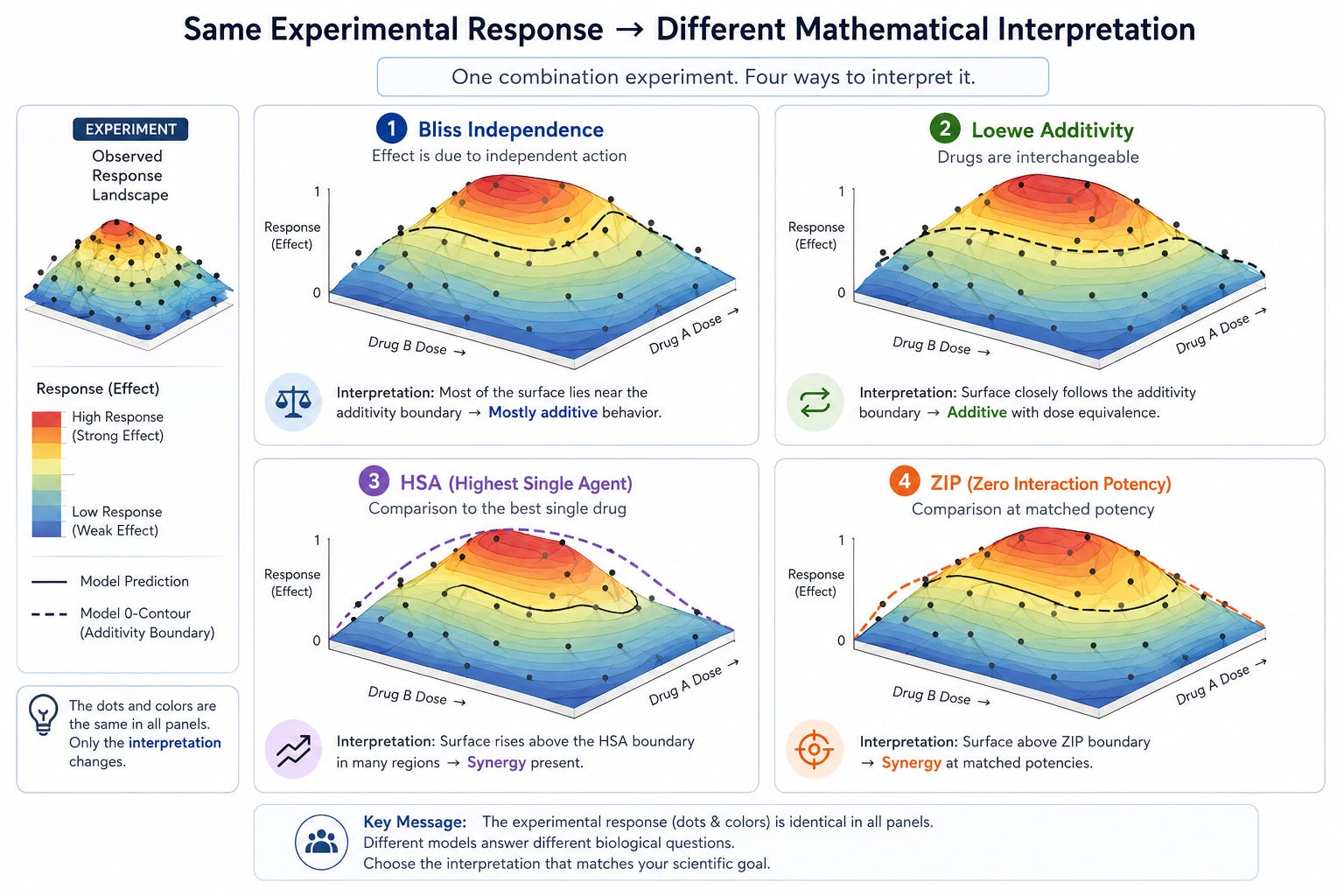
Several reference models are widely used and each makes different assumptions about how two drugs should behave in the absence of interaction. The Bliss independence model assumes that the two drugs act independently. The Loewe additivity model is based on dose equivalence and is particularly intuitive for drugs with related mechanisms. Highest Single Agent (HSA) asks whether the combination performs better than the more effective individual drug. ZIP or Zero Interaction Potency, attempts to incorporate aspects of both Bliss and Loewe reasoning across dose-response surfaces.
These are not simply different ways of calculating the same biological truth. They can produce different answers for the same experimental data. Recent work continues to highlight that synergy labels can depend substantially on the selected null model and disagreement among reference models remains an important reproducibility challenge.
So before an AI model can predict synergy, researchers face a deeper question: What exactly are we asking the model to predict?
A Synergy Score Is Not the Same as Therapeutic Effectiveness
This distinction is one of the most important in combination drug discovery. Consider two drugs that are individually weak. Drug A inhibits disease-associated cells by 10%. Drug B inhibits them by 10%. Together they inhibit them by 30%. Depending on the reference model, that interaction might generate an attractive synergy score. But a therapy producing only 30% inhibition may still be clinically uninteresting.
Now consider two highly effective drugs that each produce substantial inhibition individually. Their combination might show little mathematical synergy because much of the therapeutic effect is already achieved by either agent alone. Yet that combination could still be far more valuable clinically.
A recent analysis examining drug combination prediction made this point clearly: high synergy scores do not necessarily correspond to high overall inhibition. In the datasets examined, the correlation between several commonly used synergy metrics and maximal inhibition was low.
This creates a fundamental problem for AI. If a machine learning model is optimized to predict a synergy score rather than meaningful therapeutic benefit, it can become highly accurate at predicting the wrong outcome.
Dose Changes Everything
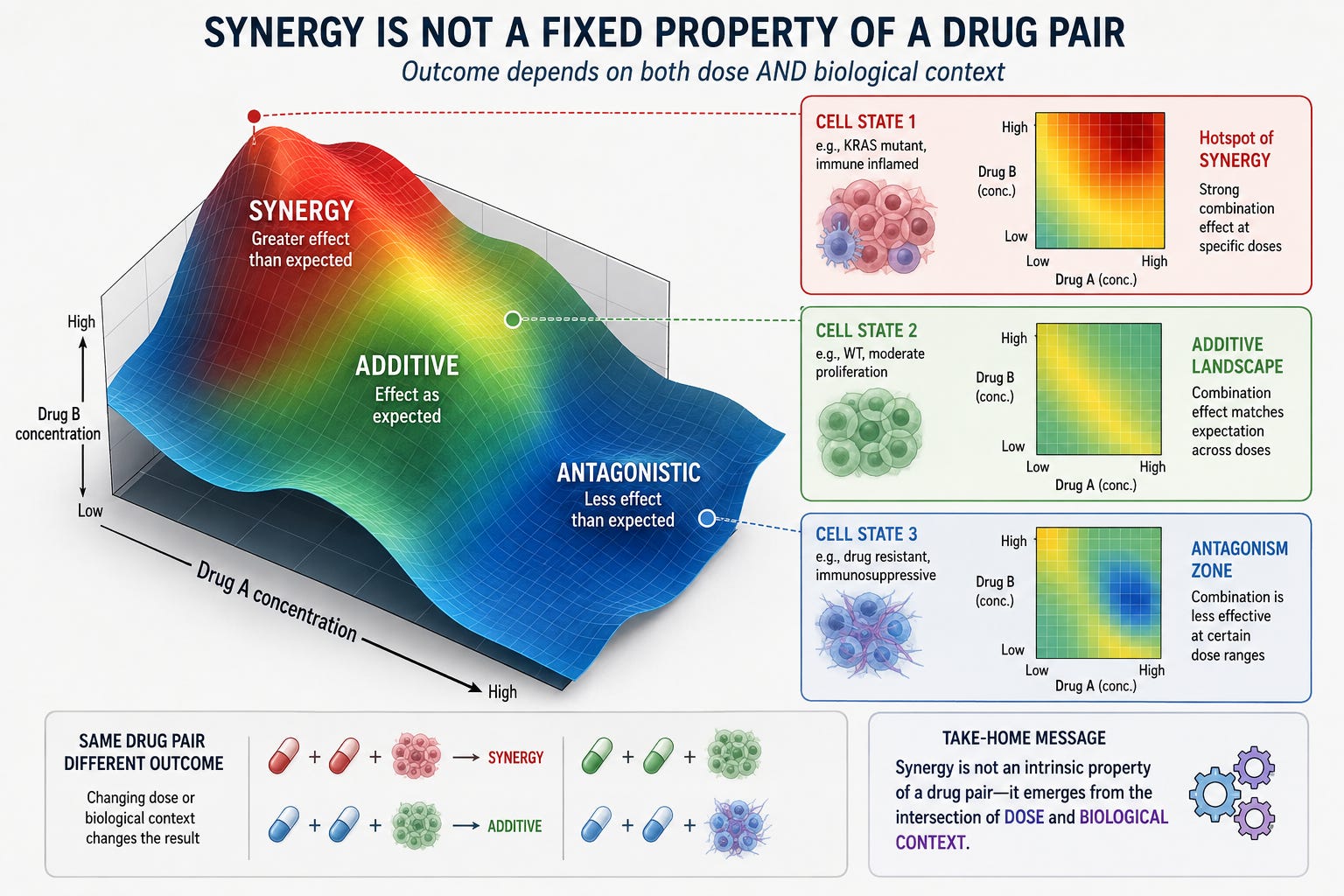
Drug synergy is not a binary property. Two compounds are not simply “synergistic” or “not synergistic.” Their interaction depends heavily on concentration. At one dose ratio, two drugs may demonstrate strong synergy. At another ratio, they may appear additive. At still another, the interaction may become antagonistic.
This creates a multidimensional dose-response landscape. Instead of predicting a single value, the ideal computational system must understand how the biological effect changes across many combinations of Drug A and Drug B concentrations.
That distinction matters clinically. The concentrations producing the strongest experimental synergy may not be achievable safely in patients. Pharmacokinetics may prevent both agents from reaching the required exposure simultaneously. One drug may clear much faster than the other.
Experimental synergy therefore has to be interpreted within the context of realistic drug exposure. A mathematically attractive dose combination that cannot exist inside the human body has limited therapeutic value.
The Same Combination Can Behave Differently in Different Cells
Biological context adds another layer of difficulty. Imagine a combination designed to inhibit two signaling pathways in cancer. In one tumor, both pathways may be active and essential for survival. The combination could therefore produce a strong response. In another patient, the second pathway may barely be active. In a third, an alternative pathway may compensate for both.
The drug molecules have not changed. The biology has. Genomic mutations, gene expression, protein abundance, epigenetic states, metabolic differences, tissue environment and prior treatment can all alter combination response.
This explains why modern drug synergy prediction increasingly incorporates molecular features from cell lines or patient-derived systems rather than relying solely on chemical structures. Recent deep-learning approaches, particularly in oncology, increasingly combine drug representations with genomic, transcriptomic, pathway and other biological features because synergy is inherently context-dependent.
In other words, the real prediction problem is not: Will Drug A and Drug B be synergistic? It is: Will Drug A and Drug B be beneficial together, at these doses, in this biological context? That is a much harder question.
Resistance Makes the Problem Dynamic
Combination therapy is often designed specifically to prevent resistance. But resistance itself evolves. When one pathway is blocked, cells can rewire signaling networks, alter receptor expression, activate compensatory mechanisms or select resistant subpopulations.
A combination that appears effective during a short-term viability assay may behave differently after prolonged treatment. This temporal dimension is particularly important in oncology. Cancer cells exist within adaptive networks rather than static pathways. Drug exposure changes the system itself. The biological state being predicted today may not be the biological state that exists after several weeks of therapy.
Therefore, combinations should ideally be understood not only as static interactions between two drugs, but as interventions in an evolving biological system.
Toxicity Creates a Second Optimization Problem
A combination can be biologically synergistic and clinically unusable. If Drug A and Drug B both affect healthy tissue through overlapping mechanisms, their toxicities may also combine. The therapeutic objective is therefore not maximum synergy. It is maximum therapeutic benefit within an acceptable safety window.
This changes the computational problem substantially. Researchers must consider efficacy, individual drug toxicity, combination toxicity, pharmacokinetics, dosing schedules, tissue distribution, target selectivity and potentially drug-drug interactions simultaneously.
A combination with slightly less antitumor synergy but dramatically improved tolerability may be the far better therapy. Drug combination design is therefore fundamentally a multi-objective optimization problem.
Why AI Finds Combination Prediction So Attractive
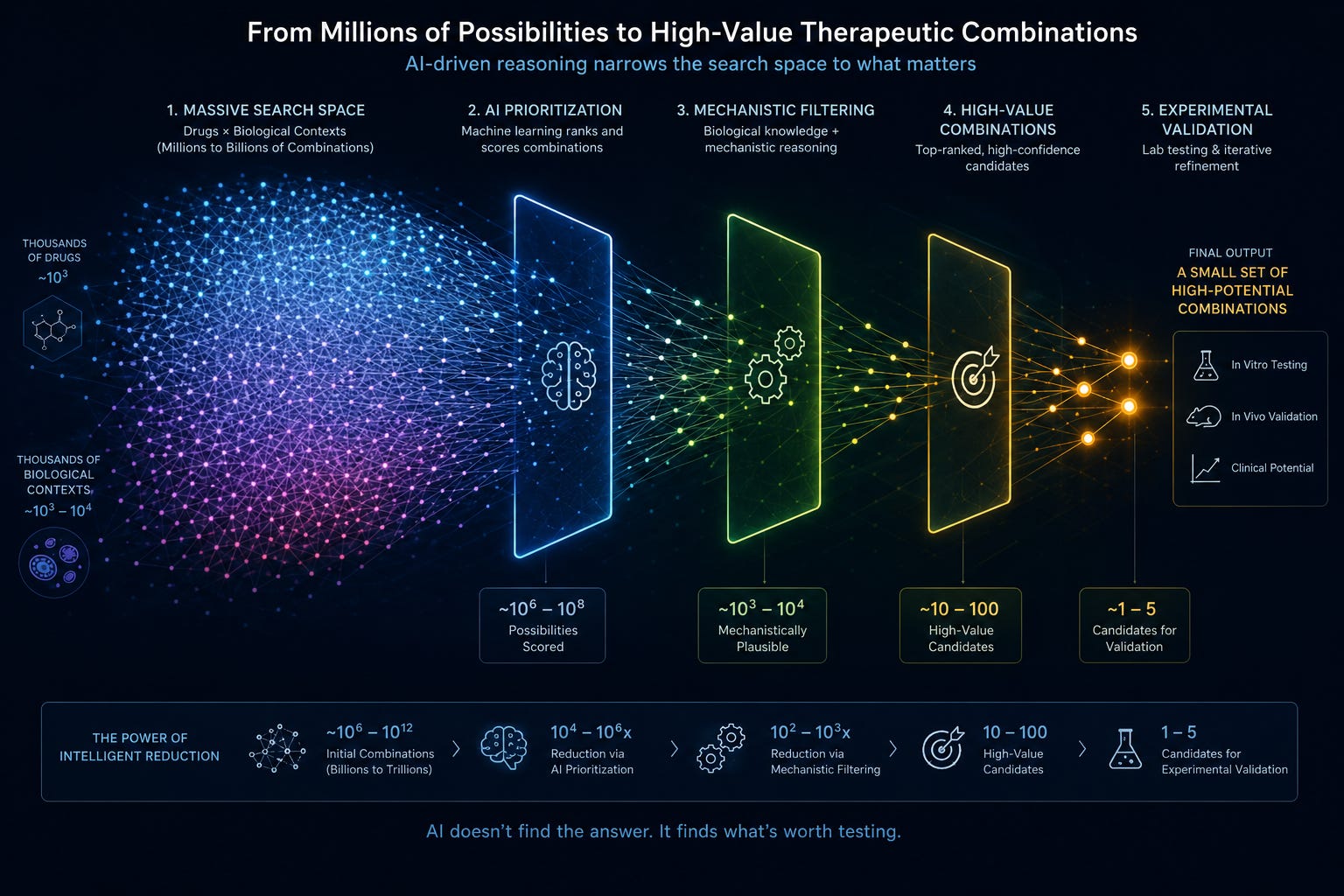
The number of possible combinations grows extraordinarily quickly. Even a library of 1,000 drugs contains nearly half a million unique two-drug pairs before considering dose. Once concentration ratios, different disease models, genomic contexts and higher-order combinations are included, exhaustive experimental testing becomes unrealistic.
This is precisely the kind of search problem in which AI can create enormous value. Machine learning models can learn from previously measured combination experiments and prioritize pairs that appear most promising. Graph neural networks can capture structural and biological relationships between compounds. Knowledge graphs can connect drugs to targets, pathways, diseases, adverse events and known mechanisms. Multi-omics data can help identify the biological contexts in which specific combinations are more likely to work.
The goal is not necessarily to replace combination screening. It is to reduce an almost infinite experimental search space into a manageable set of high-value hypotheses.
Why AI Synergy Models Still Struggle
Despite impressive progress, current models face several fundamental limitations. The first is data sparsity. Compared with single-agent datasets, experimentally validated drug combination datasets remain relatively limited. Large resources such as NCI-ALMANAC, O’Neil-derived datasets, DrugComb and related collections are extremely valuable, but they still cover only a tiny fraction of all possible drug, dose and biological-context combinations.
The second challenge is dataset bias. Oncology dominates many available synergy datasets and a relatively small group of drugs and cell lines may be disproportionately represented. The third is generalization. Predicting an unseen combination composed of two familiar drugs is easier than predicting how entirely new compounds will interact in an unseen biological system.
The fourth is the definition problem discussed earlier. If the training labels themselves change depending on whether Bliss, Loewe, HSA or ZIP is used, model performance becomes inseparable from the assumptions underlying those metrics. An AI model can only be as meaningful as the biological question encoded in its training objective.
Mechanism Matters More Than Correlation
A purely statistical model may identify that two molecular signatures frequently correlate with synergy. That can be useful. But drug discovery becomes considerably more powerful when researchers understand why the interaction occurs.
Does Drug A suppress a signaling pathway that normally compensates for Drug B? Does one therapy induce a dependency that the second exploits? Does the first drug alter protein conformation or expression in a way that increases sensitivity to the second? Does the combination simultaneously disrupt parallel survival pathways?
Mechanistic understanding improves more than scientific confidence. It can reveal biomarkers for patient selection, suggest optimal treatment sequencing, indicate resistance mechanisms and identify additional combinations.
This is where biomedical knowledge graphs, pathway analysis, network biology and mechanistically grounded AI become particularly valuable.
The Role of Timing and Sequence
There is another complication that simple synergy matrices often overlook: Drug A followed by Drug B may not be biologically equivalent to Drug B followed by Drug A. The first treatment may alter the cellular state and change how the second drug behaves.
For example, one compound might arrest cells in a specific phase of the cell cycle. If a second drug requires actively dividing cells, administering both simultaneously could reduce its effectiveness rather than enhance it. Conversely, one treatment might induce a vulnerability that makes cells dramatically more sensitive to a subsequent intervention.
Combination therapy is therefore not only about which drugs and what doses. It may also be about when. The true search space includes drug identity, dose, biological context, exposure duration and treatment sequence.
This helps explain why combination therapy prediction remains so difficult despite decades of pharmacological research.
Medvolt’s Approach: From Combination Scoring to Combination Reasoning
At Medvolt, we see combination therapy as a systems-level drug discovery problem rather than simply a mathematical synergy prediction task. The starting point is biological context.
Through knowledge-driven analysis, biomedical knowledge graphs, disease pathways, molecular interactions, literature evidence and multi-omics information can be integrated to understand how therapeutic mechanisms intersect within a disease network.
This allows potential combinations to be evaluated mechanistically. Instead of asking only whether two molecules have historically produced a high synergy score, the more valuable question is whether their targets and pathways create a biologically plausible combination strategy.
For small-molecule discovery, these insights can then connect with MedGraph™ workflows spanning AI-guided molecular analysis, structure-based modeling, docking, molecular dynamics and free energy calculations. Such approaches can help assess the molecular behavior and selectivity of individual components before they are advanced into experimentally expensive combination studies.
Importantly, multi-parameter reasoning is essential. Potency alone is not enough and neither is synergy alone. A useful combination must balance efficacy, mechanistic complementarity, selectivity, developability, potential resistance mechanisms and eventually safety and pharmacological feasibility.
As experimental results become available, they can further refine the computational hypothesis, creating a more iterative relationship between prediction and validation. The objective is not to generate an enormous list of supposedly synergistic pairs. It is to identify fewer, better-supported combination hypotheses that are worth testing.
The Future Is Personalized Combination Therapy
The next frontier may be to move beyond asking which combination is best for a disease and instead ask which combination is best for a particular biological state. Two patients with the same clinical diagnosis can have very different pathway dependencies.
One may benefit from inhibition of pathways A and B. Another may require A and C. A third may already carry a resistance mechanism that makes all three strategies ineffective.
As genomic, transcriptomic, proteomic and functional data become increasingly integrated with AI, combination therapy may become progressively more personalized. But this will require models that do more than memorize known synergy patterns. They must reason across disease biology, molecular mechanisms, dose-response relationships, treatment history and therapeutic constraints.
That is a far more ambitious problem. It is also one of the areas where computational drug discovery could create its greatest clinical impact.
Conclusion
Combination therapy is powerful because biology is complex. It is difficult for exactly the same reason. Two drugs that appear complementary mechanistically may not be synergistic at clinically achievable concentrations. A combination that is synergistic in one cell line may fail in another. Different mathematical models can disagree on whether synergy exists at all. And even strong experimental synergy may provide little therapeutic value if overall efficacy is weak or toxicity becomes unacceptable.
This is why the future of combination discovery cannot revolve around predicting a single synergy score. It must combine biological reasoning, dose-response modeling, molecular context, multi-omics information, mechanistic understanding, pharmacology and AI.
At Medvolt, this systems-level philosophy is central to how we approach complex drug discovery questions through MedGraph™. AI can help narrow enormous search spaces, knowledge graphs can reveal mechanistic relationships and structure- and physics-based approaches can deepen molecular understanding. But the ultimate objective remains the same: improve the quality of the scientific decisions that determine what should be tested next.
Because the hardest question in combination therapy is not “Do these two drugs work better together?” It is: “For which biology, at which doses, in what sequence and with enough therapeutic advantage to matter?”

