


The Future of Drug Discovery: Hybrid Intelligence
Discover how hybrid intelligence combines human expertise, AI-driven molecular design, and physics-based simulations to transform drug discovery decisions.
Drug discovery has always been a problem of incomplete information. Scientists rarely know the full biological mechanism of a disease when a program begins. Experimental data is noisy. Chemical space is effectively infinite. Proteins move. Biological systems adapt. Promising compounds fail for reasons that only become visible much later.
For decades, pharmaceutical R&D has tried to manage this uncertainty through better experiments, stronger computational methods and increasingly sophisticated models. Artificial intelligence has now added an entirely new layer of capability.
AI can extract patterns from complex biological datasets, generate molecules, predict structures and properties, search literature, prioritize targets and explore possibilities at a scale that human researchers could never manage manually.
But AI alone does not solve drug discovery. Neither does physics. And neither do humans. The future is likely to emerge from the combination of all three.
Human scientific judgment provides context. AI provides scale and pattern recognition. Physics provides mechanistic grounding.
Together, they create what can be thought of as hybrid intelligence, a discovery system in which each form of intelligence compensates for the limitations of the others. This may become one of the most important shifts in how medicines are discovered.
Why Drug Discovery Cannot Be Fully Automated
The idea of autonomous drug discovery is compelling. Feed biological data into an AI system, identify the target, generate compounds, predict their properties, select the best candidates and move directly toward experimental validation. Parts of this workflow are already possible.
But drug discovery is not simply a sequence of prediction tasks. It involves decisions under uncertainty.
A target may appear statistically associated with disease but lack a causal role. A molecule may demonstrate excellent predicted affinity yet suffer from poor selectivity. An experimentally active compound may work through an unexpected mechanism. A seemingly negative assay result may reflect experimental artifacts rather than biological failure.
These situations require interpretation. They require scientists to ask whether the evidence makes biological sense, whether the experiment tested the right hypothesis and whether a computational prediction deserves to influence the next decision.
AI can help answer many of these questions. But deciding which questions are worth asking remains fundamentally important. That is where human intelligence retains enormous value.
What Humans Bring That Algorithms Do Not
Scientists carry something that is difficult to encode completely into models: contextual judgment.
A medicinal chemist may recognize that a theoretically attractive molecular modification creates an impractical synthetic route. A structural biologist may notice that a predicted binding mode ignores a flexible loop known to influence activity. A disease biologist may recognize that an attractive target is unlikely to matter in the patient population being considered. An experienced drug developer may understand that a biomarker is scientifically interesting but operationally unrealistic for a clinical trial.
These decisions often rely on years of accumulated experience combined with incomplete evidence. They are not always formalizable.
Human researchers also generate hypotheses through analogy, intuition, skepticism and creative reasoning. Many major scientific discoveries did not emerge because someone optimized an existing numerical objective. They emerged because someone questioned the assumptions defining the problem.
This does not mean human judgment is always correct. Humans carry biases, overlook evidence and cannot process millions of relationships simultaneously. That is precisely why AI is so valuable.
AI Expands the Search Space
Humans are excellent at reasoning deeply across a manageable number of possibilities. AI is excellent at navigating enormous numbers of them.
A researcher cannot manually examine billions of chemical structures, thousands of disease-associated genes, millions of scientific papers and countless molecular relationships. Machine learning systems can.
In target discovery, AI can integrate literature, genomics, proteomics, pathways, phenotypic observations and biomedical knowledge networks to identify relationships that may not be obvious to individual researchers.
In molecular design, generative models can explore enormous regions of chemical or protein sequence space, proposing structures that would be difficult to arrive at through conventional intuition alone. Predictive models can rapidly evaluate physicochemical properties, toxicity risks, binding hypotheses and developability features.
This fundamentally changes the scale at which scientific hypotheses can be generated. But scale creates another problem. If AI generates 100,000 potential answers, researchers still need to determine which ones are believable.
That is where the third component of hybrid intelligence becomes critical.
Physics Acts as a Reality Check
Biological molecules follow physical laws regardless of what an AI model predicts. Proteins fluctuate between conformational states. Ligands compete with water molecules for binding interactions. Electrostatic forces influence recognition. Entropy affects molecular association. Small changes in chemical structure can alter binding free energy in ways that are difficult to infer from surface-level similarity.
Physics-based computational methods attempt to model these processes directly. Molecular docking can estimate plausible binding configurations. Molecular dynamics simulations allow protein-ligand complexes to evolve over time. Free energy calculations can provide deeper thermodynamic insight into how structural changes influence binding.
These methods are not perfect. They rely on approximations, force fields, sampling and appropriate system setup. But they offer something fundamentally different from purely data-driven prediction. They ask whether a proposed molecular interaction is consistent with the physical behavior of the system.
This makes physics an important counterbalance to statistical confidence. An AI model may say a molecule looks promising. Physics helps ask whether the molecular system agrees.
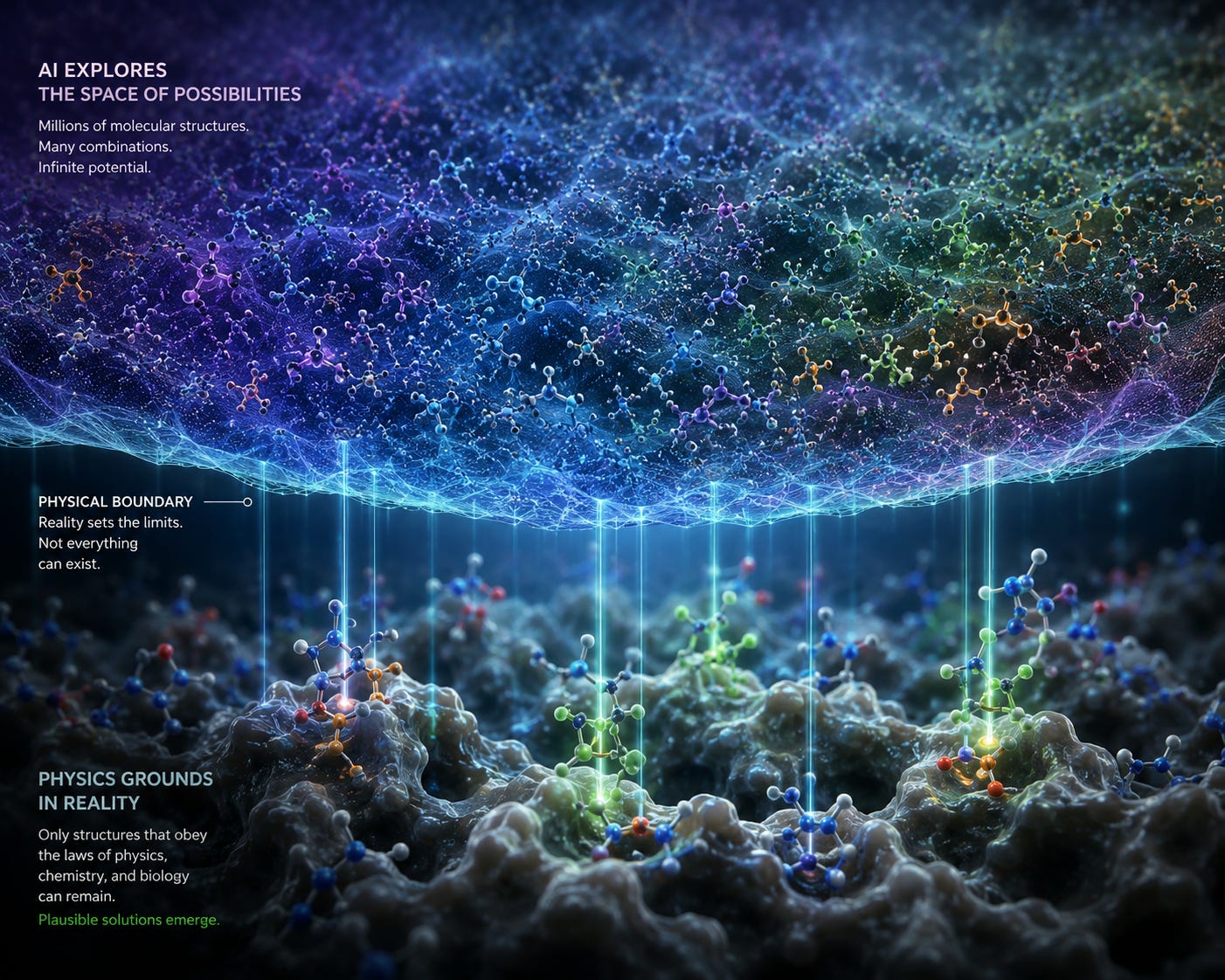
Why AI Without Physics Can Become Overconfident
Modern machine learning systems can produce predictions with extraordinary speed. That speed can create an illusion of certainty.
A predicted binding affinity, toxicity probability or molecular score may appear highly precise because it is expressed numerically. But numerical precision is not equivalent to biological truth.
Models are limited by their training distributions, input quality, representation choices and underlying assumptions. A molecule that lies outside the chemistry represented in the training dataset may behave differently than predicted. A protein conformation absent from structural training data may create unexpected interactions. Solvation, entropy, protonation states and conformational flexibility may alter real molecular behavior.
This is especially important in innovative discovery programs, where the objective is often to explore exactly the kinds of molecular systems for which abundant historical data does not exist.
AI performs best when it can learn from precedent. Drug discovery frequently asks it to venture beyond precedent. Physics becomes increasingly important as novelty increases.
Why Physics Without AI Does Not Scale
The opposite problem also exists. Highly detailed simulations are computationally expensive.
It would be inefficient to perform rigorous molecular dynamics or free energy calculations across every molecule in a library containing millions of compounds. Similarly, deeply modeling every biological pathway associated with a disease would consume enormous computational and human resources.
Physics therefore needs prioritization. AI can provide it.
Machine learning can filter enormous search spaces and identify the subset of candidates where deeper physical analysis is likely to create the greatest value. This creates a natural computational hierarchy:
- AI explores broadly.
- Physics investigates deeply.
- Humans decide what matters.
Hybrid Intelligence Changes the Drug Discovery Funnel
Traditional drug discovery is often represented as a funnel. Thousands or millions of potential compounds enter the top. A smaller number become hits. Fewer progress to leads. Eventually, perhaps one becomes a clinical candidate.
Hybrid intelligence can make this funnel more informed at every stage. At the beginning, AI can synthesize large volumes of biological evidence to support target prioritization. Human experts can evaluate whether the resulting hypotheses make biological and translational sense.
Generative and predictive models can then explore enormous chemical or protein spaces. Structure-based methods can eliminate implausible candidates. Molecular dynamics can test whether predicted interactions remain stable in dynamic environments. Free energy methods can help prioritize changes within optimized lead series.
Experimental results then feed back into the computational workflow, correcting assumptions and improving subsequent predictions. Instead of a one-way funnel, discovery begins to resemble an iterative learning system. That distinction is crucial.
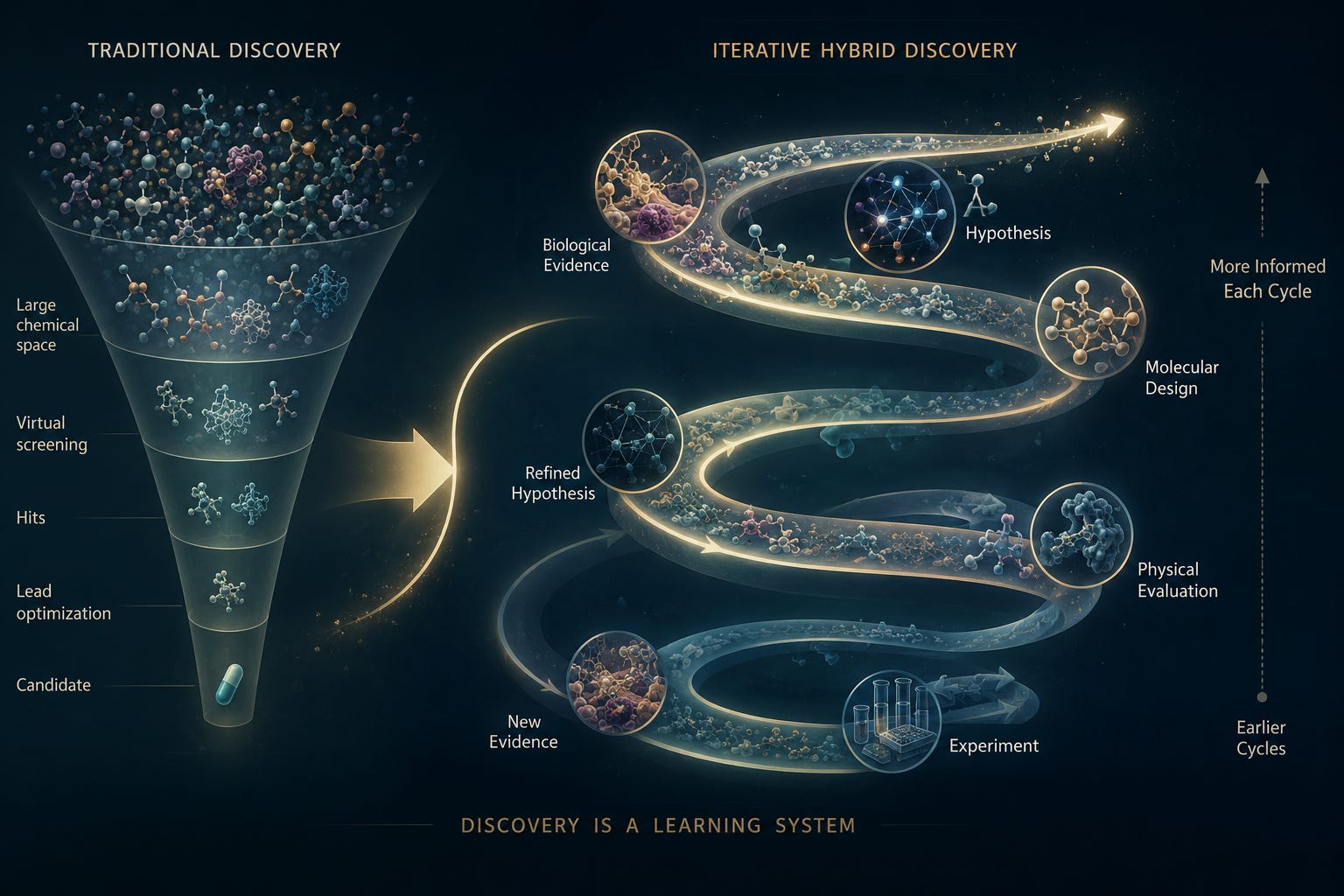
The Closed-Loop Discovery Model
One of the most powerful consequences of hybrid intelligence is the emergence of closed-loop drug discovery.
In a conventional workflow, computational teams make predictions, experimental teams test them and the results may eventually inform subsequent rounds of research. In a closed-loop system, feedback is built into the architecture:
- AI proposes hypotheses.
- Physics evaluates molecular plausibility.
- Scientists select the most informative experiments.
- Experimental results update the computational understanding.
- The next round of predictions becomes more targeted.
Each cycle reduces uncertainty.
This approach changes the role of experiments as well. Experiments are no longer used only to validate predictions. They can be designed specifically to generate information that improves the next computational decision.
This is closer to how an expert scientist learns. The system does not merely search for positive results. It learns from every result.
From Prediction Engines to Decision Engines
Much of the first generation of AI in drug discovery focused on predictions.
What is the probability that this compound is active?
What is its predicted affinity?
What molecular structure is most likely?
What target is associated with this disease?
These capabilities remain valuable, but the future will increasingly depend on decision intelligence.
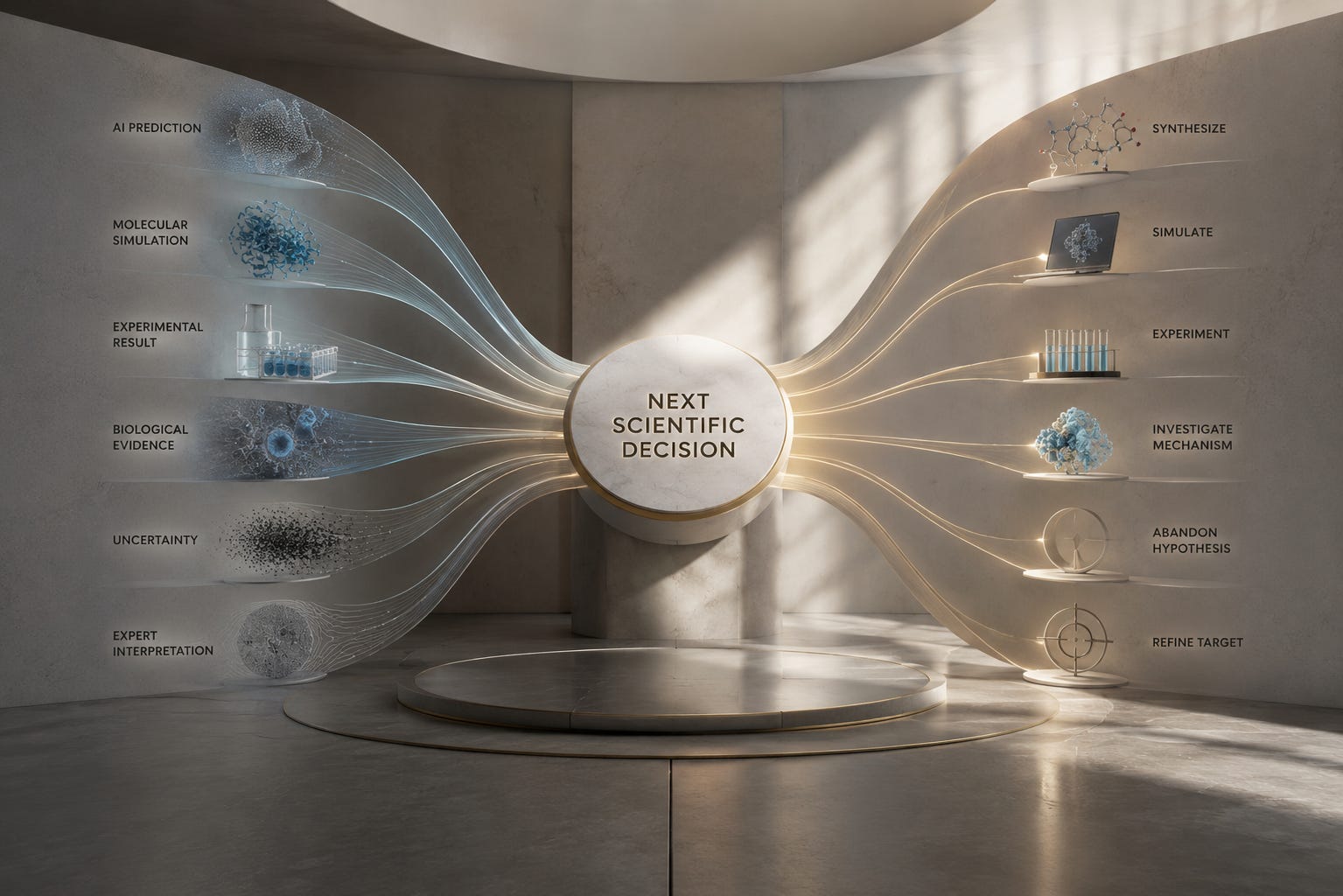
The important question is not whether a model can predict another score. It is whether the system can help researchers decide what to do next.
Should this target be pursued?
Which compound should be synthesized?
Which mutation should be tested?
Is a weak predicted binder still worth investigating because of superior selectivity?
Should another simulation be run or has uncertainty already been reduced enough to move experimentally?
This is where hybrid intelligence becomes more than the sum of its components. AI, physics, experiments and expert reasoning all contribute different evidence to the same decision.
Medvolt’s Approach to Hybrid Intelligence
This philosophy closely aligns with how we think about drug discovery at Medvolt.
MedGraph™ is designed not around a single algorithm, but around connected layers of computational reasoning. Biological knowledge provides the context. Biomedical knowledge graphs, curated scientific evidence, disease pathways and multi-omics information help establish why a target or mechanism should matter.
AI then expands the possibilities. Machine learning and generative approaches can support target prioritization, molecule generation, protein engineering and multi-parameter optimization across large search spaces.
Physics adds the next layer of scrutiny. Structure-based modeling, molecular docking, molecular dynamics simulations and free energy calculations help assess whether promising computational hypotheses remain plausible when molecular flexibility, interactions, solvent behavior and thermodynamic factors are considered.
Human researchers remain involved throughout the process, interpreting conflicting signals, refining hypotheses, selecting experiments and making program-level decisions that extend beyond what any isolated model can determine.
The longer-term opportunity is to connect these layers into increasingly closed-loop workflows, where experimental results inform subsequent computational cycles and the system improves through iterative learning.
This is particularly important for difficult discovery programs. Novel targets, flexible proteins, complex protein surfaces, engineered enzymes and multi-objective therapeutic design cannot be solved reliably by relying on a single form of intelligence. They require orchestration.
Why Human Scientists Will Become More Important, Not Less
The rise of AI is sometimes framed as reducing the need for scientists. A more likely outcome is that it changes what scientists spend their time doing.
AI can automate repetitive searches, generate initial hypotheses, summarize large evidence bases and evaluate enormous numbers of possibilities. This allows researchers to focus more attention on higher-level reasoning.
What does the evidence mean?
Which biological explanation is most plausible?
What experiment would reduce uncertainty most effectively?
What assumptions might be wrong?
Which prediction is scientifically interesting enough to pursue despite uncertainty?
The best scientists in AI-enabled discovery may therefore become less like manual data processors and more like architects of scientific reasoning. Their role shifts from evaluating every possibility individually to designing systems capable of identifying the most informative possibilities.
The Future Will Not Be AI-Driven. It Will Be Intelligence-Driven.
There is a subtle but important distinction between AI-driven drug discovery and intelligence-driven drug discovery.
AI-driven discovery places the algorithm at the center. Hybrid intelligence places the scientific problem at the center. Different tools are then applied according to what the problem requires.
Sometimes an AI prediction will provide sufficient confidence. Sometimes a molecular simulation will be necessary. Sometimes an experiment will contradict both. Sometimes an experienced scientist will recognize that the entire premise of the program needs reconsideration.
A mature discovery system must accommodate all of these possibilities. The objective is not to maximize automation. It is to maximize the quality of discovery decisions.
Conclusion
Drug discovery is too complex for any single form of intelligence. Human reasoning is powerful but limited in scale. Artificial intelligence can navigate enormous datasets and search spaces but remains dependent on data, representations and assumptions. Physics provides mechanistic grounding but can become computationally expensive and difficult to scale.
Together, they create something far more capable.
Humans define and challenge the scientific questions. AI explores the possibilities. Physics tests molecular reality. Experiments close the loop.
This is the foundation of hybrid intelligence.
At Medvolt, this principle underpins our vision for the future of computational drug discovery through MedGraph™ and our broader closed-loop Bio-AI efforts. By integrating biological knowledge, AI-driven design, physics-based simulations and expert scientific reasoning, the goal is not simply to generate more predictions. It is to make better decisions, earlier, with greater scientific confidence.
Because the future of drug discovery will not belong to humans alone, AI alone or physics alone. It will belong to systems intelligent enough to combine all three.

