The Role of Protein Flexibility in Drug Discovery: Insights and Computational Advances
Discover why protein flexibility is essential in drug discovery and how AI, molecular dynamics, and physics-based simulations improve therapeutic design.
Proteins are not static entities; they exist as dynamic molecules constantly sampling a range of conformations. This intrinsic flexibility plays a crucial role in their biological function and in how they interact with small molecules. Understanding protein flexibility is essential for drug discovery because it affects ligand binding, specificity, and efficacy.
Traditional drug discovery approaches often rely on static protein structures derived from X-ray crystallography or cryo-EM. However, these snapshots can miss important conformational states that influence binding affinity and selectivity. This raises a fundamental question: how does protein flexibility impact molecular recognition, and how can drug discovery strategies incorporate this dynamic behavior?
Recent advances in computational biology have begun to illuminate the complex interplay between protein motions and ligand binding. By integrating molecular dynamics simulations, free-energy calculations, and AI-driven modeling, researchers can now explore the conformational landscape of targets more comprehensively. This article delves into the biological basis of protein flexibility, its implications for drug discovery, and how computational methods, including those employed by Medvolt.ai, are addressing these challenges.
Why Protein Flexibility Matters in Molecular Recognition
Proteins perform their functions by adopting specific three-dimensional shapes that enable interactions with other molecules. However, these shapes are not fixed; proteins undergo conformational fluctuations on timescales ranging from picoseconds to seconds. These motions can involve subtle side-chain rearrangements or large domain movements.
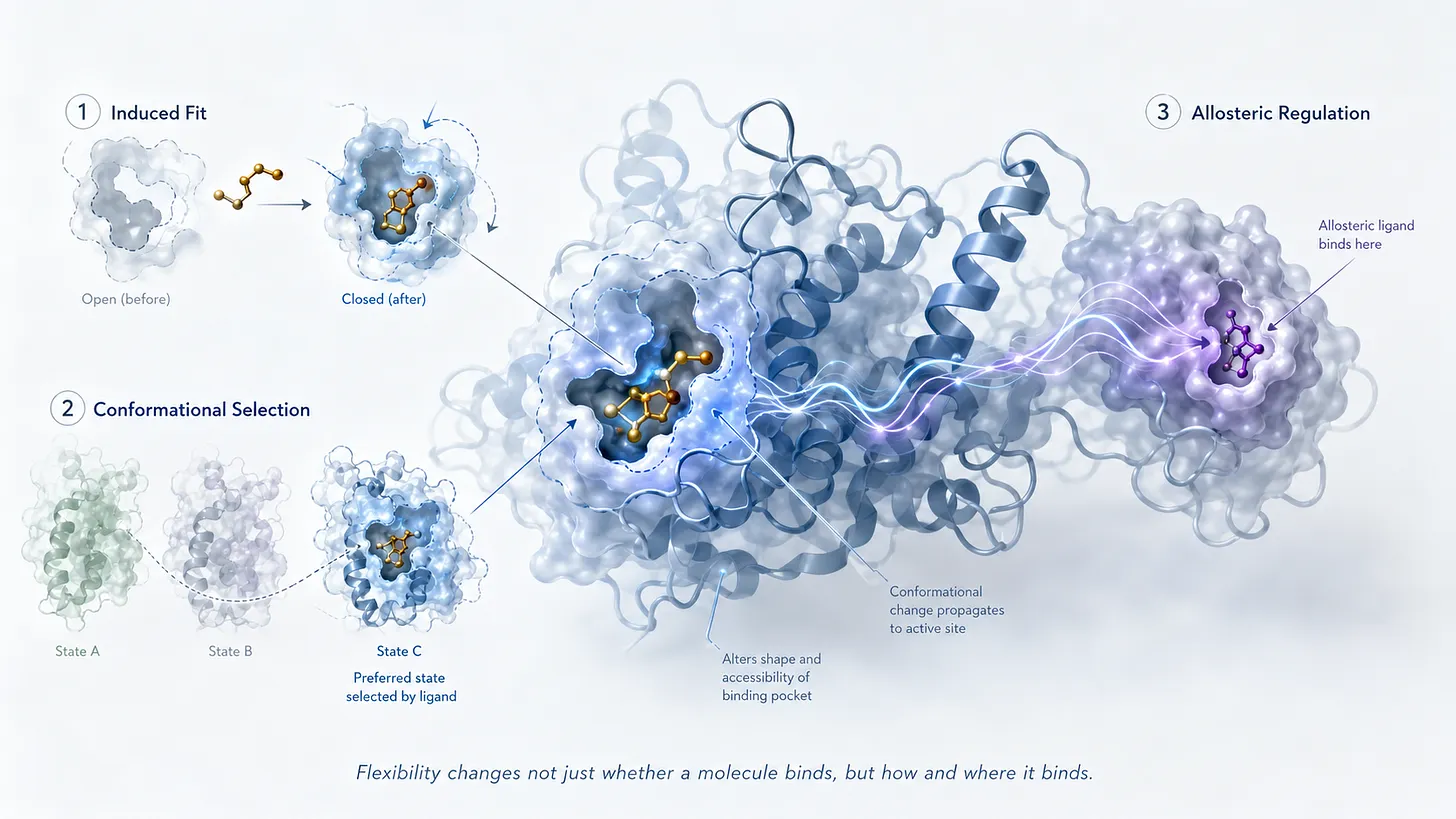
Flexibility affects drug binding in several ways:
- Induced Fit: Ligand binding can induce conformational changes in the protein, optimizing the interaction interface.
- Conformational Selection: Ligands may preferentially bind to pre-existing conformations within the protein’s dynamic ensemble.
- Allosteric Regulation: Flexibility allows communication between distant sites, enabling allosteric modulation by small molecules.
Ignoring these dynamic aspects can lead to inaccurate predictions of binding modes and affinities, resulting in failures during lead optimization.
Molecular Mechanisms Underlying Protein Dynamics
At the molecular level, protein flexibility arises from the rotation around backbone and side-chain bonds, loop motions, and domain rearrangements. These movements are influenced by:
- Energy Landscapes: Proteins sample multiple low-energy conformations separated by energy barriers.
- Solvent Interactions: Water molecules can stabilize or destabilize certain conformations, affecting binding pockets.
- Post-Translational Modifications: Chemical modifications can alter flexibility and binding properties.
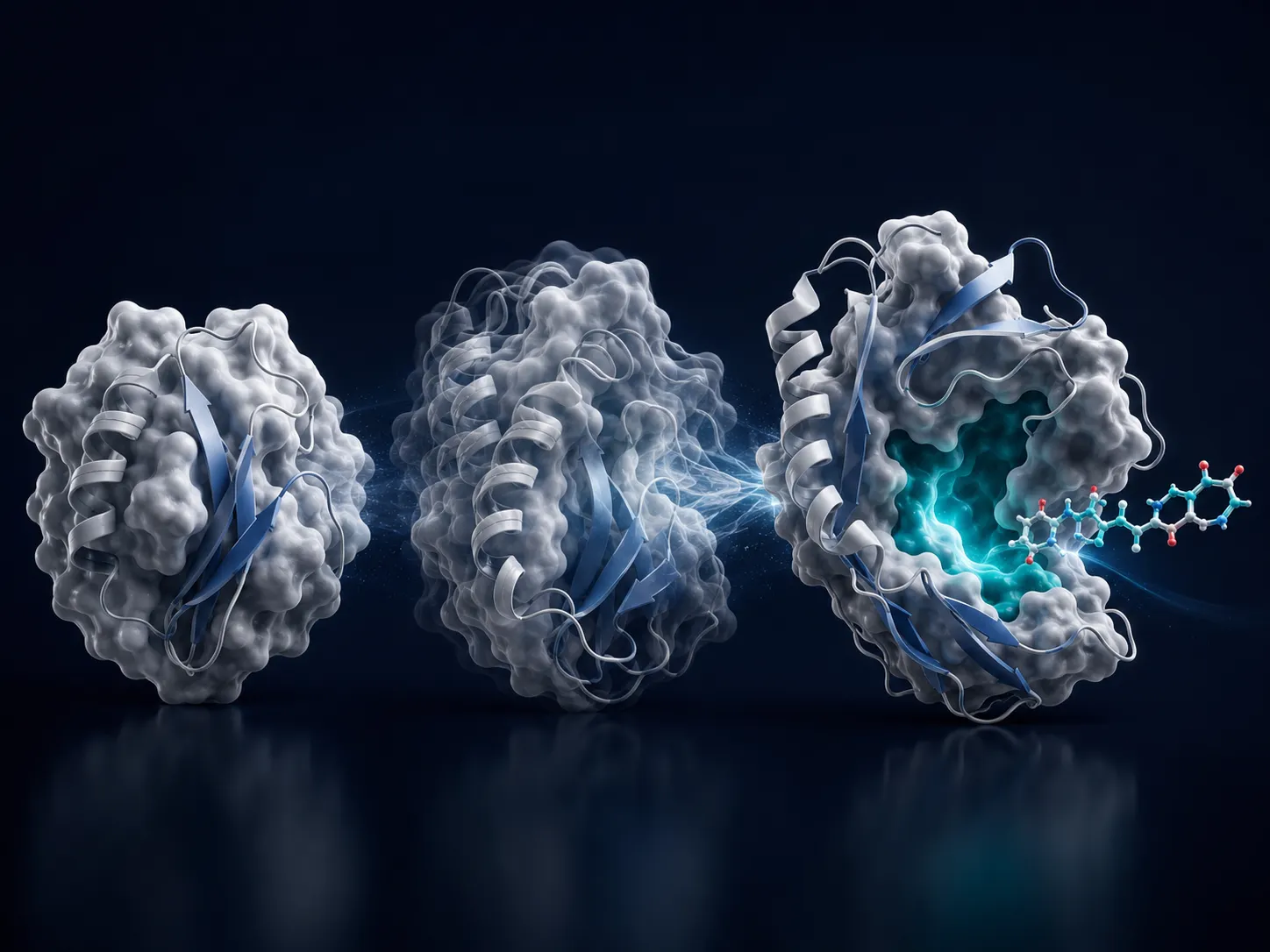
For example, a binding pocket may transiently open or close, exposing cryptic sites that are not visible in static structures. Such dynamics can be critical for designing inhibitors that target these elusive conformations.
Challenges in Targeting Flexible Proteins
Drug discovery traditionally relies on static structures for virtual screening and structure-based design. This approach can miss important binding modes or fail to predict ligand efficacy accurately when flexibility is significant.
Key challenges include:
- Capturing Relevant Conformations: Identifying which conformations are biologically relevant and druggable.
- Computational Cost: Simulating protein dynamics with sufficient accuracy and timescale is resource-intensive.
- Binding Kinetics: Flexibility influences not only affinity but also the kinetics of binding and unbinding, which affect drug efficacy.
For instance, a ligand that binds tightly to a minor conformation may exhibit slow dissociation, leading to prolonged target engagement, a desirable pharmacological property.
Computational Approaches to Protein Flexibility
Advances in computational methods have made it feasible to incorporate protein dynamics into drug discovery workflows:
- Molecular Dynamics (MD) Simulations: MD provides atomistic trajectories of protein motions over time, revealing conformational ensembles.
- Enhanced Sampling Techniques: Methods like metadynamics or accelerated MD overcome energy barriers to explore rare states.
- Free-Energy Calculations: These quantify the thermodynamic favorability of ligand binding across different conformations.
- AI and Machine Learning: AI models can predict flexible regions, generate conformational ensembles, or prioritize binding poses.
These tools enable a more nuanced understanding of how ligands interact with dynamic proteins, guiding the design of molecules that can accommodate or exploit flexibility.
Medvolt’s Integrated Computational Workflow
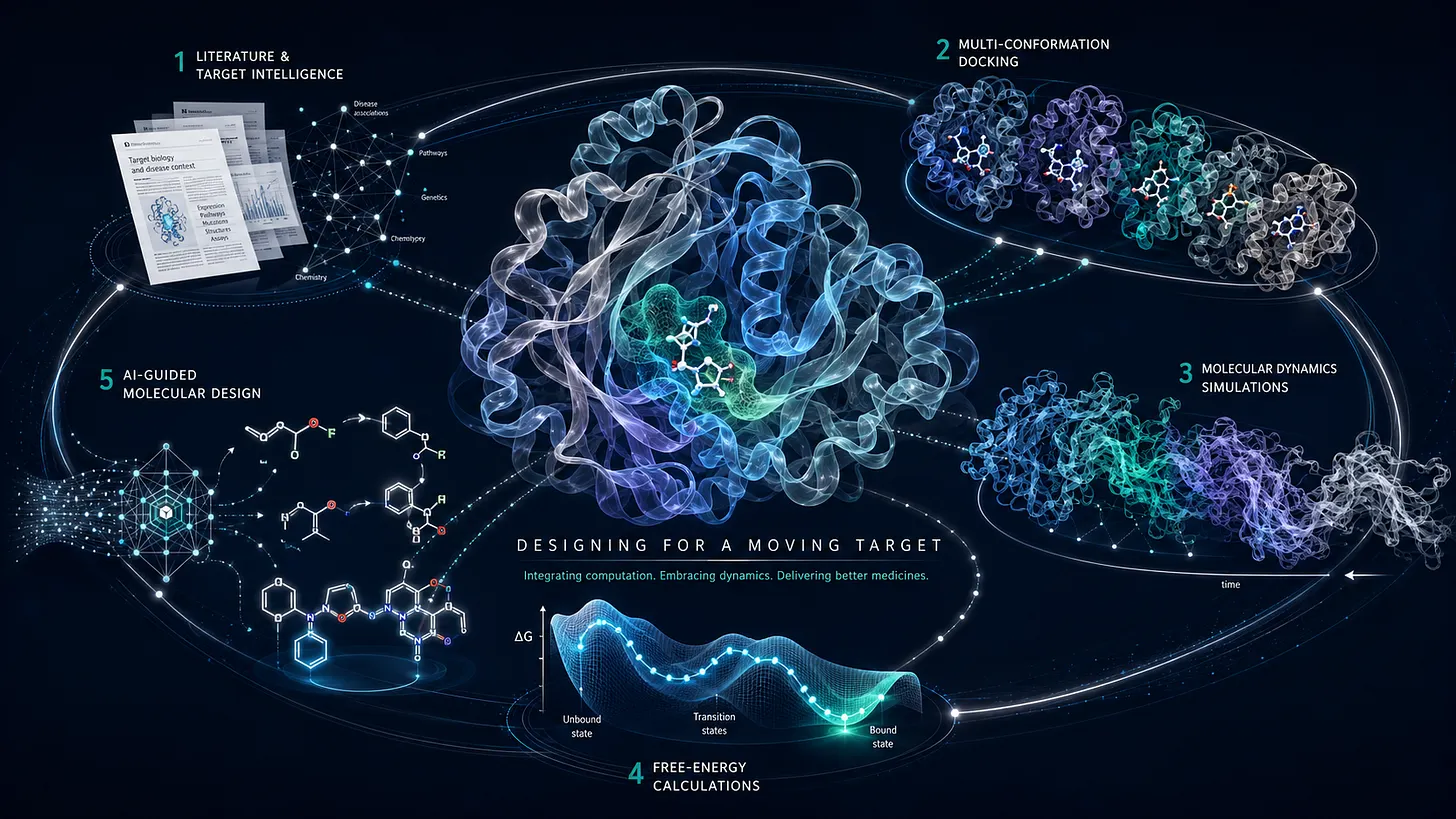
Medvolt.ai leverages a connected computational platform to address the challenges posed by protein flexibility in drug discovery. The workflow integrates:
- Biomedical Literature and Target Intelligence: To identify flexible targets and relevant biological contexts.
- Structure-Based Virtual Screening: Using docking protocols that consider multiple conformations.
- Molecular Dynamics Simulations: To sample protein conformational landscapes and validate docking poses.
- Physics-Based Free-Energy Calculations: For accurate estimation of binding affinities across conformations.
- AI-Guided Molecular Design: To generate and prioritize candidate molecules optimized for dynamic binding sites.
This integrated approach ensures that molecular design is informed by a comprehensive understanding of protein flexibility, improving the likelihood of identifying effective drug candidates.
Case Examples Illustrating the Impact of Flexibility
Cryptic Pocket Discovery
In some kinases, molecular dynamics revealed transient pockets not visible in crystal structures. Targeting these pockets allowed the design of selective inhibitors with novel mechanisms.
Resistance Mutation Effects
Simulations showed that certain mutations alter protein dynamics, disrupting drug binding despite unchanged static structures. Understanding these changes guided the design of molecules resilient to resistance.
These examples underscore the importance of considering flexibility for both target validation and lead optimization.
Future Directions and Implications for Drug Discovery
As computational power grows and algorithms improve, incorporating protein flexibility will become standard practice rather than an exception. This shift will enable:
- More accurate prediction of binding modes and affinities, reducing late-stage failures.
- Design of allosteric modulators that exploit dynamic communication pathways.
- Personalized medicine approaches that account for patient-specific protein variants and conformational behaviors.
Medvolt’s capabilities position it to contribute meaningfully to this evolving landscape by providing integrated, physics-aware computational solutions that bridge biology and chemistry.
Conclusion
Protein flexibility is a fundamental aspect of molecular recognition that profoundly influences drug discovery outcomes. Static structural models provide an incomplete picture, often overlooking transient conformations critical for ligand binding and specificity. Computational methods such as molecular dynamics and free-energy calculations offer a window into these dynamic processes, enabling more informed drug design.
Medvolt.ai’s integrated computational workflow exemplifies how combining biomedical intelligence, AI-driven design, and physics-based validation can address the challenges posed by protein flexibility. This approach not only enhances target understanding but also guides the discovery of molecules tailored to dynamic binding sites.
Recognizing and harnessing protein flexibility transforms drug discovery from a static snapshot to a dynamic exploration, opening new avenues for therapeutic innovation.