The Solvation Shell Mystery: Why Water Molecules Matter in Drug Discovery
Water molecules shape binding affinity, stability, and molecular recognition, making solvent dynamics essential to modern drug discovery.
The Hidden Role of Water in Molecular Recognition and Why Modern Drug Discovery Can No Longer Ignore It
When scientists think about drug discovery, most attention naturally focuses on the interaction between a drug molecule and its target protein. Questions about binding affinity, molecular interactions, and target specificity dominate the conversation. Yet one of the most influential participants in the entire process is often overlooked: water.
At first glance, water appears to be nothing more than the environment in which biological molecules exist. In reality, water is an active participant in molecular recognition. Every protein surface, binding pocket, and ligand exists within a highly organized network of water molecules that continuously form, break, and reorganize interactions. Before a drug reaches its target, it must navigate this dynamic aqueous environment. Even after binding occurs, water continues to influence stability, affinity, specificity, and ultimately therapeutic success. In many cases, understanding water behavior is just as important as understanding the drug itself.
Proteins Do Not Exist in Isolation
Proteins inside the human body are never isolated from their surroundings. They exist in aqueous environments where thousands of water molecules continuously interact with their surfaces, forming hydrogen-bonding networks that stabilize structures, influence flexibility, and participate directly in biochemical processes.
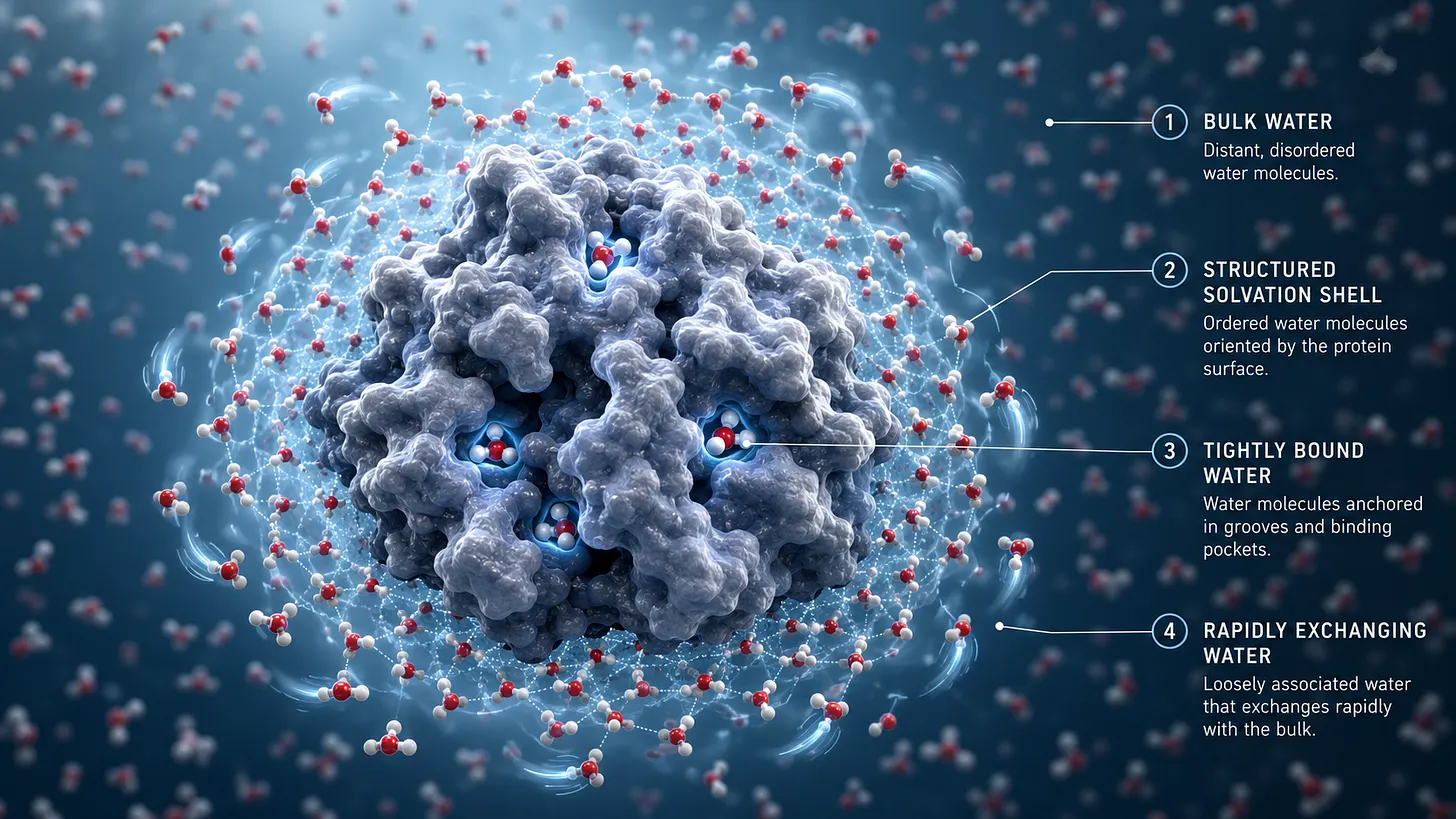
Around every protein lies a structured layer of water known as the solvation shell. Unlike bulk water, molecules within this shell are highly organized and interact closely with amino acid residues. As a result, when a drug approaches a protein, it is not interacting with the protein alone—it is interacting with both the protein and its surrounding water network.
What Is the Solvation Shell?
The solvation shell refers to the layer of solvent molecules, primarily water in biological systems, that surrounds proteins, ligands, and other biomolecules. These water molecules are not randomly distributed. Some remain tightly bound to specific protein regions, while others exchange rapidly with the surrounding solvent, creating a dynamic interface between the biomolecule and its environment.
The properties of this shell influence nearly every aspect of molecular recognition. Water molecules can stabilize protein conformations, mediate ligand binding, shield electrostatic interactions, and facilitate structural rearrangements required for biological function. In many binding sites, water molecules effectively become part of the receptor itself.
Binding Is a Competition for Space
Drug molecules rarely bind to empty protein pockets. Before a ligand arrives, binding sites are typically occupied by water molecules that interact with the surrounding amino acids and maintain local stability.
When a ligand enters the pocket, multiple events occur simultaneously:
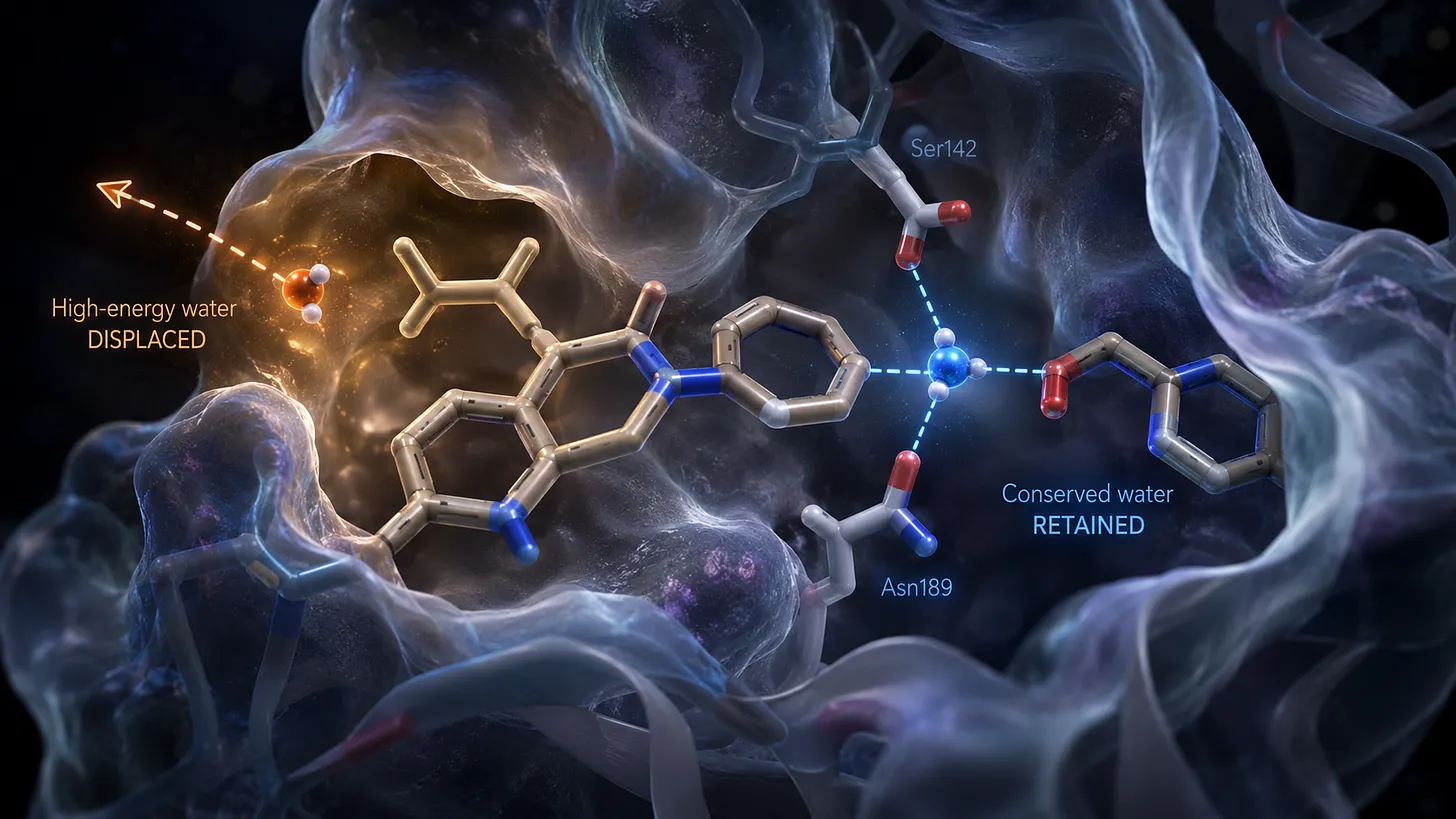
- Some water molecules are displaced into the surrounding solvent.
- Others remain trapped between the protein and ligand.
- Some reorganize into entirely new hydrogen-bonding networks.
These changes are not merely structural—they directly contribute to the thermodynamics of binding. Whether water molecules are displaced or retained can significantly influence binding affinity and overall molecular stability.
When Removing Water Improves Binding
Not all water molecules contribute positively to binding. Some occupy energetically unfavorable positions within binding pockets and are unable to form optimal hydrogen-bonding networks. As a result, these molecules exist in relatively high-energy states.
When a ligand displaces such unfavorable water molecules, the system often becomes more stable. The released water molecules return to the bulk solvent, where they regain greater freedom of movement and more favorable interactions. This increase in entropy can contribute significantly to binding free energy. Consequently, identifying and replacing high-energy water molecules has become an important medicinal chemistry strategy for improving drug potency.
Sometimes Water Should Stay
The opposite scenario can also occur. Some water molecules are positioned so favorably that removing them actually weakens binding interactions. These conserved water molecules often act as molecular bridges, simultaneously forming hydrogen bonds with both the ligand and the protein.
In such cases, water behaves almost like an additional structural component of the binding site. Removing it can disrupt a highly favorable interaction network and reduce overall binding strength. This highlights a critical principle in drug discovery: water molecules should not automatically be removed—they should be understood.
Why Traditional Docking Often Misses the Full Picture
Conventional molecular docking is one of the most widely used tools in structure-based drug discovery because it rapidly predicts binding poses and enables large-scale virtual screening. However, many docking approaches simplify or entirely neglect solvent behavior.
Water molecules are often removed before docking begins, treated implicitly through approximate scoring functions, or represented using simplified models that fail to capture their dynamic nature. As a result, docking may overestimate favorable interactions in static structures while overlooking the energetic consequences of solvent rearrangement. This limitation helps explain why compounds with excellent docking scores sometimes fail during experimental validation.
Why Molecular Dynamics Changes the Perspective
Molecular dynamics (MD) simulations provide a far more detailed understanding of solvent behavior by explicitly modeling water molecules alongside proteins and ligands. Unlike static structural methods, MD captures the continuous movement and evolution of solvent networks throughout the binding process.
These simulations can reveal:
- How water molecules enter and leave binding pockets
- Which water molecules remain highly conserved
- How hydrogen-bonding networks reorganize over time
- How solvent affects protein flexibility and ligand stability
Rather than treating water as background, MD simulations capture it as an active participant in molecular recognition, often explaining experimental observations that static docking methods cannot.
Thermodynamics: The Invisible Driver
The influence of water ultimately stems from thermodynamics. Binding free energy is determined by a balance between enthalpic interactions and entropic contributions, and water affects both components.
Displacing unfavorable water molecules can increase entropy and improve binding, while retaining beneficial water-mediated interactions can strengthen enthalpic contributions. As a result, the most effective ligand is not necessarily the one that forms the strongest direct contacts with the protein. Instead, it is the molecule that optimizes the entire energetic landscape, including solvent interactions. This explains why seemingly minor chemical modifications can sometimes produce dramatic improvements in potency.
AI Is Powerful, but Water Still Follows Physics
Artificial intelligence has significantly expanded our ability to design molecules, predict molecular properties, and explore chemical space. However, solvent behavior remains governed by physical principles that cannot always be captured through statistical patterns alone.
Machine learning models can identify promising compounds, but understanding how water molecules reorganize during binding often requires explicit physical simulation. This is why physics-based methods remain indispensable in modern drug discovery. The future is not a choice between AI and physics—it is the integration of both.
Medvolt’s Approach: Integrating Solvent Dynamics into Drug Discovery
At Medvolt, molecular recognition is treated as a dynamic process rather than a static structural problem. Successful drug design requires understanding not only proteins and ligands, but also the solvent environment that governs molecular interactions.
Our discovery workflows combine knowledge-driven target analysis, AI-assisted molecular design, molecular docking, molecular dynamics simulations, and physics-based free energy calculations. By explicitly modeling protein flexibility, ligand dynamics, and solvent behavior, we can evaluate water-mediated interactions and solvation effects under biologically realistic conditions.
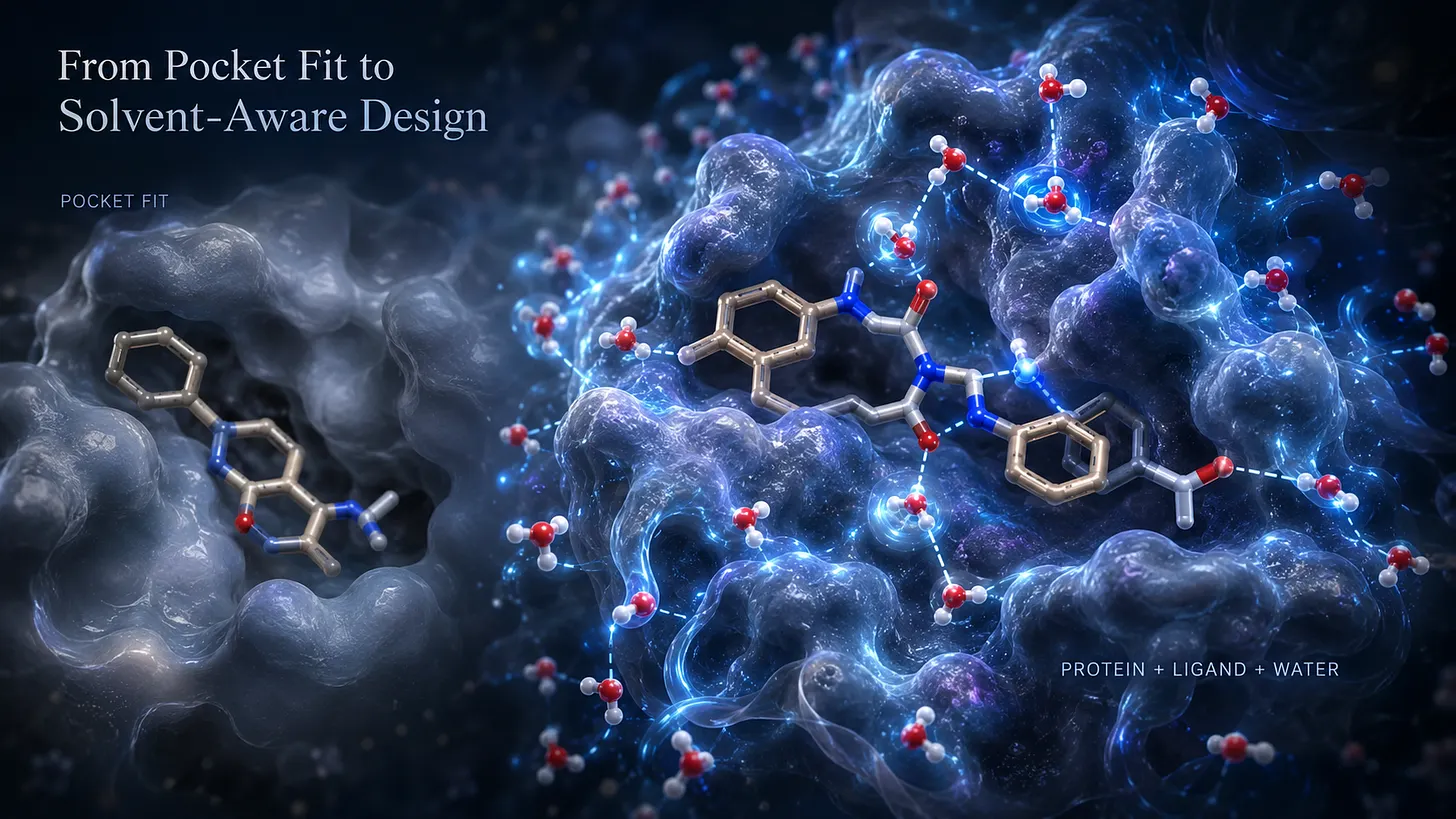
Rather than relying solely on docking scores, we analyze how interaction networks evolve over time, how conserved water molecules contribute to stability, and whether molecular modifications improve or disrupt the underlying thermodynamic landscape. This integrated approach helps distinguish molecules that simply fit a binding pocket from those capable of maintaining stable and energetically favorable interactions within living systems.
The Future of Structure-Based Drug Discovery
As computational methods continue to advance, the importance of solvent modeling is becoming increasingly apparent. Drug discovery is evolving beyond viewing proteins as static structures and toward understanding them as dynamic molecular systems immersed in continuously changing solvent environments.
Future developments in molecular simulation, enhanced sampling techniques, AI-assisted solvent analysis, and free energy calculations will provide even deeper insights into how water shapes molecular recognition. Rather than treating solvent as a complication, researchers are increasingly recognizing it as a valuable source of information that can guide therapeutic design.
Conclusion
Water is often described as the universal solvent, but in drug discovery it plays a far more active role. It influences molecular recognition, binding affinity, conformational stability, thermodynamics, and ultimately therapeutic success.
Understanding the solvation shell and the dynamic behavior of water molecules has become essential for modern structure-based drug discovery. Static structural models alone are no longer sufficient. The future lies in integrating AI-driven molecular design with physics-based simulations that capture the true complexity of biological systems.
At Medvolt, this philosophy guides our computational workflows. By combining biological intelligence, AI-assisted design, molecular dynamics simulations, and free energy calculations, we aim to model molecular interactions as they occur in reality—where proteins, ligands, and water function together as an interconnected system. Because sometimes the most important molecule in a drug discovery program is not the drug itself, but the water surrounding it.