


Uncovering Transient Protein-Ligand Binding States via Extended Molecular Dynamics: Implications for Drug Candidate Prioritization
Explore how extended molecular dynamics reveals transient protein-ligand binding states, offering insights into binding kinetics and drug candidate prioritization.
Understanding Transient Protein-Ligand Binding States and Their Role in Drug Discovery
Protein-ligand interactions are inherently dynamic processes, characterized not only by stable bound complexes but also by a spectrum of transient binding states and kinetic intermediates. These fleeting conformations occur along the pathways of ligand association and dissociation, often lasting from nanoseconds to microseconds or longer. Unlike the well-defined, low-energy binding poses typically captured by crystallography or short molecular dynamics (MD) simulations, transient states represent metastable intermediates that can modulate the kinetics and selectivity of molecular recognition.
Traditional drug discovery approaches frequently rely on static structural snapshots or brief MD trajectories to infer binding affinity and pose stability. However, these methods often fail to capture the full conformational landscape, missing transient states that influence how quickly a ligand binds or unbinds and how it interacts with the dynamic protein environment. Such kinetic parameters association (k_on) and dissociation (k_off) rates are crucial determinants of drug efficacy, selectivity and residence time in vivo.
Recognizing and characterizing transient binding states is therefore essential for a mechanistic understanding of molecular recognition and for improving drug candidate prioritization. These states can reveal alternative binding pathways, intermediate conformations that affect ligand optimization and solvent-mediated interactions that modulate binding kinetics.
Principles and Advances in Extended Molecular Dynamics Simulations
Molecular dynamics simulations provide an atomistic view of biomolecular motions by numerically integrating Newton’s equations of motion over time. Conventional MD simulations typically span nanoseconds to microseconds, sufficient to observe local fluctuations but often inadequate to sample rare or slow events such as transient binding states or kinetic intermediates.
Extended MD simulations, which can reach microsecond to millisecond timescales, enable exploration of a broader conformational landscape. By prolonging the simulation duration, these methods capture transitions between binding poses, intermediate states along association and dissociation pathways and solvent rearrangements that influence ligand dynamics.
For example, extended MD can reveal transient ligand orientations that are not the global energy minimum but serve as stepping stones during binding or unbinding. These intermediate conformations may involve partial engagement with the binding site, alternative hydrogen-bond networks or transient pocket expansions induced by protein flexibility.
Such detailed sampling is often unattainable with short simulations or static structures, underscoring the necessity of extended MD to uncover the full spectrum of binding events relevant to drug discovery.
Mechanistic Insights from Extended Simulations into Protein-Ligand Binding Kinetics
Extended MD simulations elucidate the molecular mechanisms governing binding kinetics by identifying intermediate conformations and mapping binding/unbinding pathways. These pathways often involve multiple metastable states connected by transitions that determine the rates of association and dissociation.
Protein flexibility plays a pivotal role in shaping these transient states. Conformational changes in side chains, loop regions or even larger domain motions can create or occlude binding pockets transiently, influencing ligand access and retention. Solvent dynamics further modulate these processes by mediating hydrogen bonds, stabilizing intermediates or facilitating ligand desolvation.
For instance, a ligand may initially form a loose encounter complex stabilized by solvent bridges before rearranging into a tighter binding pose. Extended MD can capture such solvent-mediated intermediates and quantify their lifetimes and transition probabilities.
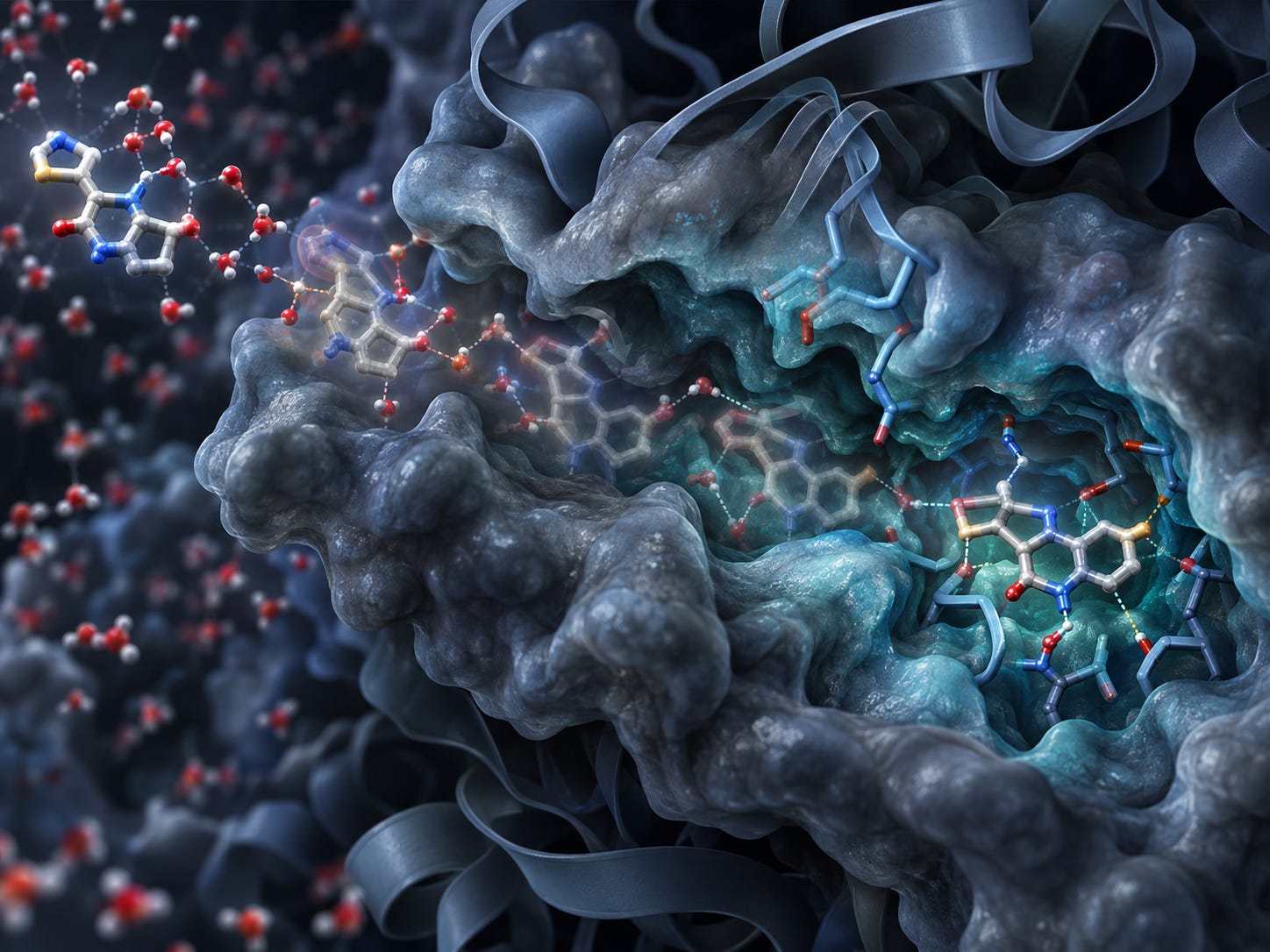
These mechanistic insights translate into kinetic parameters: the presence and stability of intermediate states can slow or accelerate binding and unbinding, affecting residence time a key factor in drug efficacy. Understanding these pathways allows medicinal chemists to rationalize why two ligands with similar static affinities may differ markedly in kinetic behavior.
Impact of Transient Binding States on Drug Candidate Evaluation and Prioritization
Traditional drug candidate evaluation often emphasizes equilibrium binding affinity (e.g., K_d or IC_50) as the primary metric. However, affinity alone does not fully predict in vivo performance, as it neglects kinetic aspects such as how long a drug remains bound to its target (residence time) or the heterogeneity of binding pathways.
Transient binding states uncovered by extended MD provide critical information beyond affinity. Kinetic parameters derived from these states can inform on drug selectivity, off-target effects and dosing frequency. For example, a ligand with a longer residence time may exhibit prolonged target engagement despite moderate affinity, potentially improving therapeutic outcomes.
Case studies illustrate that incorporating transient state analysis can reorder candidate prioritization. Ligands previously deprioritized based on static affinity may emerge as promising leads when their favorable kinetic profiles are considered. Conversely, candidates with high affinity but rapid dissociation may be deprioritized.
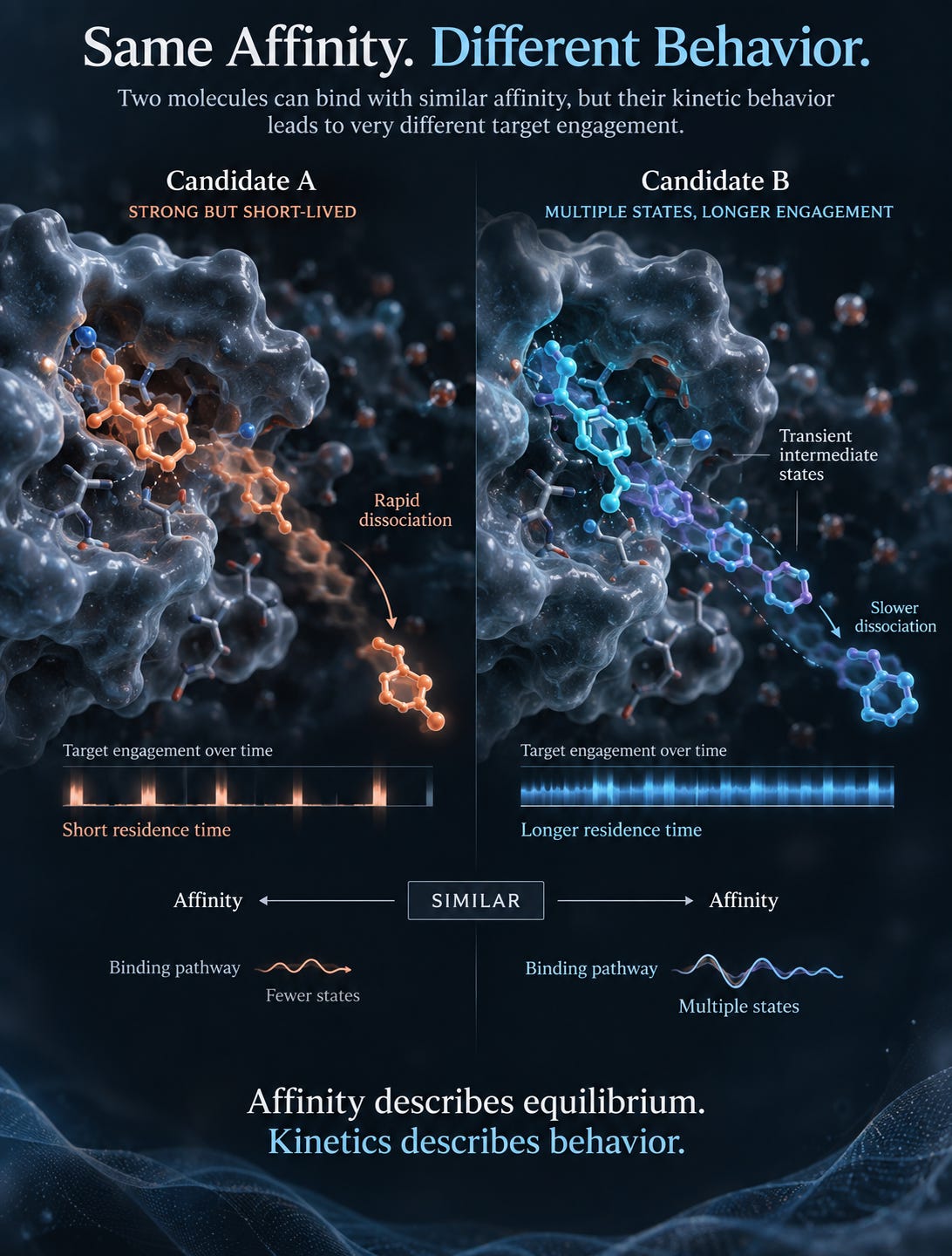
Thus, integrating transient binding state characterization into evaluation workflows enriches the decision-making process, guiding lead optimization toward compounds with optimal kinetic and thermodynamic profiles.
Computational and Experimental Challenges in Characterizing Transient States
Despite their importance, transient binding states pose significant challenges for computational modeling and experimental validation. Extended MD simulations demand substantial computational resources and time, limiting their routine application in early discovery stages.
Force field inaccuracies and solvent model limitations can introduce errors in predicting transient conformations and energetics. Capturing rare events requires enhanced sampling techniques or multiple replicates to ensure statistical robustness.
Experimentally, transient states are difficult to detect directly due to their short lifetimes and low populations. Techniques such as NMR relaxation dispersion, time-resolved crystallography or single-molecule spectroscopy can provide indirect evidence but often lack the resolution or throughput needed for systematic validation.
These challenges necessitate cautious interpretation of computational predictions and highlight the need for integrated approaches combining simulation, experiment and medicinal chemistry expertise.
Complementing Extended Molecular Dynamics with AI-Guided Molecular Design
Artificial intelligence (AI) methods offer promising avenues to enhance the efficiency and insight of extended MD simulations. AI can improve sampling by identifying relevant conformational states or transition pathways, reducing the computational burden.
Closed-loop workflows integrating AI-driven molecular design with physics-based simulations enable iterative refinement of candidate molecules. AI models can propose modifications predicted to stabilize favorable transient states or improve kinetic profiles, which are then evaluated by extended MD.
This synergy allows prioritization of kinetically relevant states and guides lead optimization beyond static affinity considerations. AI can also assist in analyzing large MD datasets, extracting patterns and features associated with desirable binding kinetics.
While AI integration is still evolving, its combination with extended MD holds potential to streamline drug discovery workflows focused on dynamic molecular recognition.
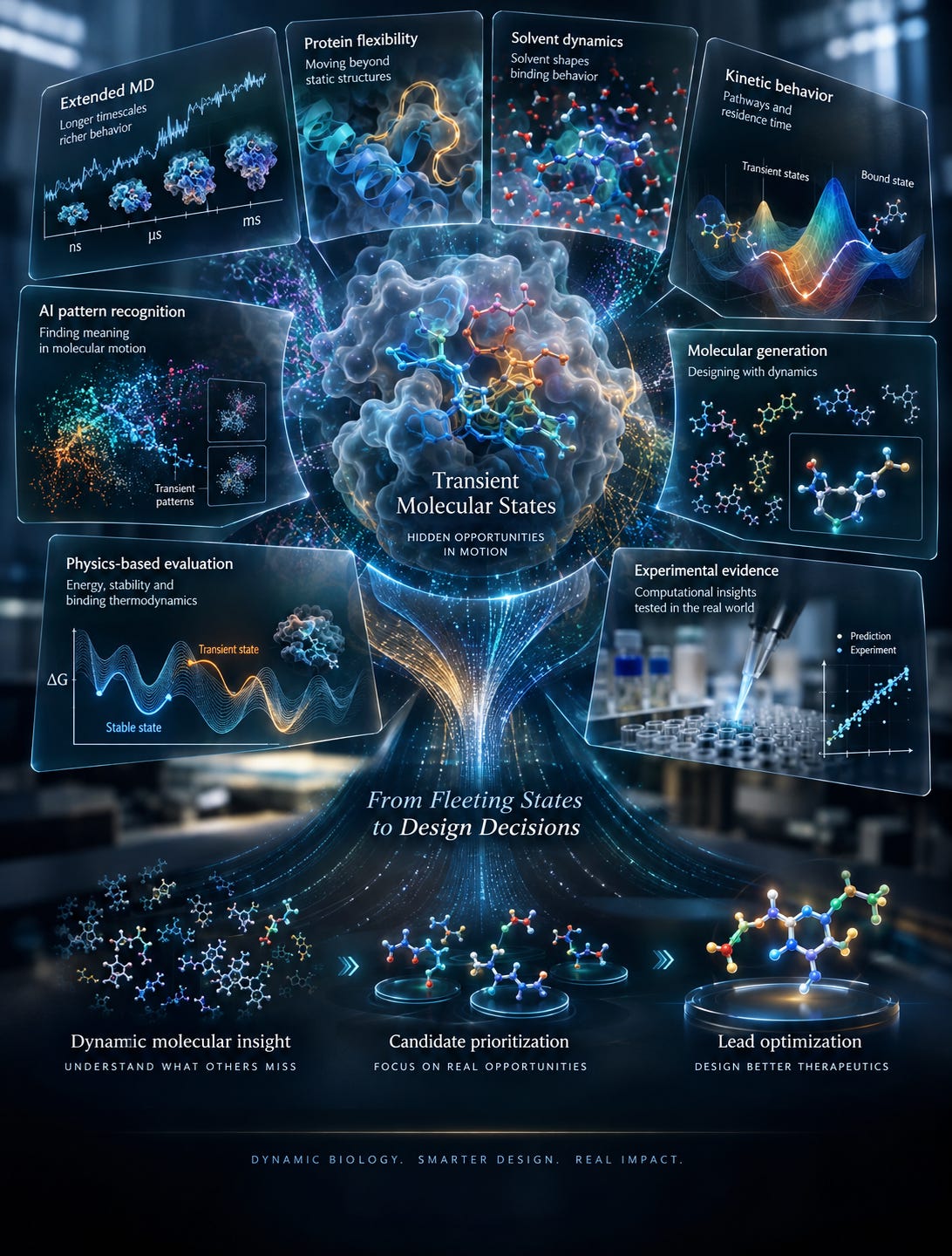
Medvolt’s Capabilities Relevant to Resolving Transient Binding States
Medvolt offers a suite of computational tools aligned with the scientific challenges of transient binding state analysis. The Oopal-cMD workflow supports advanced classical molecular dynamics simulations, enabling detailed examination of protein flexibility, ligand dynamics and solvent interactions over extended timescales.
Complementing MD, MM/PBSA post-processing provides approximate free energy estimates to contextualize transient conformations energetically. Medvolt’s generative molecular and protein design tools facilitate constrained exploration of chemical space informed by structural and kinetic insights.
Integrated structure- and ligand-based design workflows allow seamless combination of AI-guided molecular generation with physics-based evaluation. This connected discovery approach supports human-in-the-loop interpretation, enabling medicinal chemists to incorporate transient state information into candidate prioritization and lead optimization.
While Medvolt’s platform does not guarantee resolution of all computational limitations or experimental uncertainties, it provides operational capabilities to investigate dynamic molecular recognition events critical for drug discovery.
Future Perspectives on Incorporating Transient State Analysis in Drug Discovery
Advances in computational algorithms, hardware acceleration and enhanced sampling methods are progressively enabling longer and more comprehensive MD simulations. These developments will facilitate more routine characterization of transient binding states in drug discovery pipelines.
Concurrently, improvements in experimental techniques for detecting kinetic intermediates such as time-resolved spectroscopy and cryo-EM will provide complementary validation and mechanistic context.
Incorporating transient state analysis promises to refine medicinal chemistry strategies by emphasizing kinetic parameters alongside affinity, ultimately improving translational relevance. As these approaches mature, they may become standard components of integrated drug discovery workflows, informing candidate selection, dosing regimens and safety assessments.
Conclusion
Transient protein-ligand binding states and kinetic intermediates represent critical yet often overlooked facets of molecular recognition. Extended molecular dynamics simulations provide a powerful means to reveal these fleeting conformations and binding pathways that static structures and short simulations miss.
By elucidating the dynamic landscape of protein-ligand interactions, extended MD offers mechanistic insights into binding kinetics, including association and dissociation rates that influence drug efficacy and selectivity. This knowledge challenges the traditional reliance on affinity alone for candidate prioritization, highlighting the importance of kinetic parameters such as residence time.
Despite computational and experimental challenges, integrating transient state analysis into drug discovery workflows can enhance lead optimization and decision-making. The combination of extended MD with AI-guided molecular design presents a promising strategy to efficiently explore and exploit dynamic binding phenomena.
Medvolt’s computational capabilities, including advanced molecular dynamics simulation modules and integrated AI-driven design tools, align with these scientific needs, supporting the investigation of transient binding states in a connected discovery framework.
Continued progress in simulation methodologies, experimental validation and computational integration will be essential to fully realize the potential of transient binding state characterization, ultimately contributing to more informed and effective drug candidate prioritization.
Readers are encouraged to consider how extended molecular dynamics and transient state insights may complement their medicinal chemistry efforts, fostering a deeper mechanistic understanding of drug-target interactions beyond static affinity metrics.

