


Uncovering Transient Protein-Ligand Binding States via Extended Molecular Dynamics to Enhance Drug Candidate Prioritization
Explore how extended molecular dynamics reveals transient protein-ligand binding states to improve drug candidate prioritization, binding kinetics and lead optimization.
Conceptualizing Transient Protein-Ligand Binding States and Their Pharmacological Relevance
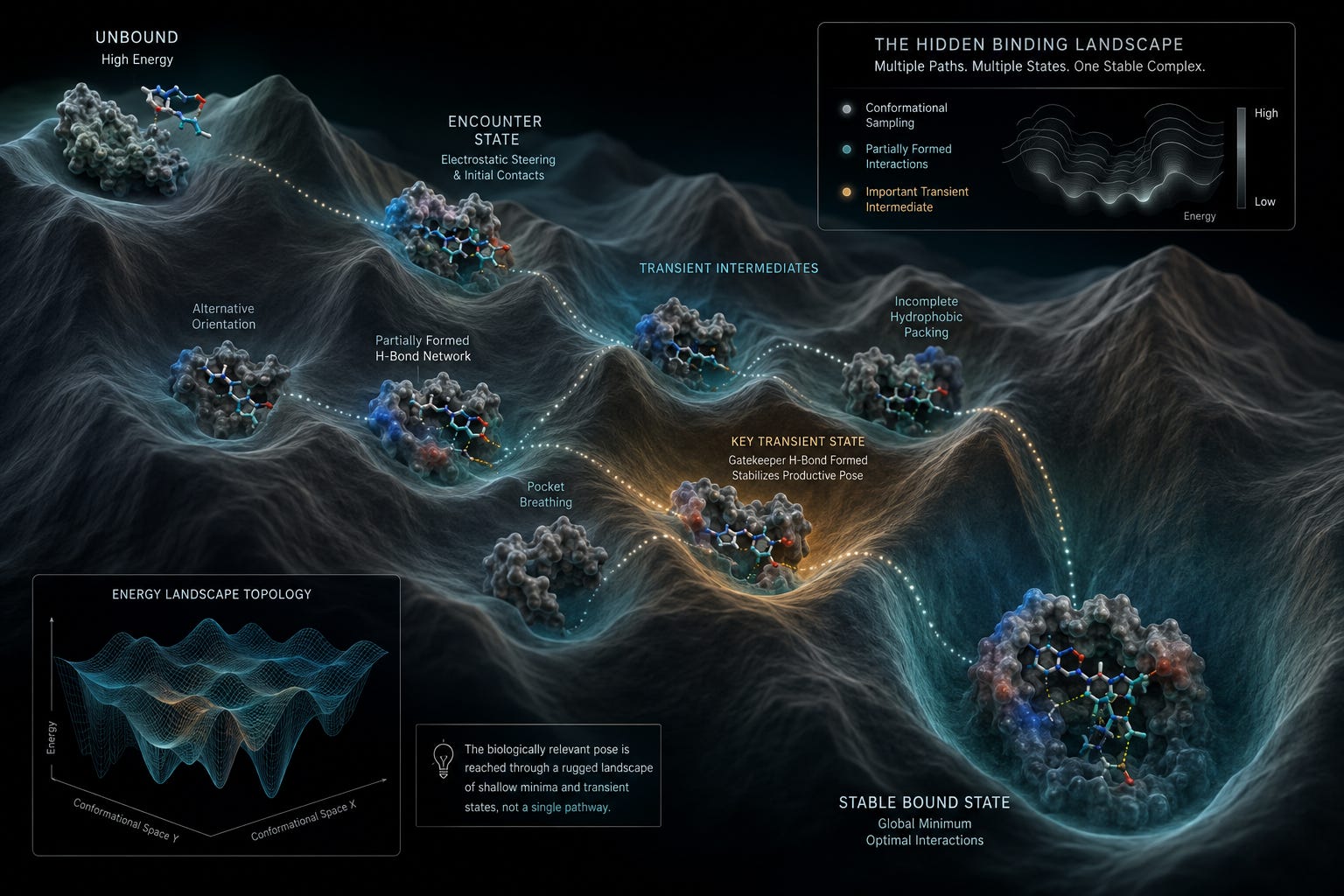
Protein-ligand interactions are fundamental to therapeutic modulation of biological targets. Traditionally, drug discovery has focused on stable binding modes observed in static crystal structures or short molecular dynamics (MD) simulations. However, these stable conformations represent only a subset of the full binding landscape. Transient binding states fleeting molecular conformations and kinetic intermediates exist along the pathway of ligand association and dissociation. These states often have low population and short lifetimes but can critically influence binding kinetics, selectivity and ultimately therapeutic efficacy.
Transient binding states differ from stable binding modes in their dynamic nature and energetic profiles. While stable modes correspond to free-energy minima with long residence times, transient states occupy intermediate or higher-energy conformations that facilitate transitions between unbound and bound forms. These kinetic intermediates can modulate the rates of association (k_on) and dissociation (k_off), impacting ligand residence time and selectivity profiles. Recognizing and characterizing these transient states is essential for a comprehensive understanding of molecular recognition and for optimizing drug candidates beyond affinity alone.
Limitations of Static and Short-Timescale Molecular Approaches in Capturing Transient States
Static structural analyses, such as X-ray crystallography or cryo-EM snapshots, provide high-resolution views of predominant binding poses but inherently lack temporal resolution. They cannot capture the dynamic processes underlying ligand binding and unbinding, nor the conformational fluctuations of proteins and ligands that facilitate these events.
Short-timescale MD simulations, typically spanning nanoseconds to low microseconds, improve upon static methods by sampling local conformational flexibility. However, they often fail to adequately explore rare or slow transitions between binding states due to limited sampling. This restricted conformational space can omit transient intermediates critical for understanding binding kinetics.
Consequently, relying solely on static affinity measures or brief simulations risks overlooking kinetic factors that influence drug efficacy, such as ligand residence time and off-target interactions. This gap can lead to suboptimal candidate prioritization, where compounds with favorable affinity but poor kinetic profiles advance.
Insights from Extended Molecular Dynamics into Transient Binding Mechanisms
Extended molecular dynamics simulations, spanning microseconds to milliseconds, enable more exhaustive sampling of protein-ligand conformational landscapes. By simulating longer trajectories, these methods can capture rare events, including transient binding states and kinetic intermediates that are inaccessible to shorter simulations.
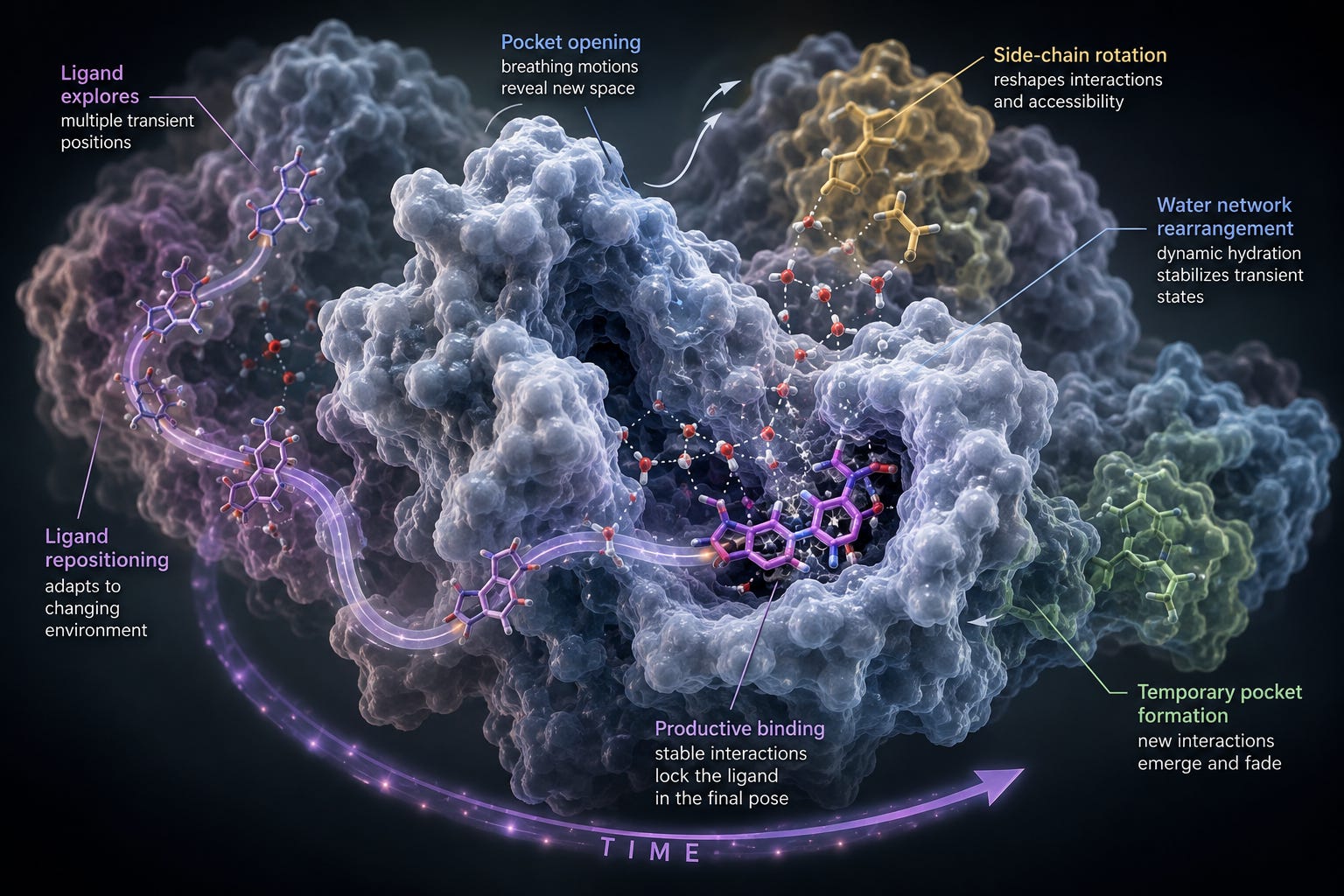
At the molecular level, extended MD reveals how protein flexibility, ligand conformational dynamics and solvent rearrangements interplay to facilitate binding transitions. For example, protein side chains may transiently adopt alternative rotamers that open cryptic pockets, allowing ligands to explore intermediate poses before settling into stable binding modes. Ligands themselves may sample multiple conformations, some of which transiently engage the target with partial interactions.
Solvent molecules also play a dynamic role, with water networks rearranging to stabilize or destabilize transient complexes. These solvent fluctuations can modulate the free-energy barriers between states, influencing association and dissociation kinetics.
Consider a hypothetical kinase inhibitor that, during extended MD, transiently occupies an alternative binding site conformation stabilized by a rearranged hydrogen-bond network. This intermediate may slow ligand dissociation, increasing residence time and potentially enhancing in vivo efficacy. Such insights are inaccessible through static or short MD approaches.
Impact of Transient Binding States on Drug-Target Interaction Kinetics and Lead Optimization
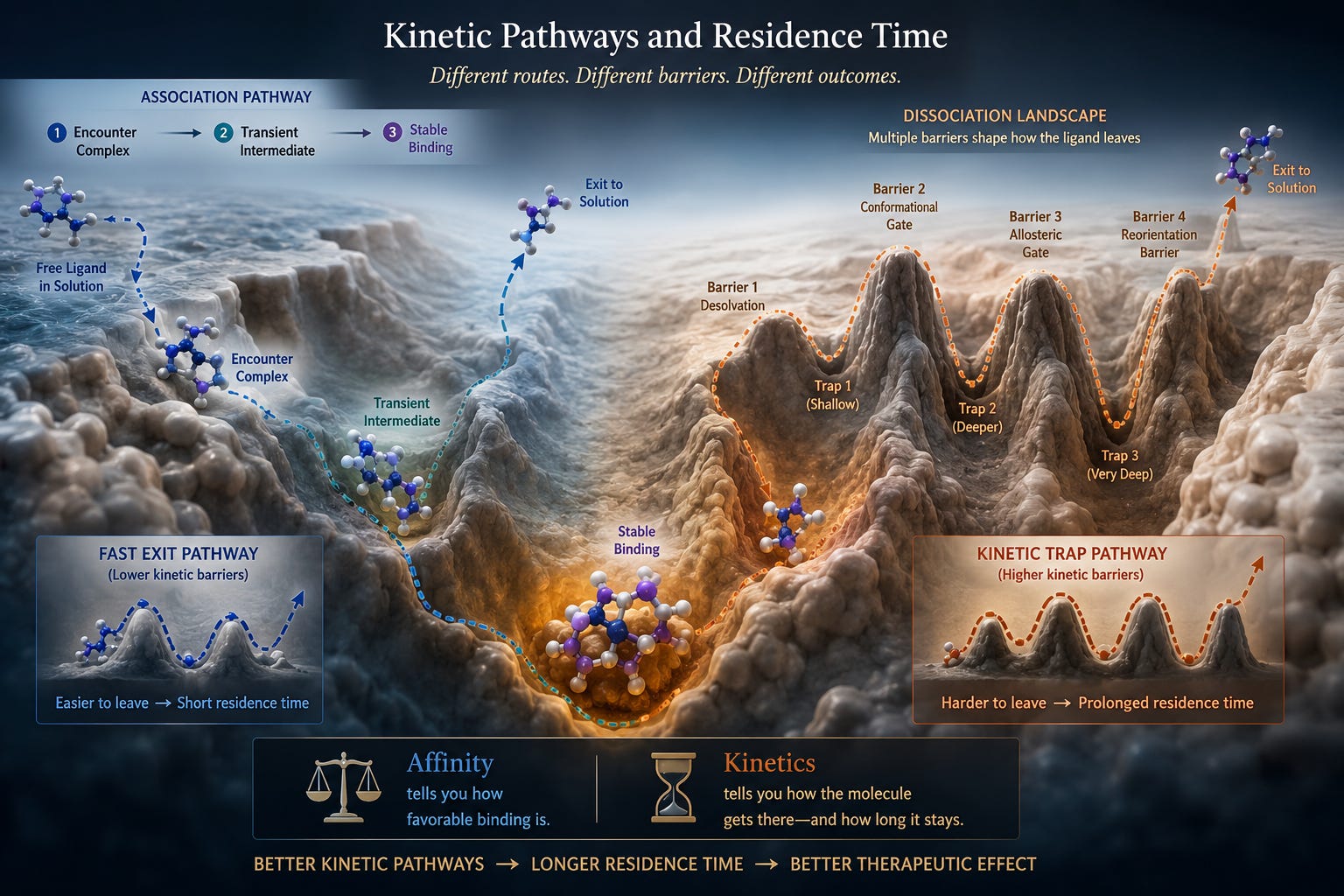
Transient binding states directly affect kinetic parameters critical for therapeutic performance. The association rate (k_on) can be influenced by the accessibility and stability of intermediate states that guide the ligand into the binding pocket. Similarly, the dissociation rate (k_off) depends on the energetic barriers separating stable binding modes from unbound states, often mediated by transient intermediates.
Ligand residence time, the reciprocal of k_off, has emerged as an important determinant of drug efficacy, selectivity and duration of action. Transient states that stabilize the ligand-protein complex or create kinetic traps can prolong residence time, potentially improving therapeutic outcomes even when equilibrium affinity is moderate.
Moreover, transient binding states can contribute to selectivity by differentiating kinetic pathways between on-target and off-target proteins. Ligands may exploit unique transient conformations in the target to achieve favorable kinetics, reducing off-target interactions that cause side effects.
In lead optimization, incorporating transient state information enables medicinal chemists to design compounds that modulate kinetic profiles intentionally, balancing affinity with desirable association and dissociation rates. This approach moves beyond traditional affinity-centric paradigms toward a more nuanced kinetic understanding.
Scientific and Computational Challenges in Modeling Transient Binding States
Despite their importance, transient binding states pose significant challenges for computational modeling. Extended MD simulations require substantial computational resources and time to achieve sufficient sampling and convergence, especially for large or complex systems.
Force field limitations and solvent model inaccuracies can affect the fidelity of dynamic behaviors, potentially misrepresenting transient conformations or interaction energetics. These limitations necessitate careful parameter selection and validation.
Experimentally, detecting and validating transient states is difficult due to their low population and short lifetimes. Techniques such as NMR relaxation dispersion, time-resolved crystallography or single-molecule spectroscopy can provide evidence but are often resource-intensive and limited in throughput.
Together, these challenges underscore the need for integrated computational-experimental workflows and cautious interpretation of transient state predictions.
Integrating Extended Molecular Dynamics within Drug Discovery Workflows
To harness the mechanistic insights from transient binding states, drug discovery workflows can incorporate extended MD simulations alongside complementary computational and experimental methods.
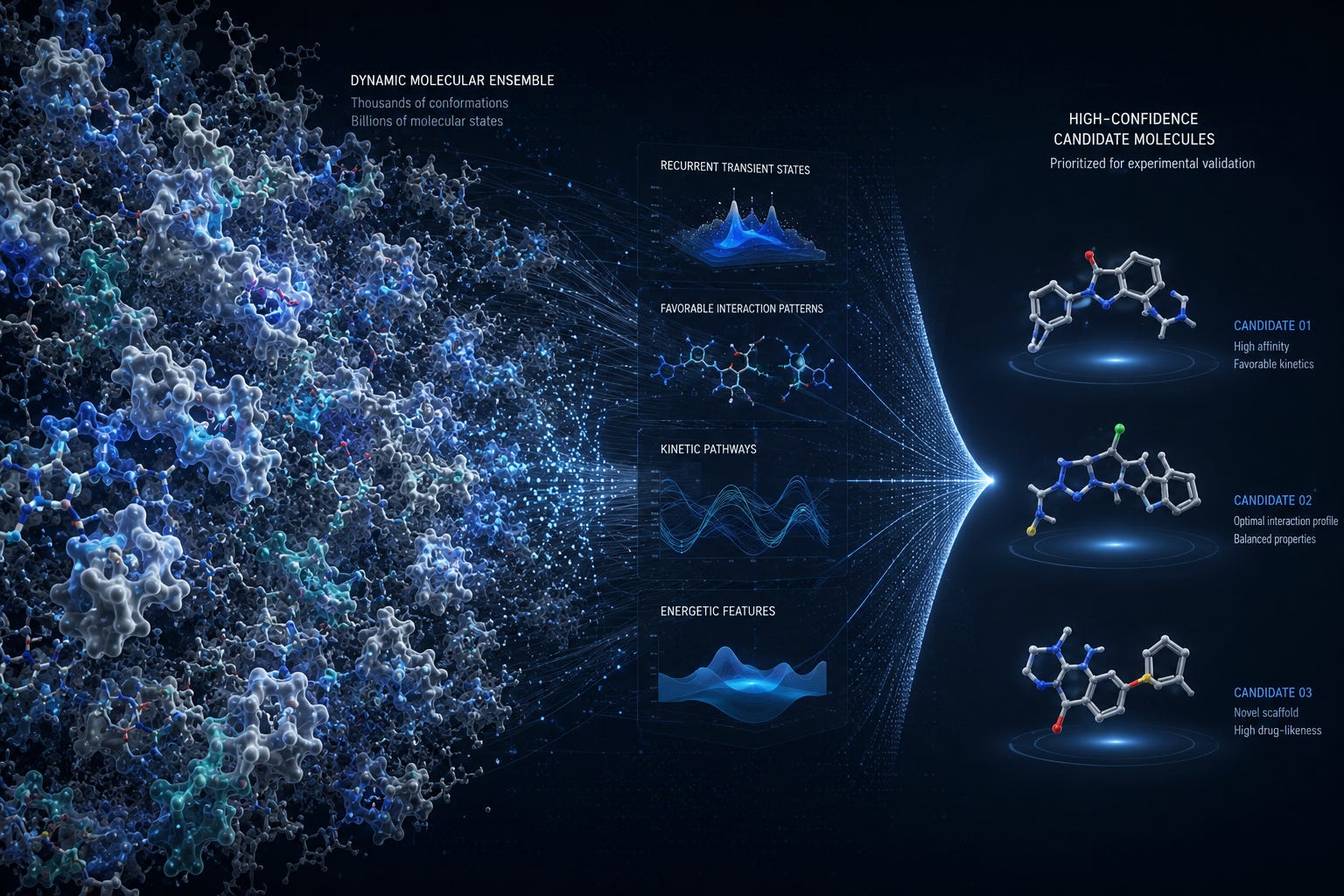
One strategy involves combining extended MD with AI-guided molecular design, where dynamic ensembles inform generative models to propose compounds optimized for favorable kinetic profiles. Physics-based free-energy calculations, such as MM/PBSA or alchemical methods, can then evaluate the thermodynamic consequences of ligand modifications observed in dynamic contexts.
Balancing computational expense with predictive value is critical. Extended MD may be prioritized for lead candidates or challenging targets where kinetic considerations are paramount. Integration with experimental data enhances confidence and guides iterative design.
Such workflows provide a more comprehensive evaluation of candidates, incorporating both thermodynamic affinity and kinetic behavior to improve prioritization decisions.
Medvolt’s Computational Framework Addressing Transient Binding State Analysis
Medvolt offers computational capabilities tailored to analyze transient protein-ligand binding states within drug discovery pipelines. The Oopal-cMD module supports extended molecular dynamics simulations, enabling detailed examination of protein flexibility, ligand dynamics and solvent behavior over extended timescales.
Complementing this, Medvolt’s generative molecular design tools leverage dynamic conformational ensembles to inform scaffold and ligand generation, facilitating exploration of chemical space attuned to transient binding features.
Physics-based free-energy evaluation workflows, such as Oopal-FEP and MM/PBSA post-processing, integrate with MD sampling to estimate relative binding energetics and assess the impact of ligand modifications on binding thermodynamics.
Together, these tools form an integrated computational framework that supports scientist interpretation and experimental planning, aligning with Medvolt’s science-first philosophy. This framework enables medicinal chemists to incorporate transient binding state insights into lead optimization and candidate prioritization with operational rigor.
Future Research Directions and Methodological Advances
Advancing the understanding and application of transient binding states will benefit from continued development of enhanced sampling techniques, such as metadynamics, replica exchange or machine learning-accelerated MD, to improve exploration of rare conformations and kinetic intermediates.
Refinement of force fields and solvent models to better capture dynamic interactions will enhance simulation accuracy. Hybrid simulation approaches combining coarse-grained and atomistic models may balance computational cost and resolution.
Integrating transient binding insights into precision drug design requires robust computational-experimental validation pipelines, leveraging emerging biophysical methods to confirm predicted intermediates and kinetic effects.
Ultimately, these advances will deepen mechanistic understanding and enable more predictive modeling of drug-target kinetics, supporting rational design of therapeutics with optimized efficacy and selectivity.
Conclusion
Transient protein-ligand binding states represent dynamic molecular conformations and kinetic intermediates that are often invisible to static structural analyses and short molecular dynamics simulations. Their characterization through extended molecular dynamics provides critical mechanistic insights into the kinetics of drug-target interactions, including association and dissociation pathways that govern ligand residence time and selectivity.
While extended MD simulations pose computational and methodological challenges, their integration with AI-guided molecular design and physics-based free-energy calculations offers a promising avenue to enrich drug candidate evaluation beyond traditional affinity metrics. This approach enables medicinal chemists to prioritize compounds with favorable kinetic profiles that may translate into improved therapeutic performance.
Medvolt’s computational framework, encompassing extended MD modules, generative design informed by dynamic ensembles and physics-based evaluation workflows, provides practical tools to operationalize transient binding state analysis within drug discovery pipelines.
As methodological advances continue, incorporating transient binding state information will become increasingly important for precision drug design, guiding lead optimization strategies that account for the full dynamic complexity of molecular recognition.
Researchers and practitioners are encouraged to explore these dynamic binding phenomena and consider how extended molecular dynamics integrated with AI and physics-based methods can refine candidate prioritization and therapeutic development.

