When Machine Learning Predictions Meet Thermodynamic Reality: The FEP Advantage
Discover why combining AI with Free Energy Perturbation delivers more reliable drug discovery by validating predictions through thermodynamic reality.
Why Physics-Based Free Energy Calculations Are Becoming Essential for Modern Drug Discovery
Artificial intelligence has transformed the landscape of drug discovery.
Machine learning models can now generate novel molecular structures, predict biological activity, estimate ADMET properties, identify therapeutic targets, and even propose entirely new chemical scaffolds. Tasks that once required months of manual work can now be completed in hours, enabling researchers to explore chemical space at an unprecedented scale.
This progress has fundamentally changed how early-stage drug discovery is performed.
Yet despite these advances, a familiar challenge continues to emerge.
Many molecules that appear highly promising according to machine learning models ultimately fail when evaluated experimentally.
The question is not whether AI has become powerful.
It clearly has.
The question is whether statistical prediction alone is sufficient to describe the physical reality of molecular interactions.
Increasingly, the answer appears to be no.
This realization has renewed interest in one of the most rigorous computational approaches available today: Free Energy Perturbation (FEP).
Rather than replacing AI, FEP complements it by answering a fundamentally different question.
Machine learning predicts what is likely.
FEP evaluates what is physically plausible.
Together, they represent one of the most promising combinations in modern computational drug discovery.
The Rise of Machine Learning in Drug Discovery
Machine learning has become deeply embedded across the pharmaceutical discovery pipeline.
Models trained on large biological and chemical datasets can rapidly estimate molecular properties, prioritize compounds, predict binding affinity, and identify patterns that would be difficult for traditional computational methods to detect.
These capabilities have dramatically accelerated early-stage discovery.
Instead of manually exploring millions of compounds, researchers can now narrow the search space using predictive algorithms capable of learning from historical data.
However, machine learning models remain fundamentally statistical.
They identify relationships based on patterns observed during training.
They do not explicitly simulate the physical interactions occurring between molecules and proteins.
For many discovery tasks, this distinction is relatively unimportant.
For predicting molecular binding, however, it becomes critically important.
Prediction Is Not the Same as Physical Reality
When a small molecule binds to a protein, the interaction is governed by physical laws.
Hydrogen bonding, electrostatic interactions, hydrophobic effects, conformational flexibility, solvent behavior, and entropy collectively determine whether binding is stable and energetically favorable.
These interactions are dynamic.
Proteins continuously fluctuate between multiple conformational states. Water molecules reorganize around the binding interface. Ligands adjust their orientation while interacting with flexible amino acid residues.
Machine learning models typically do not simulate these phenomena directly.
Instead, they infer likely outcomes from previously observed examples.
This distinction explains why statistically confident predictions may still fail during experimental validation.
The model has recognized a pattern. Nature follows thermodynamics.
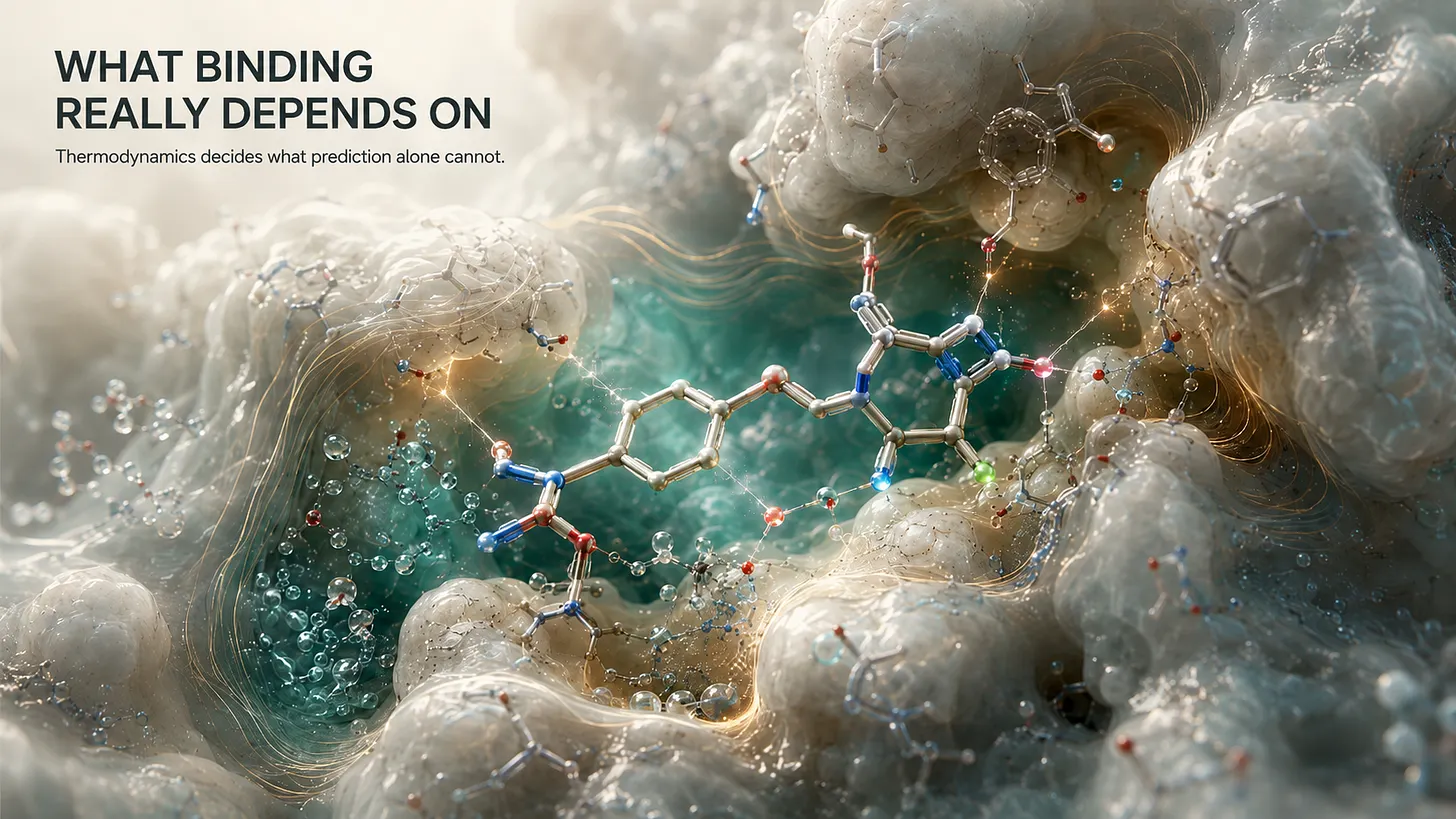
The Thermodynamic Foundation of Binding
At the heart of molecular recognition lies one fundamental quantity:
Binding free energy (ΔG).
Binding free energy determines how favorable an interaction is between a ligand and its target protein.
Unlike simplified scoring functions, free energy incorporates the combined effects of molecular interactions, conformational changes, solvent behavior, and entropy.
A lower free energy corresponds to a more favorable and stable binding event.
Importantly, free energy is directly connected to experimentally measurable binding affinity.
This makes it one of the most meaningful quantities in computational chemistry.
The challenge has always been calculating it accurately.
What Is Free Energy Perturbation?
Free Energy Perturbation, commonly known as FEP, is a physics-based computational method used to estimate changes in binding free energy between closely related molecules.
Rather than relying on empirical scoring functions or statistical correlations, FEP applies principles of statistical mechanics to simulate molecular transformations under realistic conditions.
In practical terms, FEP asks a simple question:
If one molecule is modified slightly, how will that change its binding affinity?
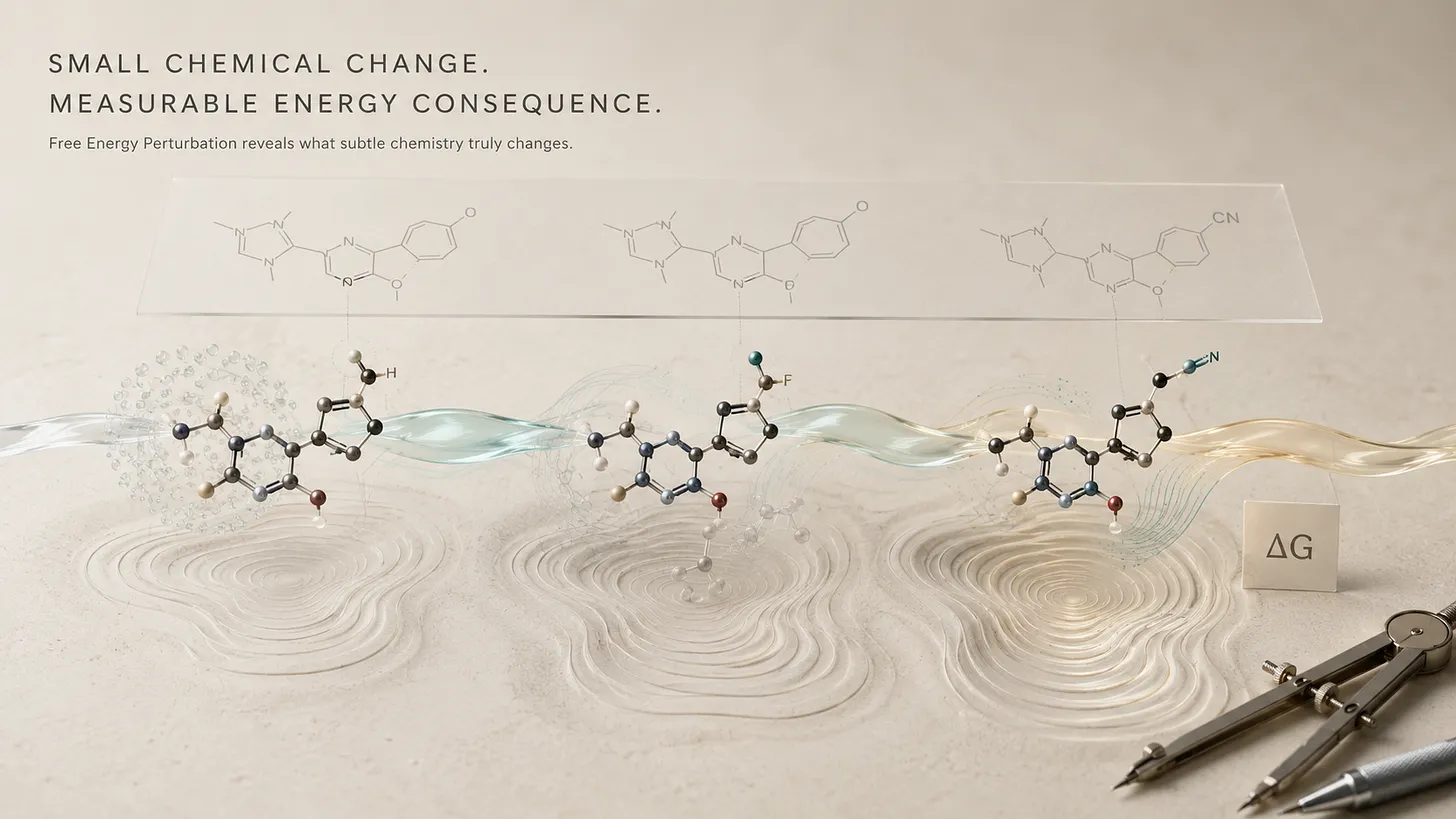
To answer this, simulations gradually transform one ligand into another while observing the energetic consequences throughout the process.
Although computationally intensive, this approach produces predictions that closely approximate experimental measurements when properly implemented.
For medicinal chemists, this capability is extraordinarily valuable.
Instead of synthesizing dozens of analogues experimentally, researchers can prioritize modifications that are most likely to improve binding before entering the laboratory.
Why FEP Matters in Lead Optimization
The greatest value of FEP emerges during lead optimization.
At this stage, researchers are no longer searching for entirely new molecules.
Instead, they are making relatively small chemical modifications in an attempt to improve potency, selectivity, or pharmacological properties.
These modifications often involve subtle structural changes.
Replacing a methyl group.
Adding a fluorine atom.
Altering a heterocycle.
Changing linker geometry.
Predicting how these seemingly minor changes influence binding affinity is remarkably difficult using conventional scoring methods.
FEP excels precisely because it evaluates these incremental transformations within a rigorous thermodynamic framework.
This enables medicinal chemists to prioritize synthesis based on quantitative predictions rather than intuition alone.
Why AI and FEP Are Complementary
Discussions about AI and physics-based simulations often frame them as competing approaches.
In reality, they solve different problems.
Machine learning is exceptionally effective at exploring vast chemical spaces. It rapidly generates hypotheses, identifies patterns, and prioritizes candidates across millions of possibilities.
FEP, on the other hand, focuses on precision.
Rather than exploring broad chemical space, it evaluates a relatively small number of carefully selected candidates with significantly higher physical accuracy.
The relationship between the two is therefore complementary.
AI expands the search space.
FEP increases confidence.
One generates possibilities.
The other validates them.
This layered approach is becoming increasingly common among organizations seeking to improve decision quality throughout lead optimization.

Beyond Docking Scores
Traditional docking remains an essential component of structure-based drug discovery.
It provides rapid estimates of binding poses and allows researchers to screen large libraries efficiently.
However, docking scores should not be interpreted as accurate measures of binding affinity.
Most docking algorithms rely on simplified scoring functions that cannot fully account for protein flexibility, solvent effects, or thermodynamic contributions.
As a result, molecules with similar docking scores may exhibit dramatically different experimental behavior.
FEP addresses this limitation by evaluating molecular interactions within a far more realistic physical framework.
Rather than replacing docking, it builds upon it.
Docking identifies promising candidates.
FEP determines which candidates deserve the greatest confidence.
Medvolt’s Approach: Combining AI with Thermodynamic Validation
At Medvolt, we believe that the future of computational drug discovery lies in integrating predictive intelligence with physical realism.
Our discovery workflows are designed around the idea that no single computational method can answer every scientific question. Instead, different computational approaches should complement one another, each contributing its strengths to a unified discovery pipeline.
The process begins with knowledge-driven target understanding, integrating biomedical literature, biological networks, and disease-specific insights to establish a strong scientific foundation. AI-guided molecular design then explores chemical space efficiently, generating candidate molecules that satisfy both biological relevance and medicinal chemistry constraints.
These candidates are subsequently evaluated through structure-based workflows involving molecular docking and molecular dynamics simulations, allowing interaction stability and conformational behavior to be assessed under realistic biological conditions.
For lead optimization, physics-based free energy calculations provide an additional layer of confidence by estimating relative binding affinities between candidate molecules with significantly greater accuracy than traditional scoring methods alone.
This integrated architecture enables researchers to move from large-scale exploration to high-confidence decision-making without sacrificing either speed or scientific rigor.
Rather than viewing AI and physics as competing paradigms, Medvolt combines them into complementary components of a single workflow designed to reduce uncertainty throughout drug discovery.
The Future of Computational Drug Discovery
The next generation of computational drug discovery will not be defined by artificial intelligence alone.
Nor will it rely exclusively on traditional physics-based simulations.
Instead, it will emerge from intelligent integration.
Machine learning will continue to accelerate hypothesis generation, target identification, and molecular design. Physics-based methods such as molecular dynamics and free energy calculations will increasingly provide the rigorous validation required for confident decision-making.
As computational power continues to improve and algorithms become more efficient, these approaches will become increasingly accessible across pharmaceutical research.
The distinction between prediction and validation will become clearer.
And workflows that successfully combine both will define the future of rational drug discovery.

Conclusion
Machine learning has transformed the speed and scale of computational drug discovery.
However, predicting molecular behavior requires more than recognizing statistical patterns.
Binding ultimately depends on thermodynamic reality.
Free Energy Perturbation provides one of the most rigorous computational frameworks available for evaluating that reality. By estimating relative binding free energies with high accuracy, FEP enables researchers to make better-informed decisions during one of the most critical stages of drug discovery.
At Medvolt, this philosophy shapes how computational workflows are designed. By combining AI-driven exploration, knowledge-based biological understanding, molecular dynamics simulations, and physics-based free energy calculations, we aim to bridge the gap between prediction and physical reality.
Because the strongest drug discovery pipelines are not built on faster predictions alone.
They are built on predictions that can withstand the laws of physics.